7 innovations from Arm that you shouldn’t miss from November 2025

Innovations in artificial intelligence (AI) and advanced compute continued to accelerate in November 2025, and Arm remained at the centre of that momentum. From new ways to run large language models (LLMs) on everyday devices to deeper architectural insights that shape next-generation performance, the month highlighted how Arm and our ecosystem are driving progress across mobile, graphics, automotive, and cloud.
Rethinking the CPU across AI workflows
Retrieval-Augmented Generation (RAG) combines two key parts of an AI workflow – retrieving relevant information from a knowledge base and generating responses using a LLM. In modern systems, this workflow relies on both the CPU – which handles data retrieval, filtering, and orchestration – as well as the GPU which manages the model inference.
Odin Shen, Principal Solutions Architect, explored this hybrid workflow on the NVIDIA DGX Spark platform, which pairs the Arm-based Grace GPU with the Blackwell CPU. Odin breaks down how Grace manages the retrieval and pipeline control, while Blackwell handles model execution, all supported by a unified memory architecture that reduces unnecessary data movement.
On-device audio generation with ExecuTorch and Stability AI
At October’s PyTorch Conference 2025, Gian Marco Iodice, Principal Software Engineer, demonstrated how users can generate audio, entirely on-device, using Stability AI’s Stable Audio Open Small model, which is powered by ExecuTorch.
Running entirely on an Arm-powered Android device, this demo showcases how ExecuTorch enables efficient, offline generative AI workloads directly on-device, with no cloud connectivity required. The application converts text prompts into high-quality 44 kHz audio, highlighting the power and flexibility of Arm CPUs for edge AI and creativity at scale.
Exploring LLMs on Android and ChromeOS with AI Chat
LLMs are increasingly running directly on devices rather than relying on cloud connectivity, offering faster responses, stronger privacy, and more predictable performance since all processing stays local. The challenge is often finding a simple way to evaluate different models on real hardware without setting up complex environments or dependencies.
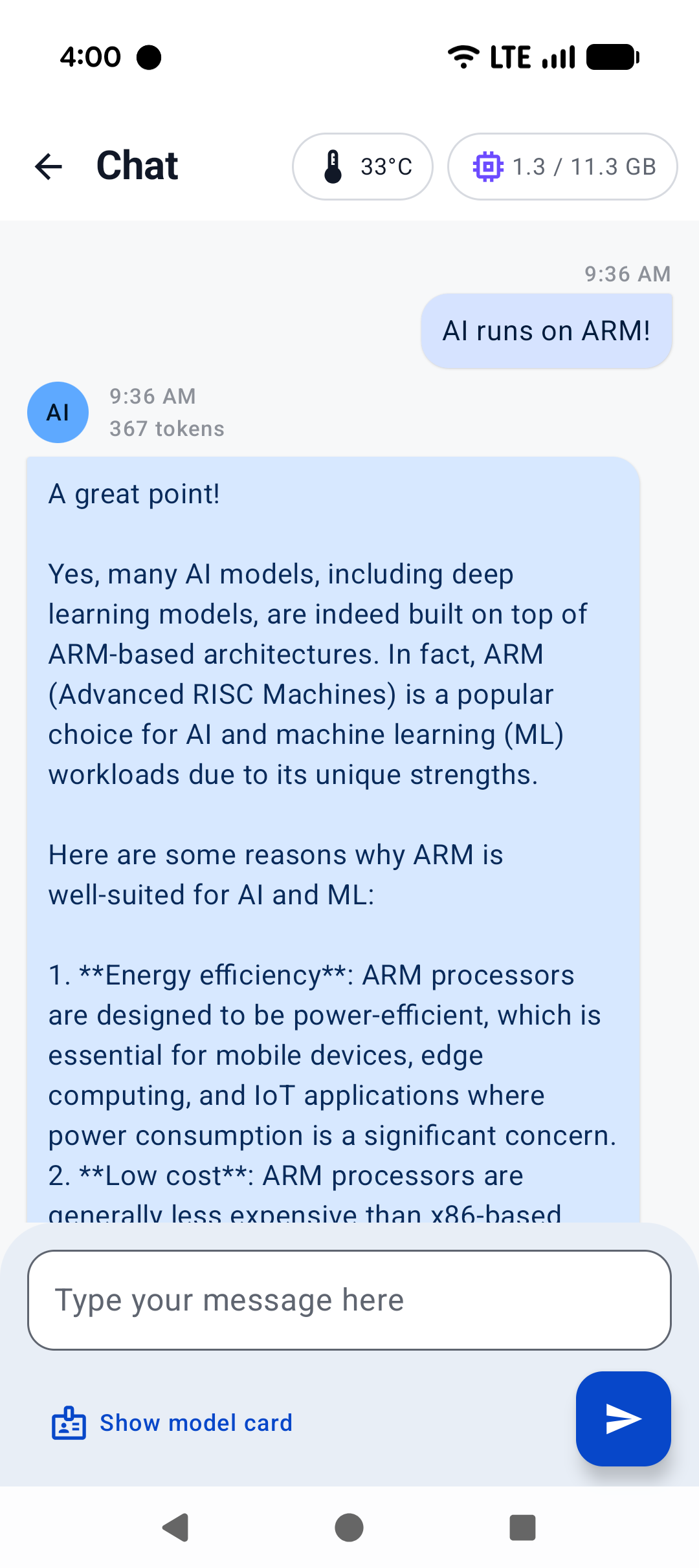
Arm introduced AI Chat, a lightweight app that lets users explore and evaluate multiple LLMs directly on Android and ChromeOS devices. As explained by Han Yin, Staff AI Technology Engineer, AI Chat makes on-device testing accessible to a broader audience and removes friction from evaluating LLM performance by offering a clear, consistent environment that works across diverse Arm-powered devices. The app can also detect the device’s hardware, recommends suitable models, and shows real-time performance metrics such as tokens-per-second and time-to-first-token.
Introducing Arm Virtual FAE
When teams evaluate IP for a new chip or product, they often need clear explanations, comparisons, and guidance. This normally involves speaking with Field Application Engineers (FAEs) who help interpret specifications, answer technical questions, and explain trade-offs.
Matt Rowley, Senior Product Manager, introduces the Virtual FAE, an AI-powered assistant built directly into Arm IP Explorer. This means chip architects, engineers, and product teams now get a faster and more intuitive way to explore Arm IP, and users can get immediate clarity on the IP that fits their goals, whether they are designing edge devices, automotive platforms, or high-performance compute systems.
The next step in Arm CPU AI acceleration
Modern AI workloads rely heavily on matrix operations – the core mathematical building blocks behind neural networks, image processing, and signal analysis. Traditionally, these operations are handled by GPUs or dedicate accelerators, but CPUs also play a critical role. To keep pace with growing on-device AI demand, CPUs need built-in capabilities that make matrix math faster, more efficient, and easier for software to use.
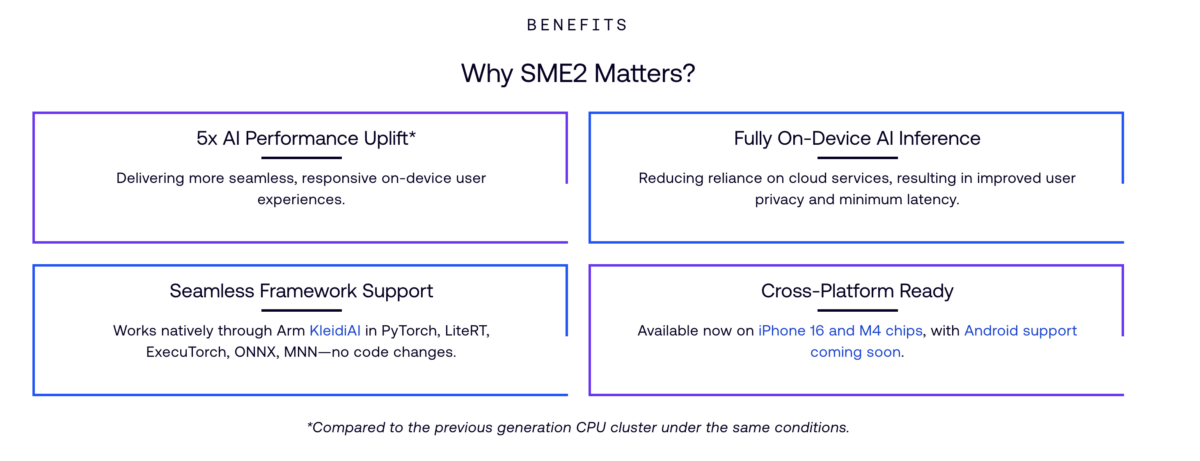
Arm Scalable Matrix Extension 2 (SME2) is Arm’s advanced matrix-processing extensions designed to accelerate AI and high-performance compute directly on the CPU. Zenon (Zhilong) Xiu, Senior Principal Applications Engineer, has now released a new technical breakdown that explains how SME2 works, why its design choices matter, and where it provides the biggest performance advantages. Xiu also covers LUT (lookup-table) enhancements, expanded vector handling, and the practical differences developers should expect in real workloads.
A clearer look at the future of automotive compute
Software-defined vehicles (SDVs) shift core vehicle functions into software that can be updated, improved, and expanded over time. As AI becomes central to perception, decision-making and in-cabin intelligence, the industry is now moving toward AI-defined Vehicles (AIDVs) in which real-time AI inference, sensor fusion and predictive behaviour shape how the vehicle responds to the world.
Prakash Mohapatra, Senior Product Manager, offers a deeper, more structured look at what AIDVs require from compute platform. The breakdown explains why AIDVs need scalable heterogeneous compute, how domain and zonal architectures change workload distribution, and which safety and real-time constraints designs must consider.
Understanding Vulkan Subpasses
Vulkan is a low-level graphics API designed to give developers more control over how rendering workloads are scheduled and executed. One of its features called subpasses, allows multiple rendering operations to be combined within a single render pass. Under optimal use, subpasses can reduce memory bandwidth, improve tiling efficiency, and boost performance on mobile GPUs. But when used in the wrong situations, they can introduce unnecessary complexity, stall pipelines or reduce clarity in the rendering flow.
Peter Harris, Distinguished Engineer, offers a practical, real-world explanation of subpasses — not just how they work, but when developers should or should not use them. This guidance goes further than standard API documentation by unpacking actual performance trade-offs, showing examples of optimal usage, and highlighting scenarios where subpasses deliver no benefit or even degrade performance.

Any re-use permitted for informational and non-commercial or personal use only.
Editorial Contact
Stay informed with Arm's top stories, insights, and conversations.


Latest on X

Congratulations to @Valve on the launch of Steam Frame, an exciting new wireless VR headset built on Arm.
We love seeing the Steam hardware family expand with Arm at its core. 👏

Steam Frame is here! Our wireless VR headset + controllers, available now in the following models:
Steam Frame 256GB
Steam Frame 1TB
Sign up now and learn more on @Steam https://store.steampowered.com/hardware/steamframe
Less time searching and benchmarking. More time building. ⚡️
At Arm Create, Shantu Roy shared how the Arm AI Portal helps you discover optimized models, performance data, code examples and deployment workflows - all accessible to coding agents through the Arm MCP Server.

The AI in your pocket. Intelligent machines. The infrastructure behind it all. Here’s what’s new on Arm. 👇
Catch up. ➡️


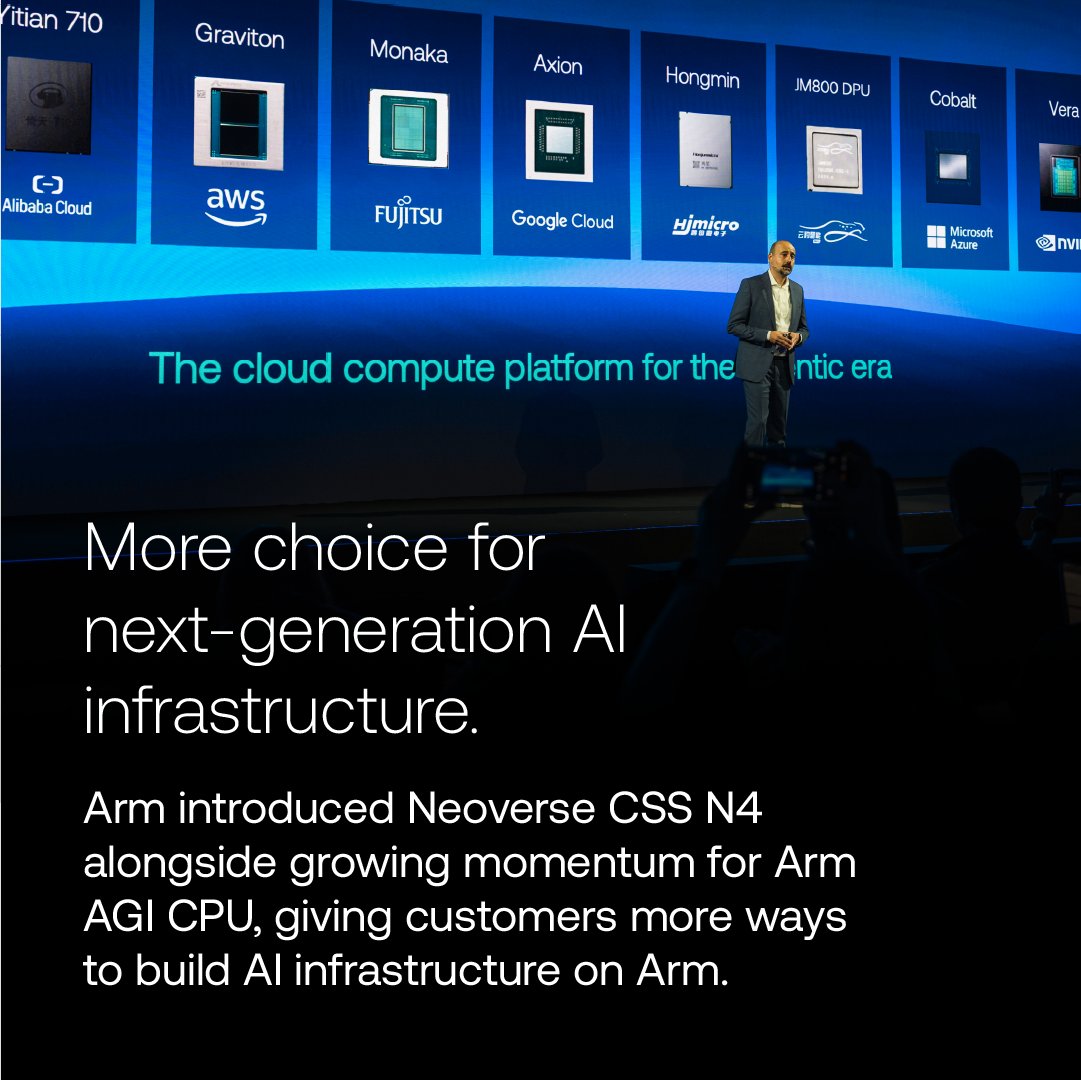

We're delivering more choice for the next generation of AI infrastructure.
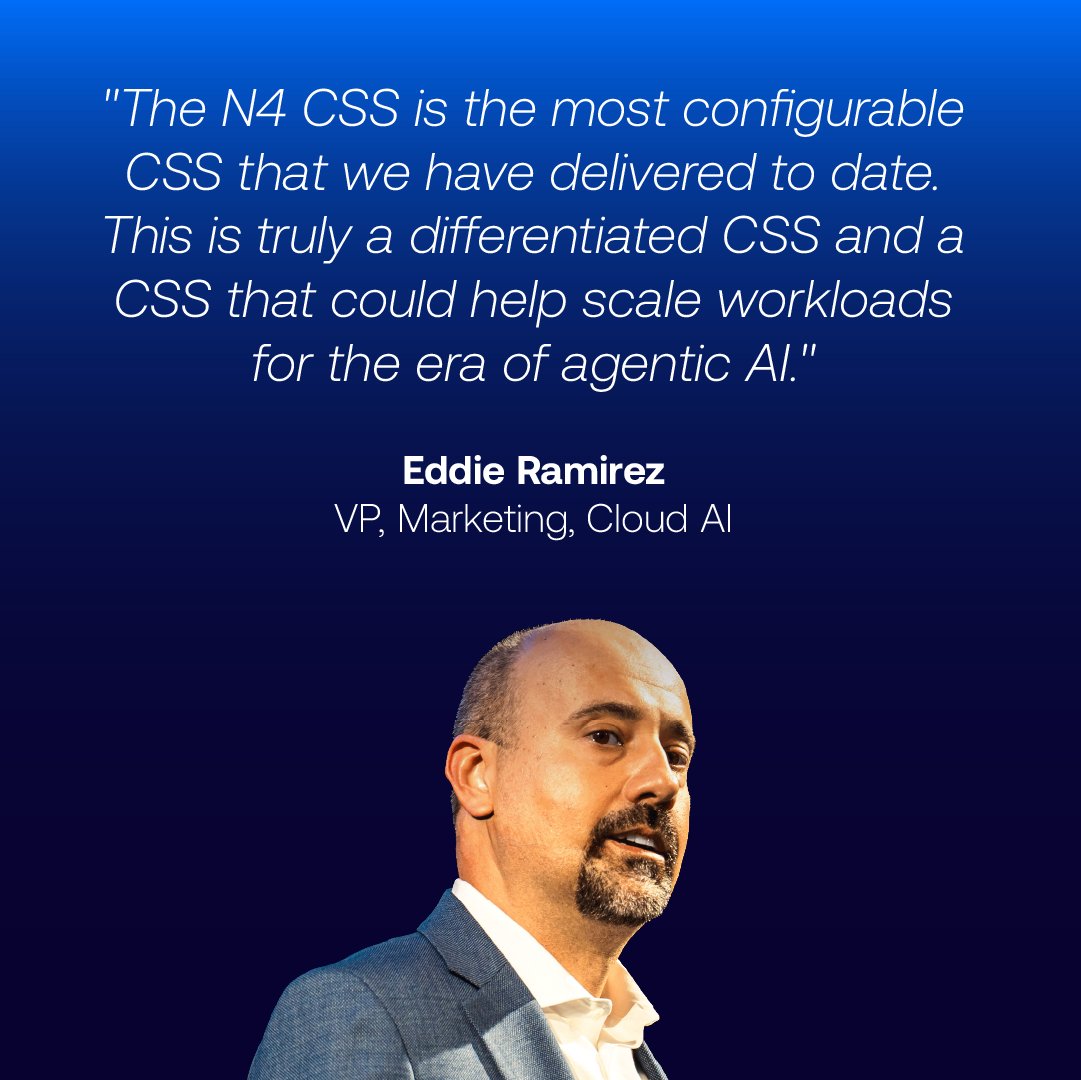
At Arm Everywhere China, Eddie Ramirez introduced Neoverse CSS N4 — Arm’s most configurable CSS yet and fastest path from CSS to silicon. ⚡️
From IP and CSS to production silicon with the Arm AGI CPU,
What does AI research look like on one of the UK’s most powerful supercomputers?
Mohamed Awad visited Isambard-AI at @BristolUni (BriCS) to see how its computing power is helping researchers advance work - from personalized cancer vaccines to dementia diagnosis.
The future of


Agentic AI and AI-native graphics are changing the mobile workload.
In 60 seconds, see how Arm CSS for Mobile 2 brings together world-class AI CPU and GPU capabilities through the Arm C2 CPU Cluster with SME2 and Mali G2-Ultra NX, alongside system IP and software in an AI-native

What does it take to make AI feel fast, useful and personal on a mobile device?
@ctbergey explores how agentic AI and AI-native graphics are reshaping mobile, and how Arm CSS for Mobile 2 brings together world-class AI CPU and GPU capabilities for what comes next.
Dive into his