Arm at Davos 2026: Setting the stage for the next era of AI

At the World Economic Forum (WEF) Annual Meeting in Davos, technology leaders, policymakers, and investors converged around a defining question for 2026: can the world sustain the explosive growth of artificial intelligence (AI)?
Across various WEF events – including interviews, panels and private discussions – it was clear the focus has shifted decisively from AI’s potential to how it’s becoming a practical reality. Emerging real-world constraints, like compute capacity, energy availability, memory bottlenecks, and physical infrastructure, are now front of mind for global leaders, as they look to sustainably scale AI everywhere.
Against this backdrop, the Financial Times (FT) hosted an exclusive live interview with Arm CEO Rene Haas, which offered a timely lens into how the AI landscape is being reshaped – and why Arm sits at the center of this ongoing transformation. As AI expands beyond hyperscale data centers into everyday devices, vehicles, and machines, the industry is being forced to rethink where intelligence runs, how efficiently it operates, and how infrastructure must evolve to support it. Arm’s unique position across cloud, edge, and physical AI places the company at the intersection of these debates, making Haas’ perspective at Davos particularly relevant.
The evolving AI and semiconductor landscape
In a forward-looking conversation with the FT, Haas described how the semiconductor industry is navigating unprecedented shifts driven by AI’s rapid growth. As AI workloads grow in scale and complexity, traditional models of compute that are heavily centralized in massive data centers are being rethought. AI’s next frontier lies not just in more compute, but in smarter, more efficient compute distributed across the cloud, edge and physical environments.
Another notable point was the perspective on the AI cycle: if AI’s development were a 90-minute football game, according to Haas, “we’re still in the first 10 minutes.” While the value of AI continues to dominate today’s discussions, true adoption – especially in enterprise and edge contexts – has only just begun. However, this early stage means tremendous opportunities. As enterprises transition from experimentation to mission-critical AI deployments, demand for compute that balances performance, cost, and efficiency will define future adoption.
As Haas explained across various Davos discussions, Arm’s heritage – designing the most ubiquitous CPU architecture on the planet – gives it a distinct vantage point for the next stage of AI innovation. From billions of smartphones to emerging AI devices, Arm’s technology is already woven into the fabric of modern compute.
Meanwhile, projects like Stargate – one of the world’s largest AI infrastructure initiatives where Arm plays a critical role as the foundational technology – highlight both the scale of today’s centralized compute and the growing need to complement it with more distributed models of intelligence.
The case for distributed computing and intelligence
A recurring theme in Haas’s remarks during the FT interview – which was aligned with earlier panel insights in the WEF “Racing for Compute” panel – was that a cloud-only AI model is unsustainable in the long-term. While hyperscale data centers will remain critical – and continue to evolve through innovations that improve performance, efficiency and energy use – the edge, on the device, and physical environments, in machines like vehicles and robotics, are poised to carry a growing share of intelligence.
The Davos conversations emphasized that edge AI breakthroughs are imminent, with new memory technologies, packaging innovations, and distributed computing enabling AI workloads to run more efficiently on devices themselves – from smartphones and wearables to new robotics platforms. This shift not only reduces energy demands on the cloud, but also unlocks real-time, low-latency experiences that benefit the end-user.
Energy, memory, and the hidden constraints of AI
Linked to compute distribution is the energy and memory challenge, which was front-of-mind in many Davos discussions on the future of AI. Industry leaders, including those on the Racing for Compute panel, explained that AI’s insatiable appetite for power not only requires more capacity but more intelligent and efficient energy use.
Memory bottlenecks – particularly around High Bandwidth Memory (HBM) – were highlighted by Haas as key constraints for today’s AI workloads. The implication is clear: memory innovation is not an afterthought, but a fundamental determinant of future compute efficiency and scalability. As these constraints become a catalyst for new architectures and data locality strategies, Arm’s role in enabling more efficient compute ecosystems becomes even more critical.

Building the next phase of AI, responsibly and at scale
The conversations at Davos 2026 highlight an AI future that will not be defined by scale alone, but by how intelligently that scale is delivered. This requires rethinking where AI runs, how data moves, and how systems are designed from the silicon up.
Arm’s perspective – shared throughout the week at Davos and articulated clearly in the FT conversation with Haas – reflects this shift. With a vast footprint spanning cloud, edge, and physical AI systems, Arm is enabling a more distributed, sustainable and resilient AI ecosystem. At the same time, as intelligence moves closer to the point of use and innovations around energy and memory emerge, Arm’s role as a foundational platform for the next generation of compute becomes increasingly central.
Together, these forces will shape the next stage of AI – one focused on making intelligence work everywhere, efficiently and responsibly, at a global scale.

Any re-use permitted for informational and non-commercial or personal use only.
Editorial Contact
Stay informed with Arm's top stories, insights, and conversations.


Latest on X

Thank you to the @verdacloud team for joining us at Arm in San Jose as we continue to build the foundation for scalable, production-ready AI systems. 💪
Verda’s adoption of the Arm AGI CPU reflects a broader trend toward integrated, heterogeneous systems optimized for AI, where

Congratulations to @Valve on the launch of Steam Frame, an exciting new wireless VR headset built on Arm.
We love seeing the Steam hardware family expand with Arm at its core. 👏

Steam Frame is here! Our wireless VR headset + controllers, available now in the following models:
Steam Frame 256GB
Steam Frame 1TB
Sign up now and learn more on @Steam https://store.steampowered.com/hardware/steamframe
Less time searching and benchmarking. More time building. ⚡️
At Arm Create, Shantu Roy shared how the Arm AI Portal helps you discover optimized models, performance data, code examples and deployment workflows - all accessible to coding agents through the Arm MCP Server.

The AI in your pocket. Intelligent machines. The infrastructure behind it all. Here’s what’s new on Arm. 👇
Catch up. ➡️


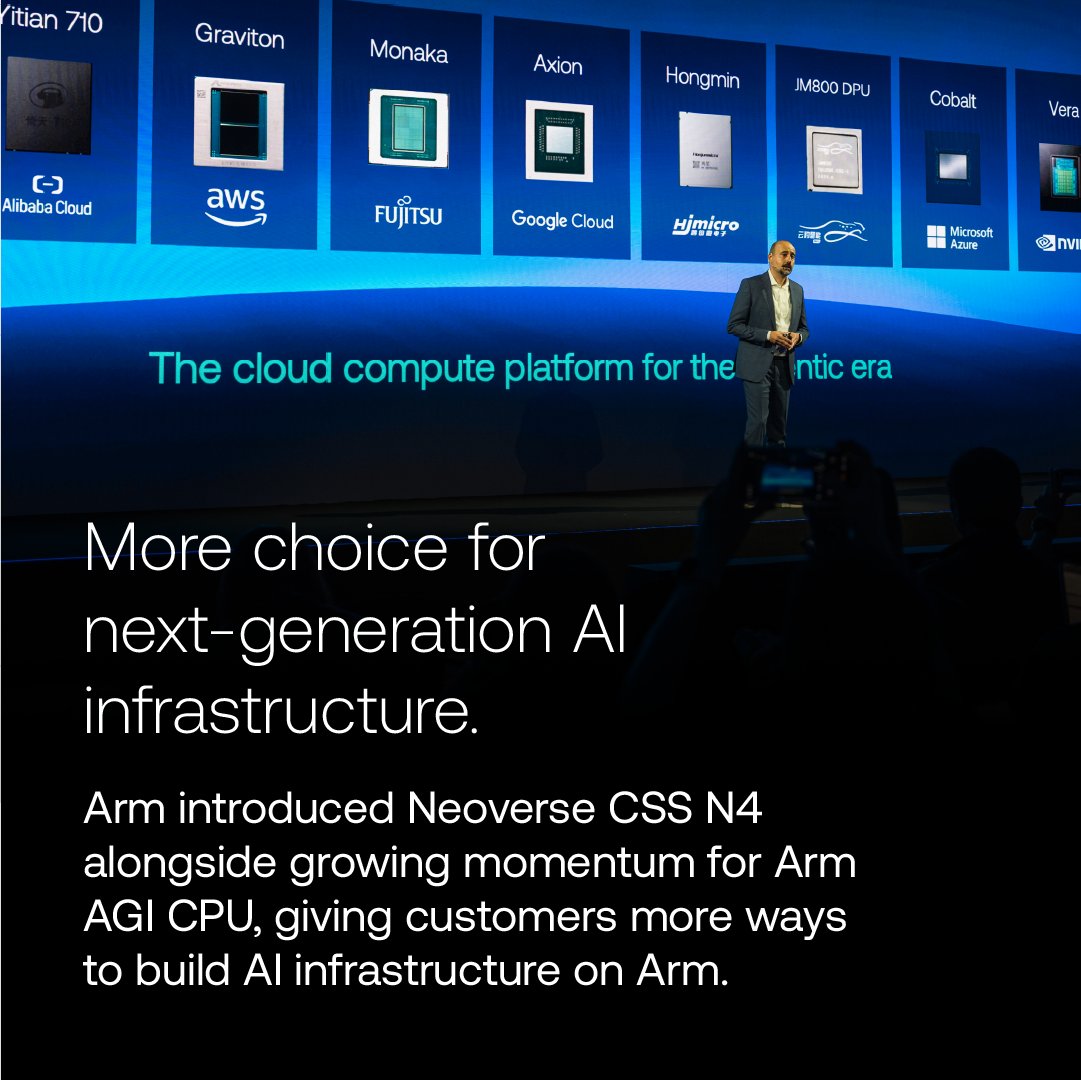

We're delivering more choice for the next generation of AI infrastructure.
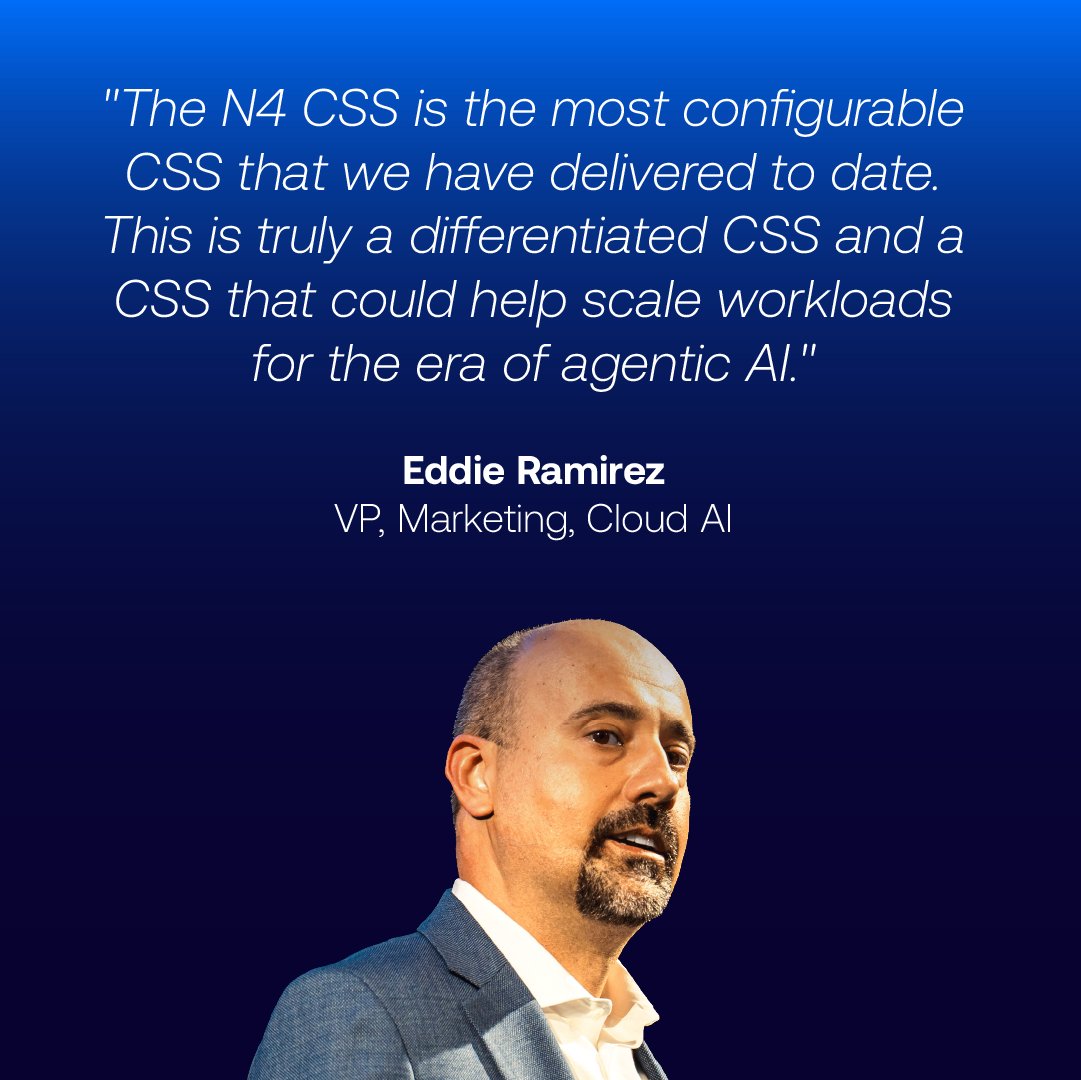
At Arm Everywhere China, Eddie Ramirez introduced Neoverse CSS N4 — Arm’s most configurable CSS yet and fastest path from CSS to silicon. ⚡️
From IP and CSS to production silicon with the Arm AGI CPU,
What does AI research look like on one of the UK’s most powerful supercomputers?
Mohamed Awad visited Isambard-AI at @BristolUni (BriCS) to see how its computing power is helping researchers advance work - from personalized cancer vaccines to dementia diagnosis.
The future of


Agentic AI and AI-native graphics are changing the mobile workload.
In 60 seconds, see how Arm CSS for Mobile 2 brings together world-class AI CPU and GPU capabilities through the Arm C2 CPU Cluster with SME2 and Mali G2-Ultra NX, alongside system IP and software in an AI-native