What Arm-based innovations happened in February 2026?

The edge is getting smarter and more immediate. February’s highlights track how Arm and its ecosystem are moving AI, graphics, and real-time workloads from “possible” to “practical,” with tangible gains in responsiveness and efficiency. Whether you’re building autonomous systems, optimizing GPU pipelines, or bringing privacy-preserving AI onto phones, these stories offer concrete guidance and platform updates to help you ship faster, leaner experiences.
Arm and Tensor join forces to power the world’s first personal robocar
Arm and Tensor have announced a multi-year strategic collaboration to build the compute foundation for the world’s first AI-defined personal robocar. Tensor’s robocar will integrates more than 400 Arm-based cores, making it the highest concentration of Arm technology ever deployed in a consumer vehicle. These cores span Arm architectures, from Arm Neoverse Automotive Enhanced IP for high-throughput AI to Cortex-X, Cortex-A, Cortex-R, and Cortex-M. With this, Arm is providing a flexible, safety-capable, and power-efficient compute platform that powers perception, autonomy, real-time control, and system management.
The partnership highlights how Arm’s compute ecosystem is enabling agentic AI workloads across the entire vehicle, helping Tensor scale Level 4 autonomous capabilities while maintaining safety, performance, and efficiency. This effort points to a future where physical AI systems, like autonomous cars, can run complex intelligence locally, leveraging the Arm compute platform and supporting ecosystem to deliver robust, real-world performance.
Showcasing Real-Time AI Robotics Innovation
Arm’s Marco Domingo created his own “Reachy Phone Home” project, which enables Reachy Mini, a compact humanoid robot from Pollen Robotics, to detect when someone is using their phone and respond instantly with coordinated voice and motion. The system uses Ultralytics YOLO vision models for object detection and runs on Arm-based platforms including Apple Mac and Raspberry Pi 5.
By combining Hugging Face’s open AI ecosystem with Arm-powered hardware, the project delivers responsive, on-device intelligence capable of analyzing visual input and generating expressive robotic behavior in real time.
The work has already gained industry recognition, earning Marco a prestigious NVIDIA GTC Golden Ticket award. Projects like this highlight how Arm’s developer ecosystem is enabling experimentation at the intersection of AI, robotics, and edge computing — where powerful models, efficient compute, and open collaboration come together to turn ideas into working systems.
Bringing on-device AI to life with Arm SME2
Arm’s Scalable Matrix Extension 2 (SME2) brings efficient matrix AI acceleration to Armv9 CPUs, boosting generative AI and computer vision workloads without compromising on power-efficiency.
Powering on-device AI in latest Exynos 2600 mobile chipset
Samsung’s latest Exynos 2600 mobile chipset includes support for SME2 to accelerate matrix operations on CPUs. This marks an important step in bringing AI acceleration directly onto the device for low-latency, real-time workloads.
Enabling a fully offline HIPAA-compliant clinical note summarization
Healthcare workers today spend a lot of time on paperwork. In rural clinics for example, doctors regularly spend minutes manually summarizing patient visit notes for referrals and billing. Connectivity issues and privacy regulations (like HIPAA) make cloud-based AI assistants impractical. On-device AI solves those problems by keeping all processing local, ensuring patient data never leaves the device, preserving privacy and compliance.
In this Arm Community blog, Cornelius Maroa, Arm Ambassador, explains how Arm built a fully offline clinical note summarization app that runs directly on Android phones and tablets. Using Google’s open-source Gemma 2B model, combined with SME2 acceleration on Armv9 CPUs, the app delivers fast, accurate summaries of clinical notes in under 10 seconds, all without sending patient data to the cloud.
How SME2 accelerates AI experiences on mobile
Meanwhile, the video below provides a deeper-look into how SME2 enables AI across real-world experiences on mobile, from agentic calling and live translation to music generation and smart yoga.
With SME2 showing up across major applications and new flagship silicon, these demos show how on-device AI is becoming faster, more efficient, and more widely available across the Arm mobile ecosystem.
How Vulkan pipeline barriers really behave on Mali GPUs
In this Arm Community blog, Panagiotis Christopoulos Charitos, Principal Engineer, explains how Vulkan “pipeline barriers” — the mechanism developers use to control the order of GPU tasks — map directly to Mali GPU hardware. In modern Valhall-based Mali GPUs, work is split across multiple parallel streams for compute, geometry, fragment, and transfer operations.
When developers use precise synchronization rather than overly broad barriers, the GPU can run more tasks in parallel instead of stalling between stages. The result is better hardware utilization, fewer idle cycles, and improved graphics and compute performance. The takeaway is simple: thoughtful Vulkan synchronization allows developers to extract more performance and efficiency from Mali GPUs — without changing hardware, just by writing smarter code.
Windows 11 MIDI 2.0 gets a boost on Arm powered PCs
Windows 11 just delivered its biggest MIDI upgrade in decades with Windows MIDI Services bringing native MIDI 2.0 support plus major MIDI 1.0 improvements.
Through the upgrade, musicians and audio developers will see how multi client devices can access built-in app-to-app loopback, automatic MIDI 2.0 translation, and microsecond level timestamping to tighten timing and simplify setups across DAWs and instruments, including on Arm64 PCs.
Real time Edge AI gets a boost with Zephyr support for Armv9 Cortex-A
Armv9‑A is the application‑class CPU architecture at the heart of many edge AI systems, handling low‑latency decision‑making, security, and system control. In this Arm Community Blog, Zineb Labrut, Software Product Owner, Arm’s Edge AI Business Unit, explains how BayLibre partnered with Arm to bring Zephyr OS support to Armv9 Cortex-A processors.
Labrut breaks down key upstream additions (including Armv9-A support in Zephyr arm64, efficient SVE/SVE2 context switching, unified FVP infrastructure, and SMP stability fixes) and how they were validated and merged into Zephyr mainline. If you’re building performance-per-watt–sensitive systems at the edge, it’s a practical look at how modern Cortex-A features are becoming viable in an RTOS-first design.
Native Arm desktop development for AI and software teams
In this video, developers get a hands-on look at purpose-built Arm workstations that make it easier to build, test, and run Arm software and AI workloads natively without the overhead of cross-compilation or emulation. The session also includes live Office Hours, so Arm Developer Program members can pose technical questions to Ampere engineers and get the latest on Arm desktop ecosystem and toolchain support.

Any re-use permitted for informational and non-commercial or personal use only.
Editorial Contact
Stay informed with Arm's top stories, insights, and conversations.


Latest on X

Build. Test. Experiment.
You won't want to miss the Arm Create Builder Zone at @WeAreDevs World Congress North America.
⬇️⬇️⬇️
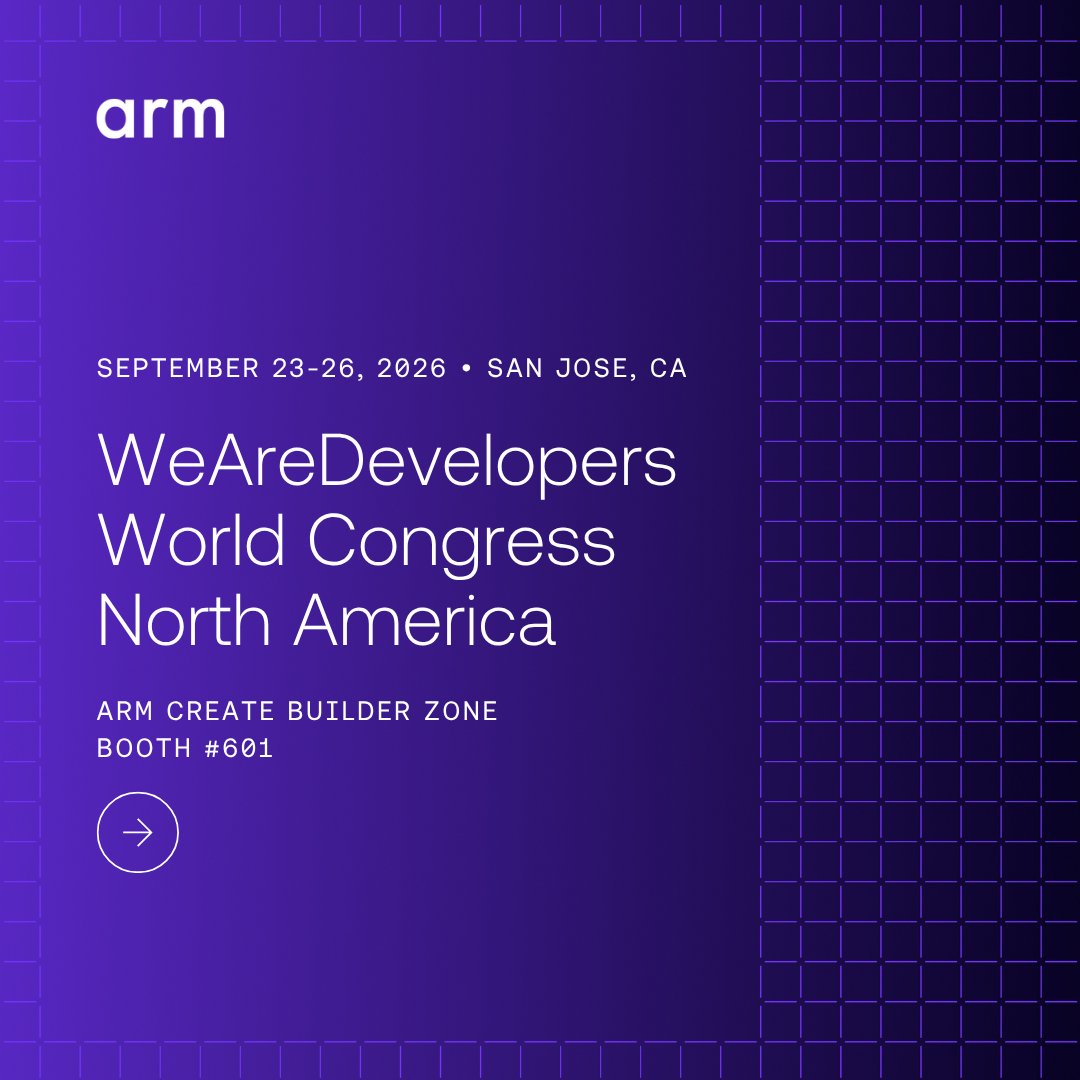
The Arm Create Builder Zone coming to @WeAreDevs World Congress North America!
🚀 Lightning talks
🚀 Demos
🚀 Conversations with the teams building the next era of AI
This is your chance to learn more about how YOU can build, test, and experiment on Arm.
Come and see us
What could AI make possible that we can’t imagine today?
Arm CEO Rene Haas talks to @BBC’s @faisalislam about the potential for AI to transform healthcare, including breakthroughs in diseases like cancer. https://okt.to/qHwKnr

Today’s @Snap SPECS launch offers an exciting look at that future—where immersive experiences can help people create, connect, and get things done while staying present in the moment.
As intelligence increasingly moves to the edge, experiences like these show what’s possible

SPECS bring useful digital experiences into the world around you while keeping you present in the moment. From work and navigation to entertainment, creativity, and connection.
https://SPECS.com
Congrats to @MediaTek on the Dimensity 9600 Pro. 🎉
Featuring the Arm C2 CPU cluster with C2-Ultra CPUs and the Mali G2-Ultra NX GPU, the new flagship SoC delivers high performance and power efficiency for faster, more responsive mobile experiences.

MediaTek Dimensity 9600 Pro Sets New Standard for Flagship Smartphone Chips
MediaTek Dimensity 9600 Pro Sets New Standard for Flagship Smartphone Chips. This 2nm SoC delivers leap in performance and efficiency for agentic AI.
okt.to
What makes Arm CSS for Mobile 2 more than a collection of IP? 📱
It brings together world-class AI CPU and GPU capabilities, including the Arm C2 CPU Cluster with SME2 and Mali G2-Ultra NX, with system technologies and software in one configurable AI-native platform.
@ctbergey

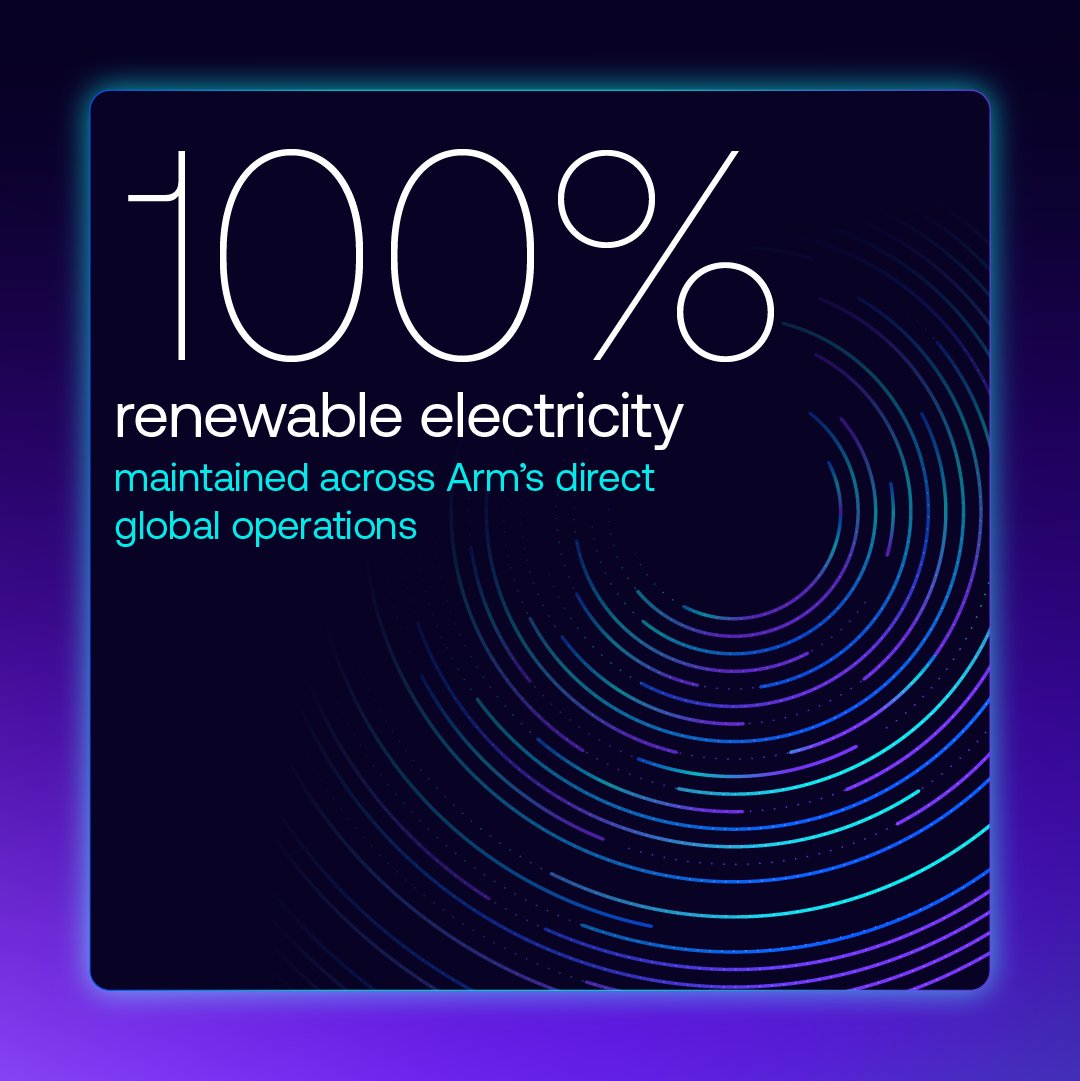
Our latest Sustainable Business Report is now live - take a closer look to see how we’re advancing power-efficient computing and working with partners to expand access to technology, skills, and opportunity.
Flip through our FYE26 highlights 👇 then explore the full report 👉



Thank you to the @verdacloud team for joining us at Arm in San Jose as we continue to build the foundation for scalable, production-ready AI systems. 💪
Verda’s adoption of the Arm AGI CPU reflects a broader trend toward integrated, heterogeneous systems optimized for AI, where