The growing momentum behind the Arm MCP Server shows how agentic AI is transforming developer workflows

AI has changed how developers write code, but the next transformation is even more significant. AI assistants are evolving from passive copilots into active pair programmers that can understand context, invoke specialist tools, execute workflows and help solve increasingly complex problems across the entire software development lifecycle.
Model Context Protocol (MCP) is helping to make that future possible. Rather than creating bespoke integrations between every AI assistant and every developer tool, MCP provides an open standard that allows AI assistants to securely discover, access and interact with external tools and knowledge sources. It is becoming a common foundation for agentic software development, enabling developers to work with AI through connected workflows instead of disconnected tools.
For developers, this represents a fundamental shift. Instead of spending time searching through documentation, switching between applications or manually coordinating development tasks, they can increasingly focus on solving engineering problems while AI assistants orchestrate much of the underlying workflow. For the end user, this ultimately means better software, delivered faster.
The Arm MCP Server demonstrates what this future looks like in practice. By bringing Arm tools and curated expertise directly into MCP-compatible AI assistants, developers can analyze codebases, migrate workloads to Arm and optimize performance without leaving their existing development environment.
Why the Arm MCP Server is gaining momentum
The momentum behind the Arm MCP Server is not simply reflected in download numbers. It is reflected in how developers are using it.
In just under a year, the Arm MCP Server has achieved more than 10,000 Docker downloads, and developers are integrating it into workflows across leading AI development environments, including Amazon Kiro, Claude Code, Codex, Cursor, Gemini, GitHub Copilot, Google Antigravity, Windsurf, and others. More broadly, technology leaders including AWS, Docker and Microsoft are using the Arm MCP Server to connect AI assistants with trusted tools and engineering workflows, demonstrating that developers increasingly expect agentic AI to work within the systems they already rely on rather than operating in isolation.
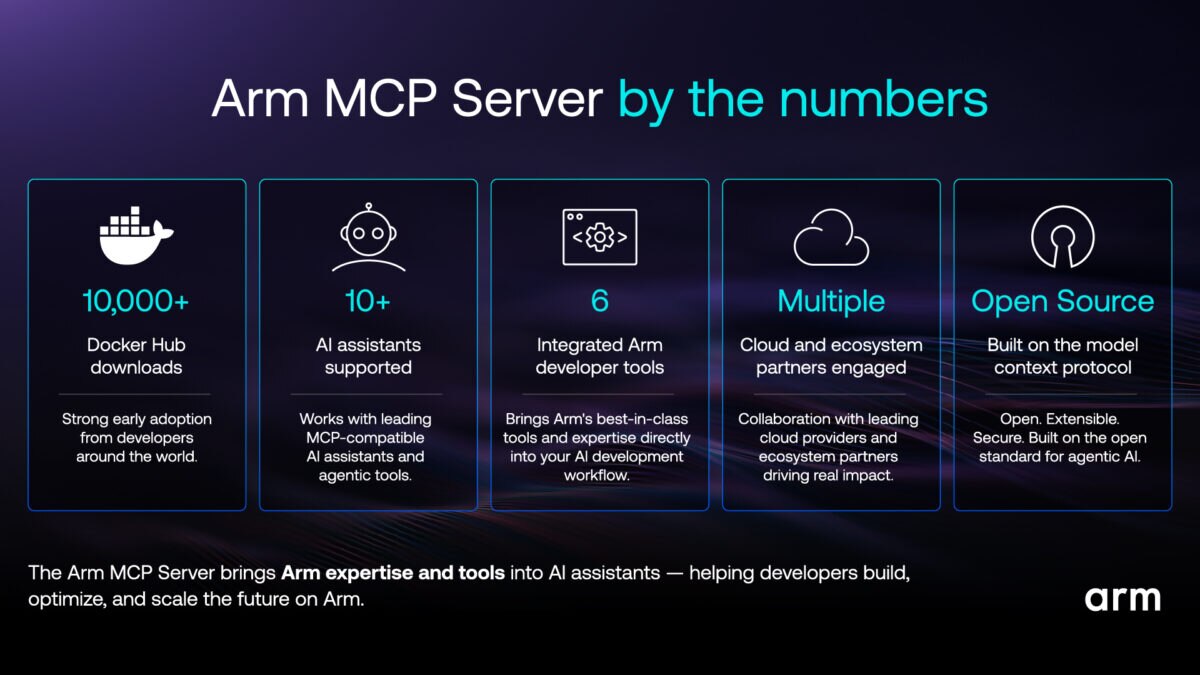
These milestones reflect a broader shift across the industry. Developers are no longer looking for AI that simply answers questions. They expect AI to understand context, invoke the right tools, retrieve trusted expertise, and help complete complex engineering tasks as part of a single, connected workflow.
When we ran into Arm64 build failures while testing a Hugging Face Space for a 3.5B-parameter music generation model, we used the Arm MCP Server with Docker MCP Toolkit to understand what was breaking. In 15 minutes, the workflow inspected the container manifest with Skopeo, scanned the source code with migrate-ease, and pinpointed a single hardcoded x86_64 wheel URL buried in requirements.txt that was silently breaking Arm builds. Without the Arm MCP Server, that blocker could have taken hours to track down manually. With it, developers get a structured GO / NO-GO verdict backed by real tooling, not guesswork.
– Ajeet Singh Raina, Developer Advocate, Docker
During an evaluation of the Arm MCP Server, we quickly identified an Arm SIMD optimization opportunity for a matrix operation in the .NET runtime. The experience demonstrated how the tool can help accelerate performance investigations and uncover architecture-specific optimization opportunities more efficiently. We’re encouraged by the potential of the Arm MCP Server and are exploring additional use cases across .NET development workflows.
– Julie Lee, Principal SW Engineering Manager, .NET, Microsoft
How the Arm MCP Server brings Arm expertise into AI assistants
The growing engagement from developers, hyperscalers and independent software vendors (ISVs), alongside real-world examples such as migrating models in Hugging Face Docker Spaces, demonstrates how AI-assisted workflows can make software migration and optimization more repeatable and scalable. That repeatability is important because many cloud workloads still carry architecture-specific assumptions. Developers may need to identify x86 dependencies, inspect container compatibility, update CI/CD pipelines, rebuild native libraries, and tune performance after migration.
The Arm MCP Server helps bring these steps into a guided agentic workflow, so teams can apply migration guidance more consistently across applications and environments. It integrates with MCP-compatible AI assistants, giving developers direct access to Arm’s software ecosystem from within their existing development environment. This means developers can:
- Assess applications and environments for Arm readiness;
- Migrate workloads with Arm-specific guidance for architecture transitions;
- Optimize existing applications through performance analysis across code and system behavior; and
- Validate container images for Arm-based deployment.
The Arm MCP Server also provides direct access to several Arm developer tools as part of this agentic workflow. Here’s an example of how Arm MCP Server utilizes all these developer tools into a guided workflow — analyzing applications, identifying required changes, validating workloads and recommending optimizations — when a developer ports an x86 workload to Arm on AWS:
- Arm MCP Server is invoked from an MCP-compatible assistant within their existing workflow;
- Migrate-ease can analyze the repository to identify x86-specific assumptions, dependencies, and migration steps;
- Skopeo can inspect container images for Arm compatibility;
- Sysreport can help validate the target Arm Linux environment;
- Arm Knowledge Base can surface trusted technical guidance from Arm experts;
- As the workload moves from migration to optimization, Arm Performix can help developers understand and tune software performance on Arm-based infrastructure; and
- Machine Code Analyzer (LLVM-MCA) provides static performance analysis for small compiled code snippets.
Together, these tools support a practical end-to-end workflow: assess the workload, identify compatibility issues, port to Arm, validate the environment, and optimize performance.
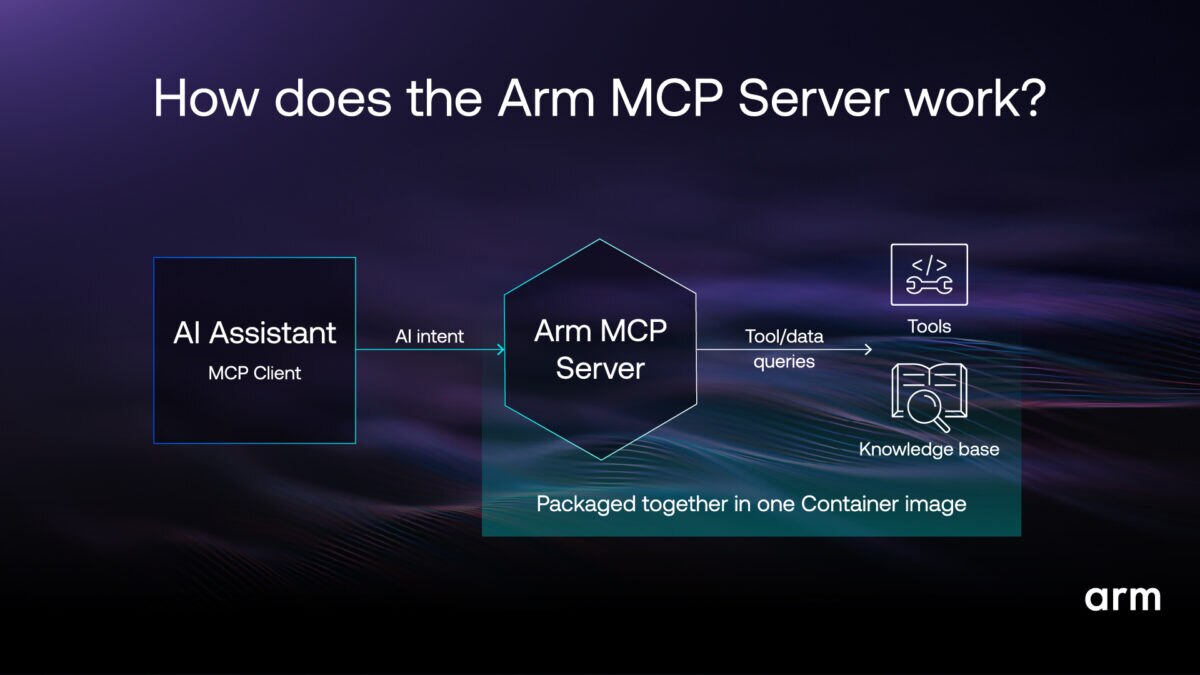
Because the Arm MCP Server runs locally inside a container, enterprise developers can also keep their code and development workflows within their own environment, providing greater privacy and control. Moreover, combining Arm-specific tools and trusted guidance helps developers complete complex engineering tasks more efficiently.
How agentic AI helps developers migrate workloads to Arm
Migrating workloads to Arm delivers clear benefits, including better performance per watt, greater efficiency, and lower infrastructure costs. For most developers, however, the challenge has never been why they should migrate — it has been how.
Common questions include:
- Do I need to rebuild my application?
- Which dependencies can I reuse?
- How do I migrate containers?
- What changes are required for my CI/CD pipeline?
- How do I optimize existing workloads for Arm?
Arm has spent years developing migration tools, documentation, and performance analysis resources in conjunction with our architecture to answer these questions. For Arm, the challenge has been making that expertise easily accessible when developers need it.
Instead of switching between documentation, terminals, container registries and multiple developer tools, developers can now access much of that guidance directly through their AI assistant. This transforms migration into a streamlined, repeatable development experience, and makes it easier to apply best practices consistently across projects.
What the Arm MCP Server means for the future of agentic AI
MCP marks the beginning of a much broader transformation in software engineering. As open standards become widely adopted, AI assistants are evolving from coding companions into trusted engineering collaborators.
The Arm MCP Server shows what that future looks like. By combining Arm’s trusted tools and engineering expertise with an open standard that is becoming part of modern AI development, it helps establish the foundations for a more connected, intelligent and productive software engineering experience.
As the Arm MCP Server adds more tools and capabilities, it can simplify porting, development, and optimization on Arm. Over time, this can reduce manual effort across the migration workflow, helping AI agents assess applications, recommend changes, validate environments, and optimize performance with minimal human intervention.
As agentic AI evolves, the opportunity is not simply to build more capable models, but to connect those models with the tools, platforms and expertise developers rely on every day. That is the shift MCP enables, and it is the future the Arm MCP Server is helping to build.
Get started with the Arm MCP Server
The Arm MCP Server is available today and works with a growing range of MCP-compatible AI assistants. Download the Arm MCP Server, explore the documentation, and see how agentic AI can become part of your Arm development workflow here.

Any re-use permitted for informational and non-commercial or personal use only.
Editorial Contact
Stay informed with Arm's top stories, insights, and conversations.



Latest on X

Introducing Arm Total Design for Physical AI — bringing an inital 80+ companies together around a shared goal to accelerate physical AI from development to deployment.
One of the first initiatives is a Robotics Capability Framework, creating a common language for defining

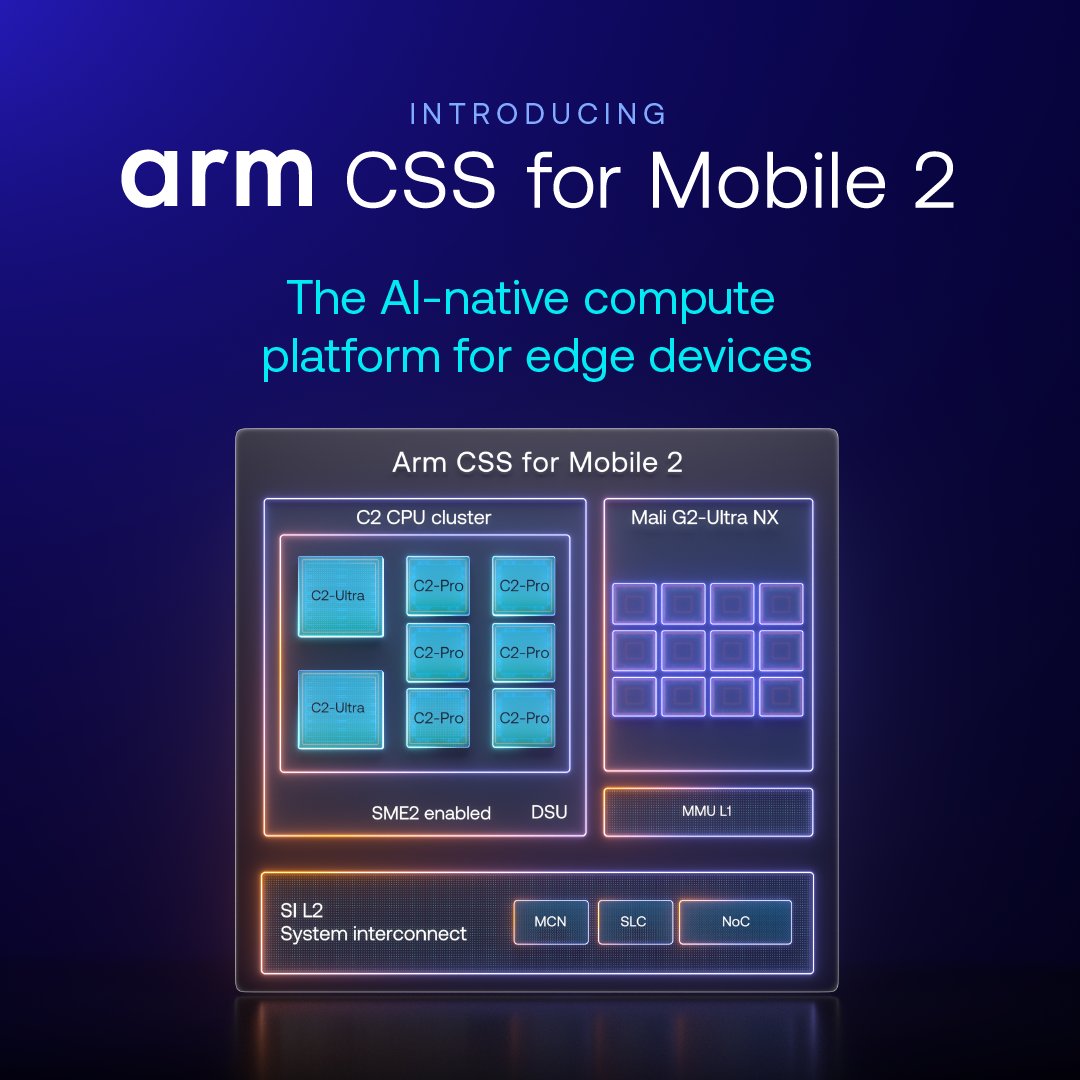
Introducing Arm CSS for Mobile 2. 📱
Built for the system-level demands of agentic AI and cinematic mobile graphics, our new AI-native compute platform brings together world-class AI CPU and GPU capabilities to change what the next generation of mobile devices can do.
AI is no longer just generating content. It’s completing tasks.
Across cloud, edge and physical systems, intelligence is becoming more capable — and compute has to keep up.
Arm is building the platform for that era.
We'll share more from our Arm Everywhere China keynote,

Agentic AI is reshaping compute everywhere.
Across cloud, edge and physical AI, systems can increasingly perceive, reason and act — creating new demands for performance and efficiency at every layer.
See how Arm is meeting them. Discover more from Arm Everywhere China,

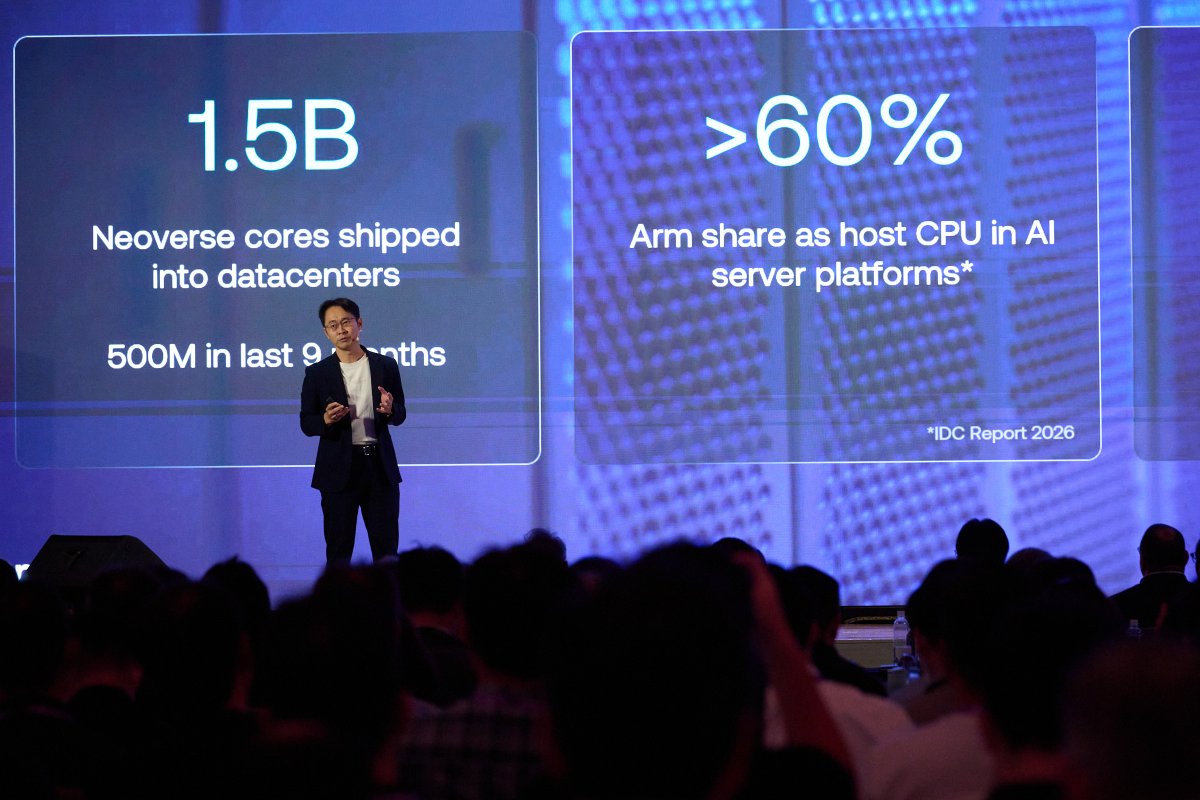
Agentic AI is changing what the data center needs from the CPU.
At SEMICON Taiwan, CK Tseng shared how Arm is helping the ecosystem scale AI infrastructure through more efficient CPUs, custom silicon, chiplets and tighter system integration.


As AI runs on-device, mobile platforms need to balance greater performance with efficiency.
Arm’s focus on performance per watt helps our partners deliver more capable mobile AI experiences, with mobile at the heart of a much bigger story across the edge.
Stay tuned for what’s

AI is changing how silicon gets designed.
On @NoPriorsPod, Rene Haas joins @Saranormous and @EladGil to discuss how AI could accelerate chip development, Arm’s evolution from IP to silicon, and why CPUs remain at the heart of computing as AI scales.
Listen