Top Arm-based innovations advancing AI infrastructure, on-device intelligence and physical AI in September 2026

September 2026’s roundup shows how the Arm compute platform is enabling AI everywhere, from infrastructure to increasingly personal, physical, and immersive experiences. Arm is helping scale agentic AI from cloud systems to mobile devices, laptops, robotics, gaming, wearables, and scientific research, while giving developers and partners a consistent compute foundation for performance, efficiency, and software innovation across diverse environments.
Where agentic AI meets the Arm compute platform
Agentic AI is pushing intelligence everywhere, from the cloud where it is created, to the edge where it becomes personal, to the physical world where it acts. That shift is turning previously separate systems into one connected computing continuum, with more diverse workloads, models, and software environments to coordinate. At Arm Everywhere China 2026, Arm showed how a common compute platform can bring consistency across that complexity, from Arm CSS for Mobile 2 and AI-native mobile experiences to next-generation infrastructure with Arm Neoverse CSS N4 and Arm AGI CPU.
The infrastructure story is also taking shape across the ecosystem. At Innovate! EMEA, Arm’s Dilip Ramachandran and Supermicro’s Trent Prestegar explored how the companies are working together on systems built to meet the performance, efficiency, and scale demands of agentic AI workloads. These efforts connect Arm platform technology with partner systems, helping organizations deploy and scale AI across increasingly diverse environments.
Developers push AI optimization across the Arm compute platform
AI optimization is becoming less about one technique and more about finding the real constraint in each workload. The Arm Create AI Optimization Challenge put this to the test, attracting more than 330 submissions that explored AI workloads ranging from local LLM inference on wearables, on-device speech processing to CPU-based cloud inference, agent throughput optimization, and more efficient mobile vision pipelines. The winning approaches show how developers can extract more from Arm-based systems by optimizing the whole workload, not just the model.
Neural graphics opens more headroom for mobile games
On-device AI is moving deeper into mobile experiences, with Arm helping developers combine CPU, GPU, and neural processing more effectively. Neural Dawn shows that shift in action, using Arm Neural Technology to bring more sophisticated real-time visuals to mobile gaming. Arm is extending this approach through Neural Frame Rate Upscaling (NFRU), which uses AI-generated intermediate frames to reduce rendering demands and improve motion. The result is more headroom for developers to balance visual quality, responsiveness, performance, and power.
That work is also moving closer to production workflows. With Arm Mali G2-Ultra NX, dedicated neural accelerators sit directly within the GPU, while Tencent Games and Unity China are integrating neural graphics into familiar rendering and engine environments. This gives developers a more practical path to techniques such as Neural Super Sampling and NFRU, while balancing visual quality, responsiveness, power, and thermal limits.
Building the compute foundation for physical AI
As robots move from demonstrations into real-world deployment, the challenge is shifting from adding more AI to making sensing, inference, planning, control, and safety work together reliably. Federico Pecora, Senior Principal Robotics Research Lead at Arm, explores why this makes robotics an increasingly complex systems problem, with different workloads placing distinct demands on compute, scheduling, data movement, and real-time control. At the World Robotics Conference, Pecora extended that systems view, sharing how Arm is exploring the compute foundation needed to coordinate these capabilities as robots become more adaptive. The goal is to translate greater intelligence into predictable, efficient, and safe operation in the real world.
MediaTek brings Arm’s latest mobile compute platform to new flagship smartphones
Arm’s latest mobile compute platform is moving from platform design into flagship smartphones. MediaTek’s Dimensity 9600 Pro combines two Arm C2-Ultra and six C2-Pro CPU cores with the Mali G2-Ultra NX GPU, giving smartphone makers a new foundation for AI, graphics, and responsive everyday computing.
That foundation now reaches users through vivo’s new X500 Pro Series and OPPO’s new Find X10 Series, both powered by the Arm-based Dimensity 9600 Pro. These launches show how the Arm CPU and GPU advances move through the ecosystem into richer device experiences, while helping manufacturers stay within the power and thermal limits that define flagship smartphone design.
Edge AI expands what wearable computing can do
AI-native devices are pushing more intelligence to the edge, where compute must support rich experiences within tight power, thermal, and form-factor constraints. Snap’s SPECS smart glasses and Meta’s latest lineup of AI devices, personal agents, and wearables point in the same direction: intelligence becoming more personal, ambient, and always available. Parag Beereka, Senior Director, Consumer Computing at Arm, explores what this new wave of wearables means for AI and the compute foundation required to make those experiences practical.
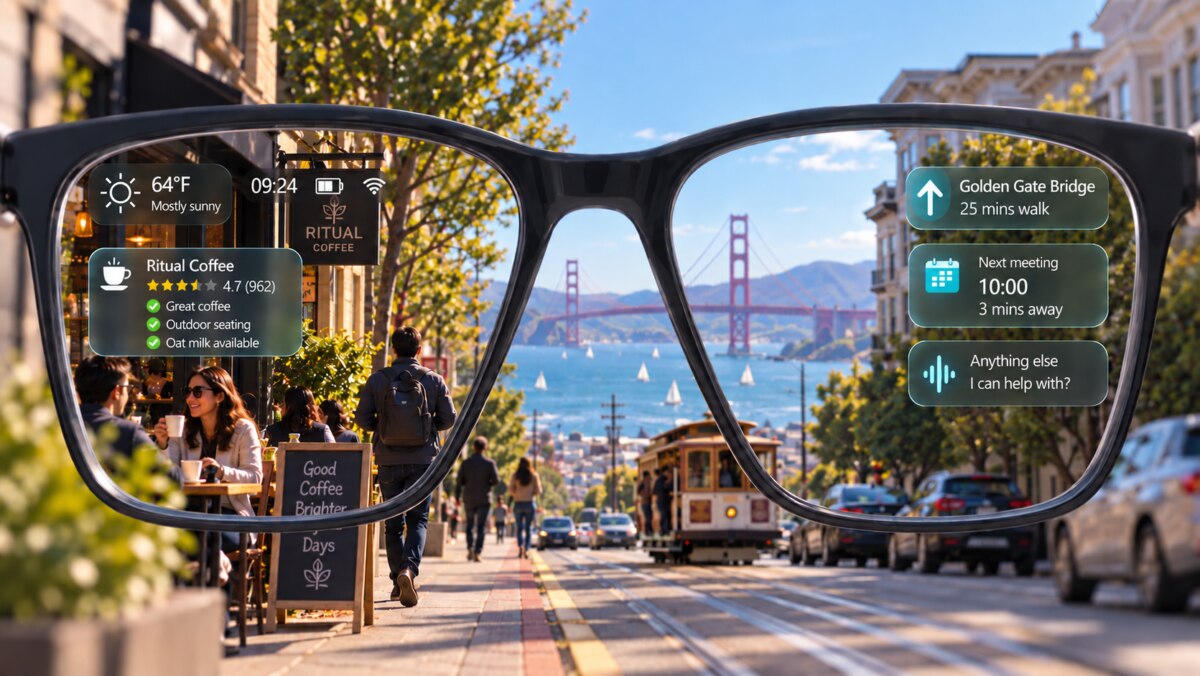
Meanwhile, that shift is extending into immersive computing too. Valve is extending the Steam hardware ecosystem into wireless VR with Steam Frame, a new Arm-based VR headset designed for both PC streaming and standalone gaming.
Chiplet connectivity converges around a scalable AMBA approach
As chiplets spread across AI and heterogeneous systems, connectivity has to serve a wider range of designs, from simple device attach to fully coherent multi-chip systems. AMBA C2C enables chip-to-chip connectivity across AMBA AXI and AMBA CHI, combining scalable protocol support, interoperability, and transport flexibility for the next-generation system design. By separating protocol and packetization from the underlying die-to-die transport, AMBA C2C can work alongside standards such as UCIe and support interoperability across different chiplets, vendors, and generations. The result is a common foundation for composing chiplet-based systems without forcing every design into the complexity of a fully coherent architecture.
Arm-powered AI advances research and healthcare
AI infrastructure is increasingly becoming a foundation for scientific and healthcare discovery, not just larger AI models. At Isambard-AI, one of the UK’s most powerful supercomputers, researchers are using Arm-based computing to advance work ranging from personalized cancer vaccines to dementia diagnosis, connecting large-scale AI compute with real-world research outcomes.
That potential extends further. In a conversation with BBC News, Arm CEO Rene Haas explored how AI could reshape healthcare and help accelerate breakthroughs in diseases such as cancer. Taken together, these examples connect the scale of modern AI infrastructure with the discoveries and human outcomes it can enable.
On-device AI brings real-time voice safety closer
Real-time voice moderation is typically a server-side workload, but more of that processing can now move onto mobile devices. One example shows how LiteRT, quantization, KleidiAI, and Arm SME2 can optimize a toxic-speech detection model to run on a single CPU thread, processing 15 seconds of audio in 0.37 seconds on the test device. SME2 provided about 60% higher performance for that workload while leaving compute headroom for the game itself. That creates a path to faster on-device moderation with less reliance on server processing, while preserving server-side safeguards for security and enforcement.

Any re-use permitted for informational and non-commercial or personal use only.
Editorial Contact
Stay informed with Arm's top stories, insights, and conversations.


Latest on X

Soon your phone won’t just respond to what you ask - it’ll anticipate what you need. 📱
@ctbergey shares how Arm CSS for Mobile 2 is built to support that shift, with the CPU performance to keep multiple AI agents working at once.

Snap SPECS. Meta's VR glasses. And more. 👓
AI is moving beyond phones and PCs - and into the devices we wear and interact with.
Parag Beeraka, Senior Director, Consumer Computing, explores what this new wave of wearables could mean for AI and the compute foundation making it
Bringing production silicon to market is more than an engineering challenge - it requires a holistic organizational shift.
What does that look like in practice? Charlotte Eaton, Chief People Officer at Arm, shares what went into building the workforce behind Arm AGI CPU,
More flexibility. More customization. A faster path to differentiated silicon.
That’s what Neoverse CSS N4 is designed to give Arm partners building for the agentic AI era. 💪

We’ve worked with the @TencentHunyuan team to bring its translation models to Arm CPUs in SME2-enabled devices, helping make translation available wherever you are, even without a connection. 🌍

🚀 Tencent Hy Translation just landed.Powered by Hy-MT2.
33 languages. 5 Chinese minority languages & dialects.
Voice. Photo. Full offline — on-device, no network required.
Already live in 12 countries and regions.
Travel, drive, work or read abroad. Accurate. Natural. Always
Run the agent. Secure the infrastructure around it.
As AI agents become more autonomous, security has to be built into the infrastructure around them. Arm CPUs run agentic workloads, while Arm-based DPUs provide independent observation, isolation and policy enforcement.

What if AI could help create the pixels behind the next generation of mobile games?
Mali G2-Ultra NX brings world-class AI GPU capabilities to mobile, with neural acceleration built directly into the graphics pipeline.
@ctbergey shows what that unlocks through Neural Dawn,