Top Arm-based innovations advancing on-device AI, cloud infrastructure, and physical AI in October 2026

Throughout October 2026, developments across the Arm ecosystem showed how a common compute foundation is helping partners deploy more capable intelligence, scale demanding workloads, and connect AI with the physical world.
Tensor brings distributed Arm intelligence to autonomous mobility
Autonomous vehicles bring together some of the most demanding requirements in physical AI, where complex reasoning must work alongside real-time sensing, control, and safety systems. The Tensor RoboCar integrates 433 Arm-based cores across the vehicle, using technologies including Arm Neoverse AE, and Cortex processors to support centralized AI, agentic in-cabin experiences, distributed sensing and vehicle control.
A new video takes a closer look at how Arm technology is distributed throughout the Robocar. From processing road information and planning vehicle actions to coordinating the systems that steer, brake and respond, the vehicle illustrates the breadth of Arm-powered compute required to bring AI-powered decisions into the physical world.
PSYONIC connects human dexterity with robotic learning
Teaching robots to handle everyday objects requires real-world data on touch, force, and movement. In a BBC Tech Now report filmed at Arm’s Cambridge headquarters, presenter Paul Carter joins PSYONIC founder and CEO Dr. Aadeel Akhtar and Drew Henry, EVP for Physical AI at Arm, to explore the Ability Hand, a touch-sensitive prosthesis powered by 12 Arm-based microcontrollers that coordinate sensing, motor control, and feedback.
The same hand can be used on robotic platforms, opening opportunities to use human-generated grip and contact data to help train machines for more precise manipulation. By connecting prosthetic technology with robotics research, PSYONIC is showing how technology that supports people today can also inform the development of more capable physical AI systems.
Arm is powering more intelligent consumer devices
AI is extending beyond smartphones into personal consumer devices designed for more natural, contextual interactions. Alibaba’s Qwen Glasses N1 Series combines camera-based capture, voice assistance and connected services, while Himax’s Arm Cortex-M55 and Ethos-U55-based WiseEye processor enables low-power, always-on visual sensing. By detecting relevant events locally and waking the main system only when needed, this architecture helps address the battery constraints of intelligent eyewear.
Meanwhile, Amazon’s new Alexa Tablet lineup brings Alexa+ into a broader range of everyday computing experiences. The flagship Alexa Tablet 12 Pro uses a MediaTek Dimensity 8400 processor featuring Arm Cortex-A725 CPUs and Arm Mali-G720 GPU, supporting multitasking, entertainment, and personalized assistance within portable device.
PCs are also evolving beyond traditional keyboard and mouse interactions as touch, voice and AI reshape how people work, create and communicate. In his LinkedIn article, The next PC transformation: When computers adapt to us, Christopher Bergey, Executive Vice President of Edge AI at Arm, explores how agentic AI could make PCs more intuitive and capable of acting on users’ behalf. With Arm’s compute platform spanning smartphones, PCs and cloud infrastructure, the ecosystem has a common foundation for delivering responsive, efficient and increasingly connected AI experiences.

The shift points toward personal computers that adapt more naturally to users, rather than requiring users to adapt to the technology.
Shared frameworks, common compute platform and reasoning models advance physical AI
As robots become more capable, developers need better ways to describe their capabilities, coordinate their actions and deploy them reliably. The Robotics Capability Framework is helping establish a common language for defining robotic capabilities and system requirements. This makes it easier for the industry to compare systems, reduce fragmentation, and align development efforts.
At the intelligence layer, Google’s Gemini Robotics Embodied Reasoning 2 is now available in public preview on the Gemini platform, which brings advanced spatial reasoning, multi-step planning, and multi-robot coordination into enterprise development workflows. Arm is working with Google to explore how these emerging reasoning capabilities could shape future robotics compute platform, connecting advances in AI models with the broader systems needed to deploy physical AI.
On the hardware side, Agile Robots’ new Agile ONE SN brings NVIDIA Isaac GR00T and Jetson Thor compute, built on Arm Neoverse V3AE CPUs, into a compact humanoid research platform. By connecting data capture, simulation, training, and testing, it aims to reduce the integration work that slows robotics research and give developers a clearer path to real-world validation.
Liquid AI expands the possibilities for on-device intelligence
More capable AI models are becoming practical on smaller devices as developers improve inference efficiency without relying entirely on cloud infrastructure. Liquid AI’s new LFM3 family brings compact, open-weight models for text, vision, audio and decision-making, with Arm supporting efficient inference from launch.
Early, provisional benchmarks of the quantized LFM3-1.7B model on Arm CPUs show 3.1x faster prefill and 1.5x faster decoding with Arm Scalable Matrix Extension 2 (SME2) enabled, using just two CPU threads. These advances create more opportunities for responsive, specialized AI applications that can run locally.
Liquid AI is also among the partners in Arm Total Design for Physical AI, which connects model, software, and computing expertise to support the development of intelligent physical systems. The Arm video below explores how the companies are working together on the technology foundations needed to bring those systems into real-world deployments.
Arm AI Model Optimizer simplifiers deployment across hardware
Choosing a model is only a part of building AI applications: developers also need to understand how changes in precision, memory use, and model structure affect performance on real devices. Will Lord, Senior Technology Manager, Embedded Tools at Arm, and Tae-ho Kim, Chief Technology Officer at Nota AI, explain how Arm AI Model Optimizer, built on Nota AI’s NetsPresso, helps teams optimize, evaluate, and compare models through Arm AI Portal.
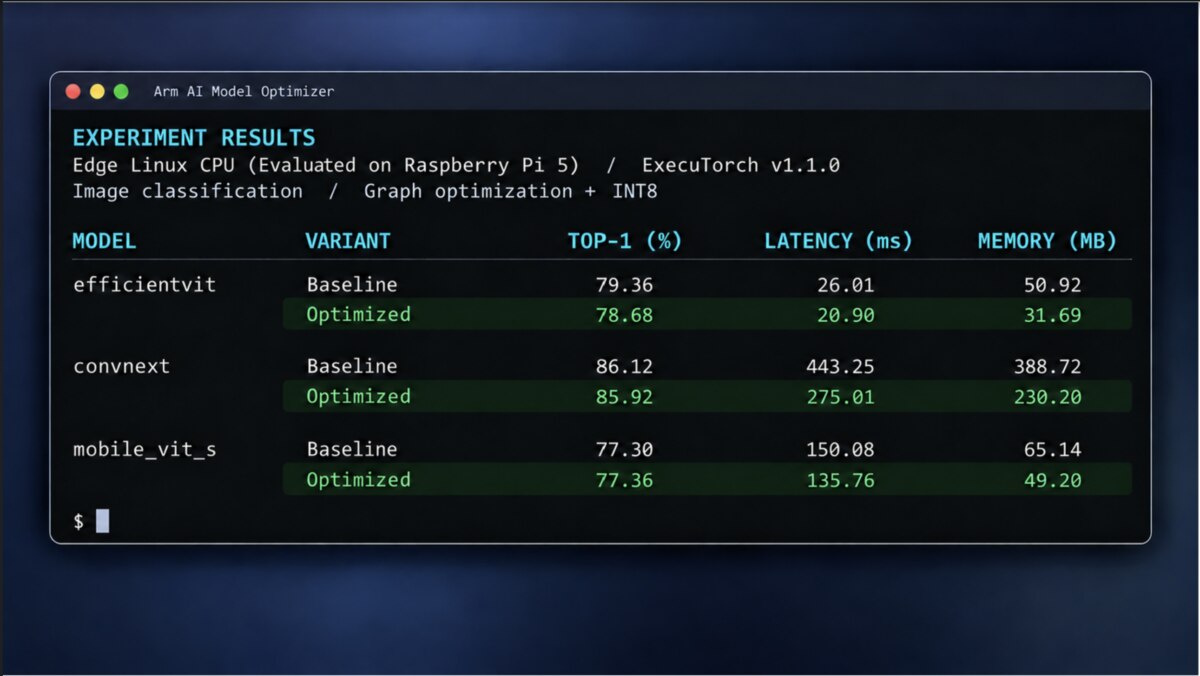
Early tests on a Raspberry Pi 5 showed up to 5.9x faster inference and 74% lower memory use for one image-classification model, with only a small reported change in accuracy. Available through an Early Access Program, the tooling gives developers a more systematic way to judge whether a model is ready for a specific Arm-based target.
Improving on-device AI performance and development with Google
Running AI efficiently on mobile devices requires both optimized software and tools that help developers understand how models perform on hardware. Bala Gattu, Senior Director, Software Platform Partnerships at Arm, explains how Arm and Google have collaborated to optimize Google’s ML Drift framework for Arm Mali GPUs, improving GPU inference through compute kernel, memory, and workgroup tuning.
Meanwhile, Charles Stokes, Product Manager at Arm, explores how Arm’s open-source adapters for Google AI Edge Model Explorer help developers visualize model transformations, inspect execution graphs and identify performance bottlenecks. Together, these collaborations with Google make it easier to develop, optimize and deploy AI workloads on Arm without managing as much hardware-specific complexity.
Arm and Tencent make neural image compression more practical on mobile
Neural image coding offers a way to reduce image file sizes without sacrificing visual quality, but the additional compute required for decoding can limit its usefulness on smartphones. Arm and Tencent Media Lab have been optimizing Tencent’s neural image decoder using SME2, reducing latency in a key decoder module from 61 ms to 30 ms for a 2K image on a reference smartphone using two CPU threads.
Jason Zhu, Principal Engineer, Jackie Lee, Solutions Architect, and Damien Dooley, Principal Software Engineer, along with Greyson Xu, Neo Zhang, and Yiming Li from Tencent Media Lab, explain how matrix acceleration and reduced data movement contribute to these improvements. The work brings more efficient image storage and sharing closer to everyday mobile use.
Elastic improves cloud search efficiency with Arm-based Azure instances
Search, indexing, and retrieval are increasingly important to AI applications, which in turn increase the demand for cloud infrastructure that can deliver more work per dollar. Elastic Cloud on Microsoft Azure now offers CPU-optimized instances powered by Arm-based Azure Cobalt processors, with Elastic reporting up to 44% better price-performance compared with the tested Fsv2 instances. The gains gives customers another option for scaling search services while managing infrastructure cost.
The connection between retrieval and AI infrastructure is explored further by Sameer Nori, Senior Manager Software Ecosystem at Arm, in this Arm Community article on vector databases. The article explains how Arm Neoverse platforms can support the retrieval workloads that provide relevant context to AI applications, helping developers balance performance, latency and efficiency as agentic systems grow.

Any re-use permitted for informational and non-commercial or personal use only.
Editorial Contact
Stay informed with Arm's top stories, insights, and conversations.



Latest on X

A shared language can help robotics innovation scale.
A Robotics Capability Framework creates a common foundation for describing, measuring and comparing intelligent robotic systems, helping reduce fragmentation across the ecosystem. Arm
Dermot O’Driscoll explains why shaping

Together with @Supermicro, we're advancing high-density, liquid-cooled AI infrastructure powered by Arm AGI CPUs, helping data centers scale compute while addressing the growing demands of agentic AI workloads. 💪

AI's rapid growth is putting the spotlight on data center infrastructure.
At @Theinformation's WTF Summit earlier this week, Arm CMO Ami Badani joined Nscale's Nidhi Chappell and The Information's Phoebe Liu to discuss the state of the AI data center buildout and what's next

A robot must think, react and act simultaneously, with AI models running at different speeds within one system.
The Arm compute platform supports diverse workloads across reasoning, perception and real-time control, helping developers scale physical AI.
At @Robo_Business,

Google's Gemini Robotics ER 2 is advancing how robots reason, plan and adapt.
At Arm, we're exploring these capabilities with @googlecloud to better understand future robotics compute needs, as part of our broader focus on scalable physical AI. https://okt.to/49w0SJ

Ready, player one? Neural Dawn is yours to explore! 📱
Co-developed by Arm and Sumo Digital, Neural Dawn is now available to download, bringing cinematic lighting, ray tracing and neural graphics to mobile gaming.
Powered by Arm Neural Technology and the Arm Mali G2-Ultra NX

2x performance per rack 🚀
That's what independent testing from Signal65 validates - demonstrating the performance of Arm AGI CPU for agentic AI workloads. Arm's Mohamed Awad shares why designing compute from the ground up delivers results.
https://okt.to/46TBdn