Scaling physical AI: Five takeaways from Moor Insights & Strategy
"This is an AI-powered audio summary and responses are AI-generated."

Physical AI is bringing intelligence into machines that operate in the real world, from industrial robots and autonomous vehicles to drones and intelligent equipment. These systems must process information, coordinate with other equipment, and support decisions and physical actions within demanding power, performance, and safety constraints.
A new Arm-commissioned research paper from Moor Insights & Strategy (MI&S) examines how shared robotics capabilities, integrated compute, and industry collaboration can help address these challenges. With physical AI estimated to become a $200 billion opportunity annually in 2030s, improving the economics of physical AI development is essential to realizing its potential. Here are five takeaways from the paper.
1. Physical AI needs a platform approach that embraces diversity
Physical AI systems combine processors, AI accelerators, sensors, software, and control technologies from multiple suppliers. These components must work together within the performance, power, timing, and safety constraints of each machine.
The challenge grows with the diversity of physical AI applications. An industrial robotic arm, autonomous vehicle, and a drone each have different computing requirements, physical designs, and operating environments. As a result, manufacturers often need to integrate, customize and validate technologies for individual products, repeating engineering work that increases costs and extends development timelines.
The research paper identifies a fundamental requirement for scaling physical AI: “To reach its market potential, physical AI needs a new kind of platform specification that embraces diversity.”
The opportunity is therefore establishing common computing foundations that can be reused across different applications to reduce engineering complexity, while giving manufacturers the flexibility to develop differentiated products.
2. A shared robotics language gives the industry common design targets
Although a delivery robot and cleaning robot may serve different purposes, both need to navigate their surroundings, detect obstacles, and respond to changing conditions. Today, manufacturers and suppliers often define and engineer these capabilities separately, which creates repeated integration work across products with similar requirements.
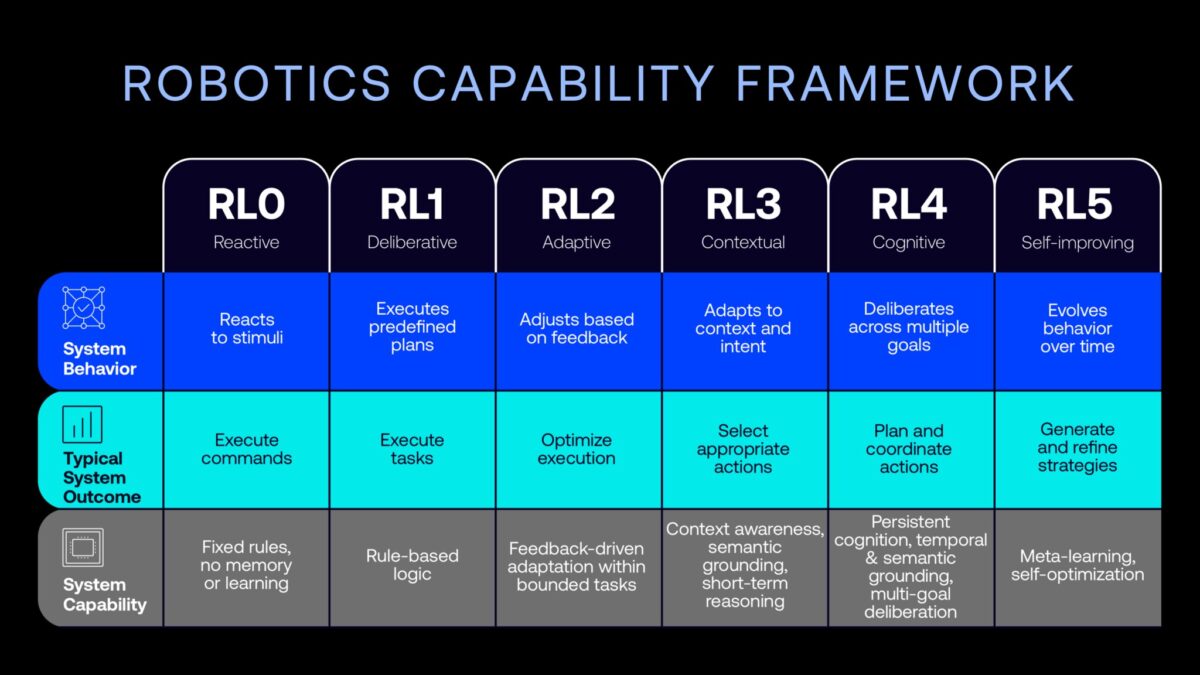
Moor Insights & Strategy highlights the practical value of shared engineering targets: “A common target minimizes the undifferentiated friction that constrains physical AI.”
A Robotics Capability Framework provides an initial, architecture-agnostic approach for describing robotic capabilities and their underlying system requirements. Developed with input from across the robotics industry, it establishes a starting pont that Arm is inviting the wider ecosystem to help evolve. By mapping the capabilities required at each level, manufacturers can create profiles that translate physical AI functions into clearer engineering requirements for compute performance, memory, power, timing, and safety. This gives suppliers common targets to develop against, enabling greater technology reuse across different products and reducing repeated engineering work.
3. Physical AI depends on coordinated compute across the system
Physical AI brings together multiple computing functions with distinct requirements that must operate and work together in real time. Cameras feed image signal processors, GPUs handle vision data, application processors and AI accelerators support decision-making, and real-time processors coordinate sensing and movement.
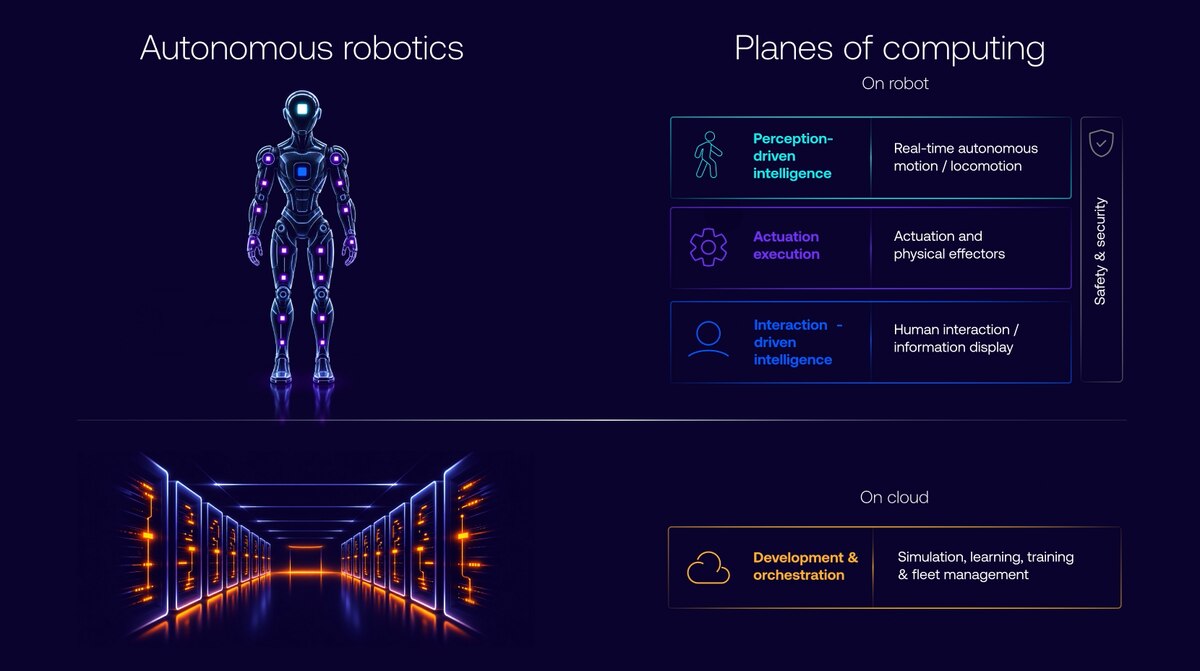
As explored in a recent blog, these technologies work together across three planes of computing in physical AI systems, connecting perception-driven intelligence and interaction-driven intelligence with physical actions. The challenge for system designers is coordinating these workloads reliably within the constraints of each machine.
The Arm compute platform spans these requirements for physical AI systems, from Arm CPUs for autonomous motion and interactions, to Arm Cortex-M and Cortex-R processors for real-time processing, control, and actuation.
This also extends into the cloud infrastructure supporting physical AI development. Arm-based CPUs, including NVIDIA Grace and Arm Neoverse-based cloud platforms, support AI model training and simulation. This gives the ecosystem a compute platform spanning intelligent machines and the infrastructure used to develop and improve their AI capabilities.
4. Pre-integrated compute and virtual development reduces engineering effort
Supporting different planes of computing also creates integration challenges. Processors, AI accelerators, memory systems, security technologies, and software must operate together, often with different performance and timing requirements.
Arm Compute Subsystems (CSS) help address this complexity through pre-integrated and pre-validated technology. For autonomous vehicles and robotics, Arm Zena CSS combines application processing, real-time safety capabilities, security, and supporting system IP into a configurable subsystem. Semiconductor partners can adapt this foundation to different product requirements.
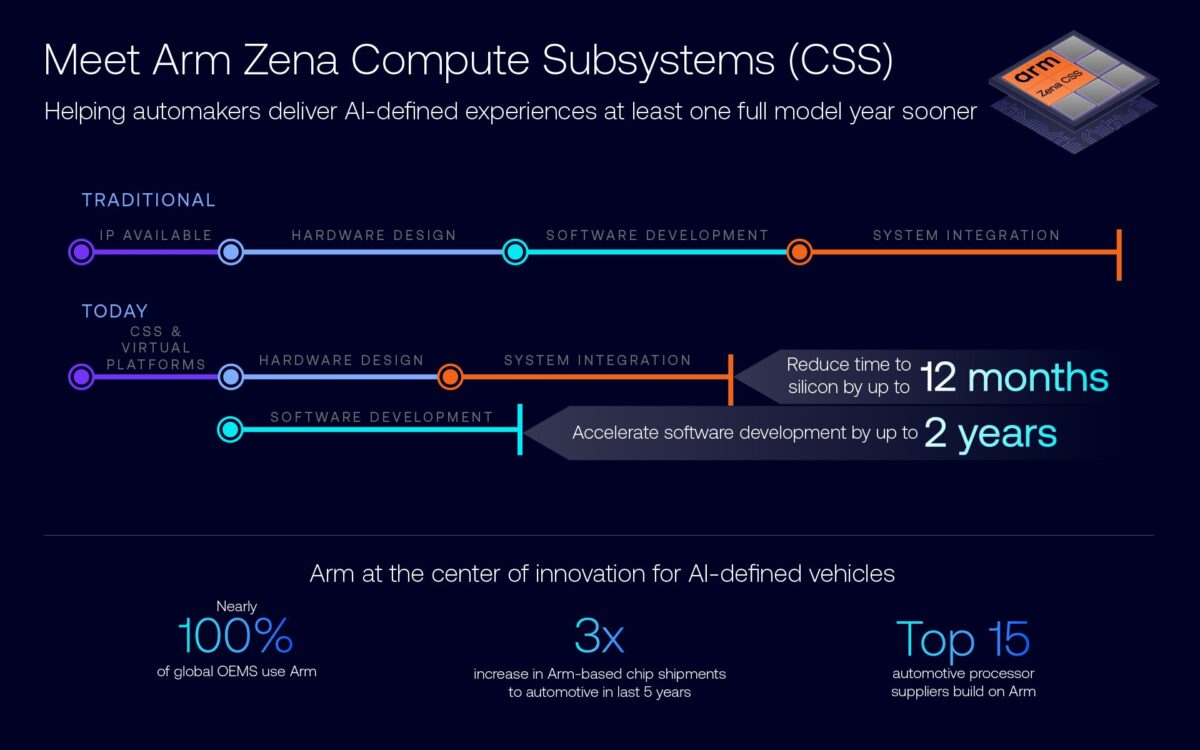
Also with Arm Zena CSS-based virtual platforms, software teams can begin development, integration, and testing before physical silicon becomes available. This enables teams to identify and resolve issues earlier, reducing their dependence on physical hardware and helping accelerate the path to deployment.
The research paper points to a broader shift in how the industry develops technology: “Hardware no longer marks the beginning of software integration; it confirms software readiness for production.”
5. Ecosystem collaboration creates the foundation for scalable physical AI value chains
Today, manufacturers often work with suppliers to develop components based around individual product specifications. Establishing common capability requirements across the ecosystem could give suppliers clearer targets and allow them to serve multiple customers with reusable technologies, while still providing the flexibility that manufacturers need to differentiate their products.
The research paper captures the potential of this approach: “When many companies build to the same capability definitions, the whole industry begins to think in terms of reusable components.”
Arm Total Design for Physical AI brings together companies working across silicon, AI models, software, sensors, virtual platforms, and system integration to address these shared development challenges and support collaboration on integrated solutions. This could help create a more scalable physical AI supply chain, reducing development complexity and accelerating the adoption of intelligent machines across different industries.
Hear from our ecosystem partners in the video below about why they’re supporting Arm Total Design for Physical AI and the role they believe collaboration will play in accelerating the future of intelligent robotics and autonomous systems.
Building the foundations for physical AI at scale
The research paper points to a practical path forward for physical AI: establish shared robotic capabilities, build compute foundations that support different system requirements, and bring the ecosystem together to reduce complexity and accelerate innovation.
Arm is enabling this shift by providing the compute platform and ecosystem collaboration needed to develop reusable technologies that can be adopted across different products without re-engineering the same underlying systems.
As the paper concludes: “The value chain that forms around this new kind of platform can turn a $200 billion opportunity into a $200 billion market.”
Explore the full research on scaling physcal AI
Shared robotic capabilities, integrated compute, and a new industry value chains are helping physical AI reach a commercial scale.

Any re-use permitted for informational and non-commercial or personal use only.
Editorial Contact
Stay informed with Arm's top stories, insights, and conversations.



Latest on X

New @Signal_65 research highlights the performance gains of Arm-based @Microsoft Azure Cobalt 200 over Cobalt 100, both per core and per instance.
With nearly 2x the agentic AI function-calling throughput in Signal65 testing and over 5x the chip-design simulation throughput in
Arm CEO Rene Haas has affirmed his long-term commitment to leading Arm through its next phase of growth, supported by a new agreement extending through 2033.
He will also assume the role of Vice Chairman of SoftBank Group, effective December 1, 2026. https://okt.to/y2oCXP

AI can produce an answer in seconds. Building intelligent systems people can trust takes deeper understanding.
As AI moves into robots, vehicles and intelligent machines, safety and security must be designed in from the start.
At Arm, this is central to building trusted

How do robots turn AI decisions into precise movement? 🤖
Physical AI relies on three interconnected planes of computing: perception, interaction and actuation.
Arm's compute platform spans AI processing and real-time control. Together with @ST_World, we're advancing embedded

Arm CEO Rene Haas joins @TomorrowXSummit on Wednesday, November 18, for a fireside chat exploring the future of AI and the trends shaping the technology industry.
Tune in at 10:10am to hear his perspective. #tomorrowXsummit

Exciting news today coming out of #MSIgnite - @Microsoft Azure Cobalt 200 is now generally available! 🎉
This is a great example of what's possible when we innovate together, bringing the next generation of Arm-based cloud compute to customers.
https://okt.to/JvWQPy

Arm-powered @Microsoft Azure Cobalt 200 is accelerating cloud and agentic AI workloads. 🚀
Built on Arm Neoverse CSS V3, Cobalt 200 delivers significant performance gains across databases, web infrastructure, and AI applications.
Together we're advancing the performance and