Why wearables are the next frontier of AI-first personal computing

From Snap’s SPECS smart glasses to Meta’s expanding wearable portfolio, including its Ray-Ban smart glasses and Muse Charm, there are a new generation of devices designed to make AI more personal, contextual, and accessible throughout the day.
Rather than reaching for a smartphone, opening an app or typing a prompt, people will increasingly interact with AI through natural conversation, gestures, and devices that understand more about their surroundings.
But making these experiences a reality presents a fundamental computing challenge: delivering sophisticated AI on devices that are small, lightweight and efficient enough to wear all day. This is where Arm has an important role to play.
AI is changing the wearable computing experience
Smart glasses are one of the clearest examples of how AI is reshaping personal computing.
The ambition is to deliver useful intelligence in devices that people wear throughout the day. These intelligent experiences could mean understanding what someone is looking at, translating conversations, providing contextual information, or helping them interact more naturally with the world around them.
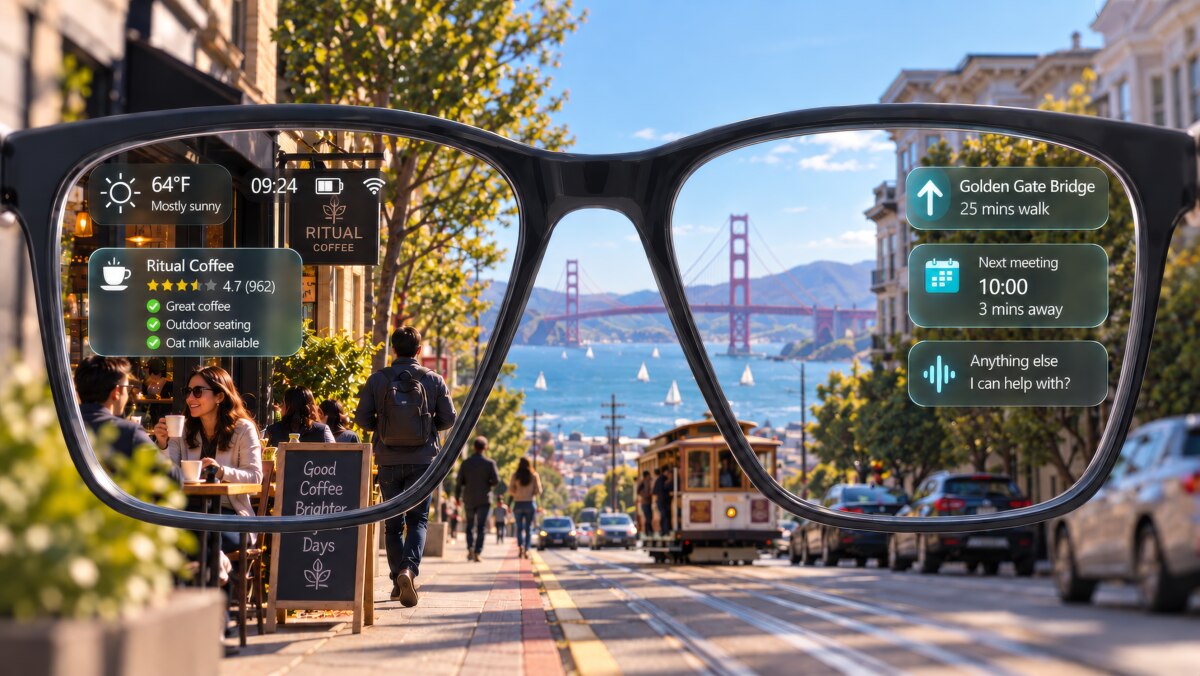
Underneath these experiences is a complex combination of computing workloads. For example, smart glasses must process sensor information, understand voice commands, interpret visual context, run AI models, render graphics, and communicate with connected devices. All of this must happen within exceptionally tight power, thermal, battery, weight, and size constraints.
Unlike smartphones or laptops, smart glasses have little room for larger batteries or additional cooling. Increasing compute performance can enable more sophisticated experiences, but also increases the potential for heat, weight and reduced battery life. For wearables, power efficiency isn’t simply a technical specification; it directly determines how useful, comfortable and capable the device can be.
The right compute, in the right place
Delivering all-day AI experiences also requires a fundamental rethink of where intelligence runs. Some workloads benefit from running directly on the wearable device, with processing sensor data, tracking movement, recognizing gestures, and interpreting the surrounding environment requiring immediate responses. Local processing also reduces latency, improves privacy, and allows certain capabilities to continue when connectivity is limited.
Everysight’s smart glasses demonstrate this on-device AI approach. Using the Alif E4 platform with Arm Ethos-U85 NPU, they support local eye-tracking inference, reducing the need to transfer raw sensor data to a connected smartphone, while meeting the device’s strict power and form factor requirements.
Other workloads, such as more complex reasoning or information retrieval, may benefit from the greater processing capabilities of a connected smartphone or cloud infrastructure. The opportunity is to bring these environments together.
This means wearables, smartphones and cloud infrastructure are increasingly operating as one system through hybrid intelligence, with AI workloads running wherever they deliver the best balance of performance, responsiveness, privacy, and efficiency. The Arm compute platform spans cloud to edge, enabling AI workloads to run where they can deliver the best balance of performance, responsiveness, and efficiency to bring intelligent wearable experiences to life.
Arm is the foundation for AI-first wearables
Arm technology already provides the computing foundation for an estimated 99 percent of smart glasses, reflecting its established position across the wearable ecosystem.
Arm CPUs deliver efficient processing across a range of performance requirements, while Arm Mali GPUs support graphics and display experiences. Arm Ethos-U NPUs enable efficient on-device AI capabilities, including object detection, speech and gesture recognition as well as contextual awareness.
Alongside these technologies, Arm’s common architecture and software ecosystem help silicon and device manufacturers develop differentiated products while benefiting from established development tools and software expertise.
Crucially, Arm’s architecture extends beyond wearables, spanning billions of smartphones and connected devices, an expanding PC ecosystem, and cloud infrastructure.
As AI becomes more distributed, this common compute foundation gives partners greater flexibility to build connected experiences across different devices and computing environments.
Making all-day intelligent wearables a reality
We’re still early in the evolution of AI-first wearables, but the pace of innovation across smart glasses and emerging form factors offers a clear indication of where personal computing is heading.
The opportunity goes beyond putting more AI into smart glasses, earbuds or other wearable devices; it’s about making intelligence a natural part of everyday life: responsive enough to feel immediate, efficient enough to last all day, and useful enough to become indispensable.
Arm is providing the efficient, scalable, and secure compute foundation to help make that future possible.

Any re-use permitted for informational and non-commercial or personal use only.
Editorial Contact
Stay informed with Arm's top stories, insights, and conversations.



Latest on X

Google's Gemini Robotics ER 2 is advancing how robots reason, plan and adapt.
At Arm, we're exploring these capabilities with @googlecloud to better understand future robotics compute needs, as part of our broader focus on scalable physical AI. https://okt.to/49w0SJ

Ready, player one? Neural Dawn is yours to explore! 📱
Co-developed by Arm and Sumo Digital, Neural Dawn is now available to download, bringing cinematic lighting, ray tracing and neural graphics to mobile gaming.
Powered by Arm Neural Technology and the Arm Mali G2-Ultra NX

2x performance per rack 🚀
That's what independent testing from Signal65 validates - demonstrating the performance of Arm AGI CPU for agentic AI workloads. Arm's Mohamed Awad shares why designing compute from the ground up delivers results.
https://okt.to/46TBdn

Physical AI moves faster when the ecosystem builds together.
Arm Total Design for Physical AI brings silicon, software, safety, security, validation, and more into one collaborative ecosystem to help build, validate, and scale full-stack solutions on Arm.
Hear from Dermot

2x performance per rack 🚀
That's what independent testing from @Signal_65 validates - demonstrating the performance of Arm AGI CPU for agentic AI workloads. Arm's Mohamed Awad shares why designing compute from the ground up delivers results.
https://okt.to/j7QEFR

More high-performance compute options are coming to the cloud! 🎉
Together with @OracleCloud, we're bringing Arm AGI CPU to OCI, providing support for everything from general-purpose cloud workloads to agentic AI.
https://okt.to/6lUg5t

Touch, voice and AI are changing how we interact with PCs.
With Arm's compute platform spanning smartphones, PCs and the cloud, the foundation is in place for more intelligent experiences across devices.
More from @ctbergey. 👇
What would SJ think? My first thought this morning as I saw @Apple bring touch to their @Arm powered MacBook.
But the more I thought about it, the more I believe that Steve Jobs would have been obsessed about where Mac could go, so I decided to write my own thoughts on the