As AI and HPC converge, Arm is enabling a new generation of supercomputers
"This is an AI-powered audio summary and responses are AI-generated."
This blog was written by Koray Ozkal, Senior Product Marketing Manager, Cloud AI, Arm, and Conrad Hillairet, Principal HPC Engineer, Ecosystem & Partner Engagement, Arm.
High-performance computing (HPC) is undergoing a transformation. Scientific simulations that have traditionally defined supercomputing are increasingly being combined with AI training, inference and AI-assisted research, creating new demands on the processors, memory systems and accelerators at the heart of the world’s most powerful machines.
Meeting these demands requires more than simply adding computing capacity. Supercomputer designers must balance performance, power efficiency, memory bandwidth, and data movement while supporting an increasingly diverse range of scientific and AI workloads, all within tighter power budgets.
This is creating new opportunities for architectural innovation. Rather than pursuing a single approach to high-performance computing, organizations are developing specialized systems that combine CPUs, GPUs, and other technologies to meet their particular requirements.
Arm provides a common computing foundation for many of these approaches, enabling partners to develop differentiated HPC platforms while drawing on a mature and growing software ecosystem.
Arm continues to lead in TOP500 and Green500 rankings
The latest TOP500 and Green500 rankings demonstrate Arm’s established role in high-performance and energy-efficient supercomputing. Arm retains the #1 position in both rankings following the June 2026 results, with the Arm compute platform featuring in four of the world’s 10 fastest supercomputers and powering the four most power-efficient systems.
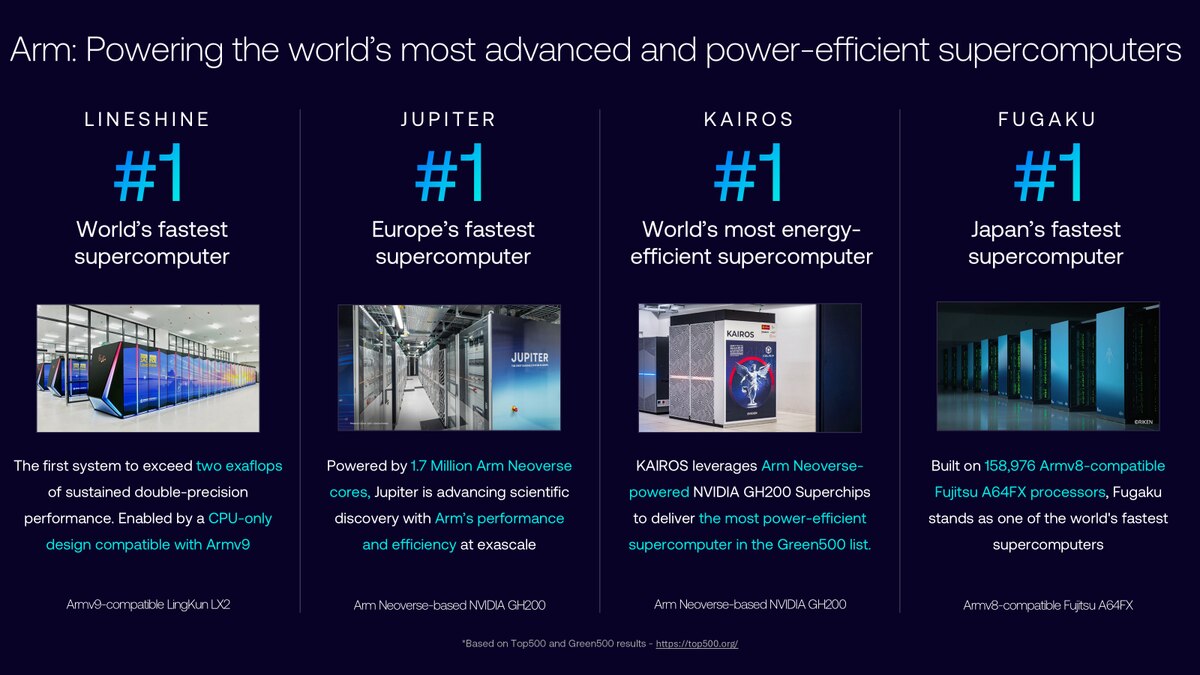
LineShine, the world’s fastest supercomputer in both the June and November 2026 TOP500 rankings, features Arm-compatible custom processors and is the first system to exceed two exaflops of sustained double-precision performance using a CPU-only design.
JUPITER, Europe’s first exascale supercomputer, continues to showcase the scale of Arm-based computing. Built on Bull’s BullSequana XH3000 liquid-cooled architecture and powered by Arm Neoverse-based NVIDIA Grace Hopper Superchips, JUPITER combines high-performance computing and AI capabilities to support demanding scientific and industrial workloads.
JUPITER also remains the world’s most power-efficient exascale supercomputer and has allocated computing time to more than 500 national and international research projects.
Fujitsu’s Fugaku remains among the world’s leading supercomputers, demonstrating the continued importance of the Arm compute platform in large-scale scientific computing.
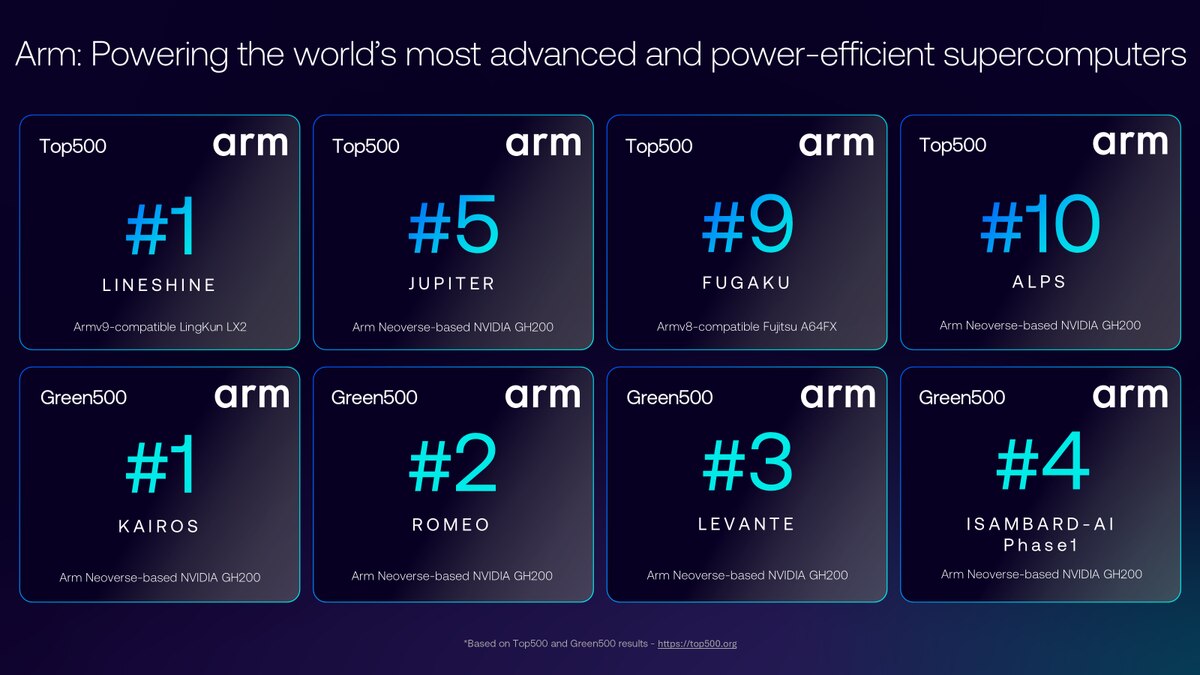
Arm’s role in power efficiency remains equally important. In the new Green500 rankings, Neoverse-based NVIDIA Grace Hopper systems continue to claim the top four positions, with KAIROS, ROMEO, Levante and Isambard-AI Phase 1 leading the rankings. Overall, five of the top 10 and 14 of the top 30 most power-efficient supercomputers feature the Arm compute platform.
The TOP500 and Green500 results also reflect the breadth of the Arm HPC ecosystem, with different system architectures and designs addressing a wide range of computational performance and power efficiency requirements.
Different architectural approaches, a common compute foundation
Beyond the TOP500 and Green500 rankings, developments across the Arm ecosystem highlighted around Supercomputing 2026 (SC26) point to an equally important story: how supercomputing is evolving to meet the demands of AI-driven scientific discovery. Recent milestones across the Arm HPC ecosystem illustrate how partners are taking different approaches to processor design, memory architecture and accelerator integration to address the evolving requirements of scientific computing and AI.
SiPearl advances European HPC innovation with Neoverse
SiPearl has reached a significant milestone in the development of its Rhea1 processor, delivering the first CPU samples to Bull for integration into the JUPITER supercomputer.
Built on Neoverse technology, Rhea1 features 80 cores and high-bandwidth memory designed to support demanding HPC workloads. The milestone represents significant progress toward bringing European-designed processors into production across supercomputing environments.
SiPearl will also use Arm Neoverse V3 technology in Rhea2, its second-generation CPU designed for HPC, AI, cloud and data centers.
Fujitsu advances the next generation of Arm platform-based supercomputing
Building on the success of Fugaku, Fujitsu continues to advance its Arm-based processor roadmap with FUJITSU-MONAKA and MONAKA-X.
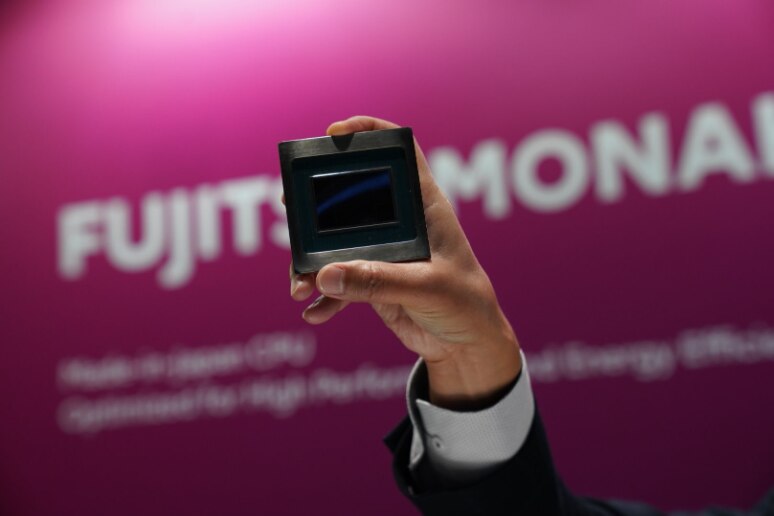
Designed to deliver high performance and power efficiency, MONAKA represents the next generation of Fujitsu’s Arm platform-based processors. Fujitsu has also outlined plans for MONAKA-powered servers, extending the technology into HPC, AI and general-purpose computing environments.
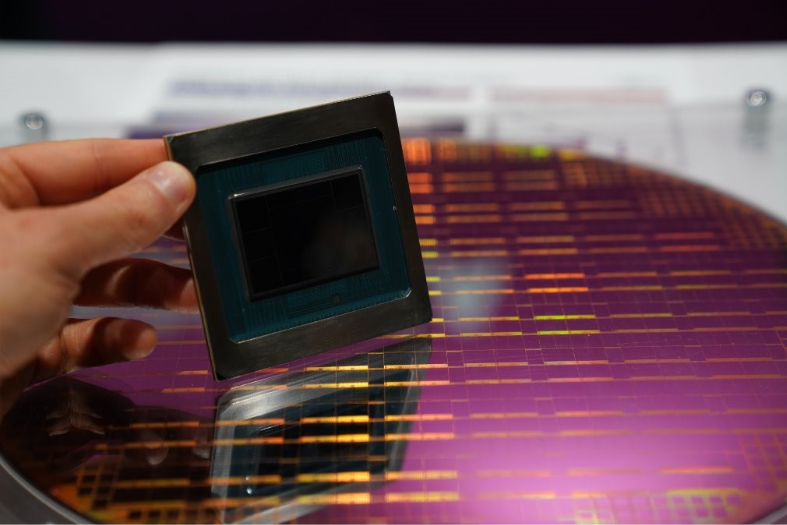
Looking farther ahead, MONAKA-X is being developed as part of Fujitsu’s next-generation AI-HPC roadmap, building on the Arm compute platform and contributing to FugakuNEXT. Led by RIKEN in collaboration with Fujitsu, FugakuNEXT aims to combine advanced Arm platform-based CPU technology with GPU acceleration to support the convergence of scientific simulation and AI.
Advancing scientific computing with NVIDIA’s Arm-based CPU innovation
Arm continues to play an important role in NVIDIA’s accelerated computing platforms, from Neoverse-based Grace CPUs powering systems such as JUPITER and Isambard-AI to the next generation of Arm-compatible Vera-based supercomputers.
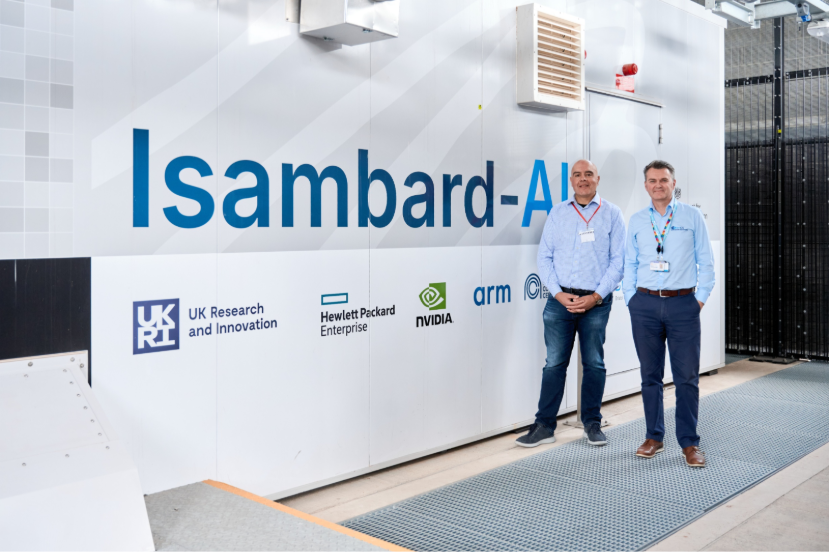
Powered by Neoverse-based NVIDIA Grace Hopper technology, Isambard-AI supported approximately 1,000 research projects and more than 4,000 users in its first year, with new plans announced in October to connect the system with Jean Zay and Adastra supercomputers in France for cross-border AI research.
In the United States, the Texas Advanced Computing Center (TACC) opened its Horizon supercomputer to early users during SC26. Powered by Arm Neoverse-based NVIDIA Grace Blackwell technology, Horizon ranks as the most powerful academic supercomputer in the U.S., with Arm-compatible NVIDIA Vera CPU servers planned for installation in early 2027.
NVIDIA has announced that its Vera Rubin platform will power several next-generation supercomputers, including Blue Lion at the Leibniz Supercomputing Centre, Doudna at Lawrence Berkeley National Laboratory’s NERSC and systems planned for Los Alamos National Laboratory. Built on the Arm compute platform, NVIDIA’s Vera CPU features custom-designed cores and represents another example of Arm’s architectural flexibility in supporting specialized computing platforms.
At SC26, NVIDIA also introduced its Vera CPU rack-scale platform for high-performance computing, extending the use of the Arm compute platform across scientific modeling and simulation workloads.
South Korea’s HANGANG makes a powerful TOP500 debut with Neoverse
South Korea’s sixth national supercomputer, HANGANG, featuring Neoverse-based NVIDIA Grace Hopper technology, was the highest-ranking new entrant in the November TOP500 at #12, achieving 342.6 petaflops of sustained HPL performance and ranking #8 in HPCG. The overall system includes 8,496 GPUs and 9,936 CPUs, delivering approximately 24 times the theoretical peak computing performance of its predecessor, Nurion, to support scientific research and AI.
Hardware flexibility backed by software maturity
The Arm compute platform gives partners the flexibility to optimize compute, memory and connectivity for different HPC workloads. High-bandwidth memory and tightly coupled CPU-GPU designs enable efficient data movement, while Arm Scalable Vector Extension (SVE) and Scalable Matrix Extension (SME) technologies, alongside optimized compilers and math libraries, help accelerate scientific calculations on processors supporting these capabilities.
This hardware flexibility is backed by a mature and growing Arm software ecosystem, including Arm Toolchain for Linux and Arm Performance Libraries. The widespread adoption of Arm-based platforms across cloud and enterprise environments has also contributed to a broad ecosystem of software optimized for Arm, including widely used HPC applications, frameworks, libraries and development tools. Together, these enable partners to optimize application performance, scalability and energy efficiency across HPC platforms.
Powering the future of supercomputing
As AI and HPC continue to converge, the next generation of supercomputers will need to support increasingly diverse workloads, from traditional scientific simulations to advanced AI models and AI-assisted research.
The momentum across the Arm partner ecosystem demonstrates how different approaches to system design are helping meet these evolving demands. With Arm providing the common compute foundation and a mature software ecosystem, partners have the flexibility to innovate and build the next generation of high-performance, power-efficient supercomputers that will accelerate scientific discovery.
Leading the way in HPC
Learn more about Arm’s work in high-performance computing and the growing Arm HPC ecosystem
Any re-use permitted for informational and non-commercial or personal use only.
Editorial Contact
Stay informed with Arm's top stories, insights, and conversations.


Latest on X

Want to know what's next for cloud performance, efficiency, and the future of AI?
Join Arm and @awscloud at #AWSreInvent for a night of darts, networking, and conversations with the Graviton community.
Space is limited ➡️ https://okt.to/54hPBs
📍 Flight Club, Las Vegas |

Physical AI represents an estimated $200B annual compute opportunity in the 2030s.
But fragmented development and integration costs remain barriers to scale.
See how Arm is helping address these challenges in new @MoorInsStrat research. https://okt.to/Qtp2eO

New @Signal_65 research highlights the performance gains of Arm-based @Microsoft Azure Cobalt 200 over Cobalt 100, both per core and per instance.
With nearly 2x the agentic AI function-calling throughput in Signal65 testing and over 5x the chip-design simulation throughput in
Arm CEO Rene Haas has affirmed his long-term commitment to leading Arm through its next phase of growth, supported by a new agreement extending through 2033.
He will also assume the role of Vice Chairman of SoftBank Group, effective December 1, 2026. https://okt.to/y2oCXP

AI can produce an answer in seconds. Building intelligent systems people can trust takes deeper understanding.
As AI moves into robots, vehicles and intelligent machines, safety and security must be designed in from the start.
At Arm, this is central to building trusted

How do robots turn AI decisions into precise movement? 🤖
Physical AI relies on three interconnected planes of computing: perception, interaction and actuation.
Arm's compute platform spans AI processing and real-time control. Together with @ST_World, we're advancing embedded

Arm CEO Rene Haas joins @TomorrowXSummit on Wednesday, November 18, for a fireside chat exploring the future of AI and the trends shaping the technology industry.
Tune in at 10:10am to hear his perspective. #tomorrowXsummit