Arm at NeurIPS 2025: How AI research is shaping the future of intelligent computing

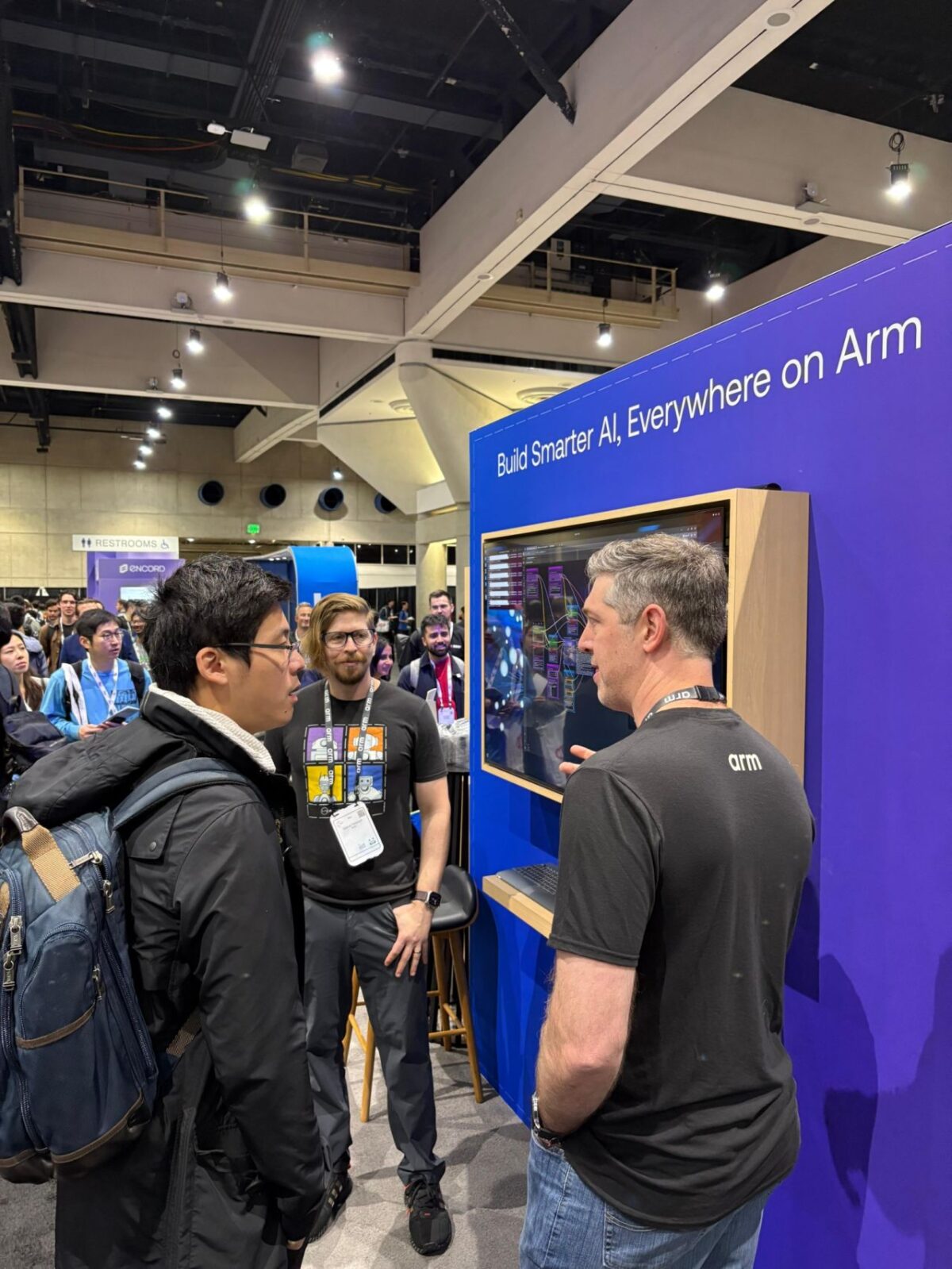
NeurIPS (Conference on Neural Information Processing Systems) is one of the world’s leading AI research conferences, acting as a thriving global hub for the latest breakthroughs and discussions around machine learning (ML), deep learning, and AI research. With AI moving rapidly from models to full systems – spanning reasoning, multimodality, physical intelligence, and highly efficient training and inference – Arm was present at NeurIPS 2025 (2-7 December) to showcase our forward-looking technologies, while exchanging the latest trends and insights with the global AI research community.
For Arm, the event is not just an opportunity to highlight the strength of the Arm compute platform; it’s a two-way conversation about the future of AI.
What were the key AI research trends at NeurIPS 2025?
NeurIPS 2025 made one thing clear: the industry is moving toward architectural efficiency, theoretical grounding, and stability as the foundation of AI innovation. In fact, efficient compute, memory patterns, and architectural flexibility will matter more than the race to over trillion-parameters of AI compute.
A range of technical papers at the event underscored this shift, with insights around foundational AI models, generative systems, and training dynamics, to name a few. These reinforced a broader theme that emerged across NeurIPS 2025: AI’s next wave of progress will come not just from scaling, but from better understanding, smarter engineering, and tighter system-level design.
Just some of the award-winning papers showcased at the event included:
- Understanding model homogeneity and the “Artificial Hivemind” effect, with one of the Best Paper award winners, ‘Artificial Hivemind’ by Jiang et al., revealing a striking pattern of intra- and inter-model homogeneity showing that models not only repeat their own ideas, but also increasingly converge on similar outputs across different architectures due to shared training data and alignment techniques. This challenges assumptions about model diversity and raises questions about the true independence of model ensembles, with the authors introducing a dataset and evaluation framework to help diagnose and mitigate these effects. This could be an important step towards more varied and robust generative AI systems.
- Gated attention Improves large language model (LLM) stability and scaling, with another Best Paper, ‘Gated Attention for LLMs’ by Qiu et al., demonstrating that adding a simple, head-specific sigmoid gate to the attention mechanism can meaningfully improve training stability, mitigate activation spikes, and deliver better scaling behavior across both dense and “Mixture-of-Experts” models. The approach outperforms standard SoftMax attention in large-scale experiments spanning 400B to 3.5T tokens, and also enhances the models’ ability to handle extended context lengths. This supports a broader trend that incremental architectural refinements can meaningfully boost LLM efficiency and capability without requiring larger model sizes.
- Why diffusion models generalize without memorization, with Bonnaire et al.’s Best Paper on diffusion models showing that diffusion models naturally undergo two predictable training phases: an early generalization phase independent of dataset size, and a later memorization phase that grows linearly with the amount of data. This discovery provides the clearest explanation to date for why diffusion models avoid memorizing their training sets, and establishes a rigorous foundation for designing more reliable and privacy-preserving generative systems.
Why NeurIPS matters for Arm
Arm’s focus in AI research broadly centers around enabling efficient, scalable, and trustworthy AI across cloud, edge, and physical computing. This aligns closely with future trends identified across the Arm ecosystem, covering thousands of technology partners and over 22 million developers.

NeurIPS offered the perfect opportunity for Arm to have a range of conversations with academic and research partners, including Graphcore Research and leading academic institutions like Carnegie Mellon University (CMU). This included discussions about the AI breakthroughs that are likely to define the next generation of technologies, with several being frequently referenced:
- Small language models (SLMs) that are shrinking in size while growing in compute capabilities. These are supported by breakthroughs in distillation, compression and new architectural features that enable SLMs to deliver reasoning capabilities at a fraction of the compute, while running on-device with low latency and high privacy.
- World models that will transform physical AI – from robotics to autonomous machines –through allowing developers and engineers to construct rich virtual environments that can predict and simulate how their AI models and workloads will perform in the real-world before deployment. These world models are enabled by advances in video generation, diffusion-transformer hybrids, and high-fidelity simulation.
- Ultra-efficient AI model training, with “reasoning per joule” emerging as a key benchmark to measure training efficiency. This is likely to lead to model distillation, like FP8 precision, becoming the standard across the industry.
- The rising use of agentic AI and reinforcement learning, with AI evolving from an assistant to autonomous systems that perceive, reason, and act with limited oversight.
Engaging directly with the AI research community helps Arm to hone the research strategy as well as our future technologies, from optimizing performance and efficiency benefits to adding new features that will be important to our ecosystem in the next decade, and even beyond. Two great recent examples include Arm neural technology – which adds dedicated neural accelerators to future Arm GPUs for PC-quality, AI-powered graphics on mobile – and Arm Scalable Matrix Extension 2 (SME2) – which accelerates matrix heavy workloads that are essential for computer vision (CV) and generative AI directly on the CPU. While both are recent releases, these technologies were years in the making, with Arm’s architecture, engineering and research teams realizing their value even before the rapid acceleration of AI-based compute.
Why Arm is the right partner for the AI research community
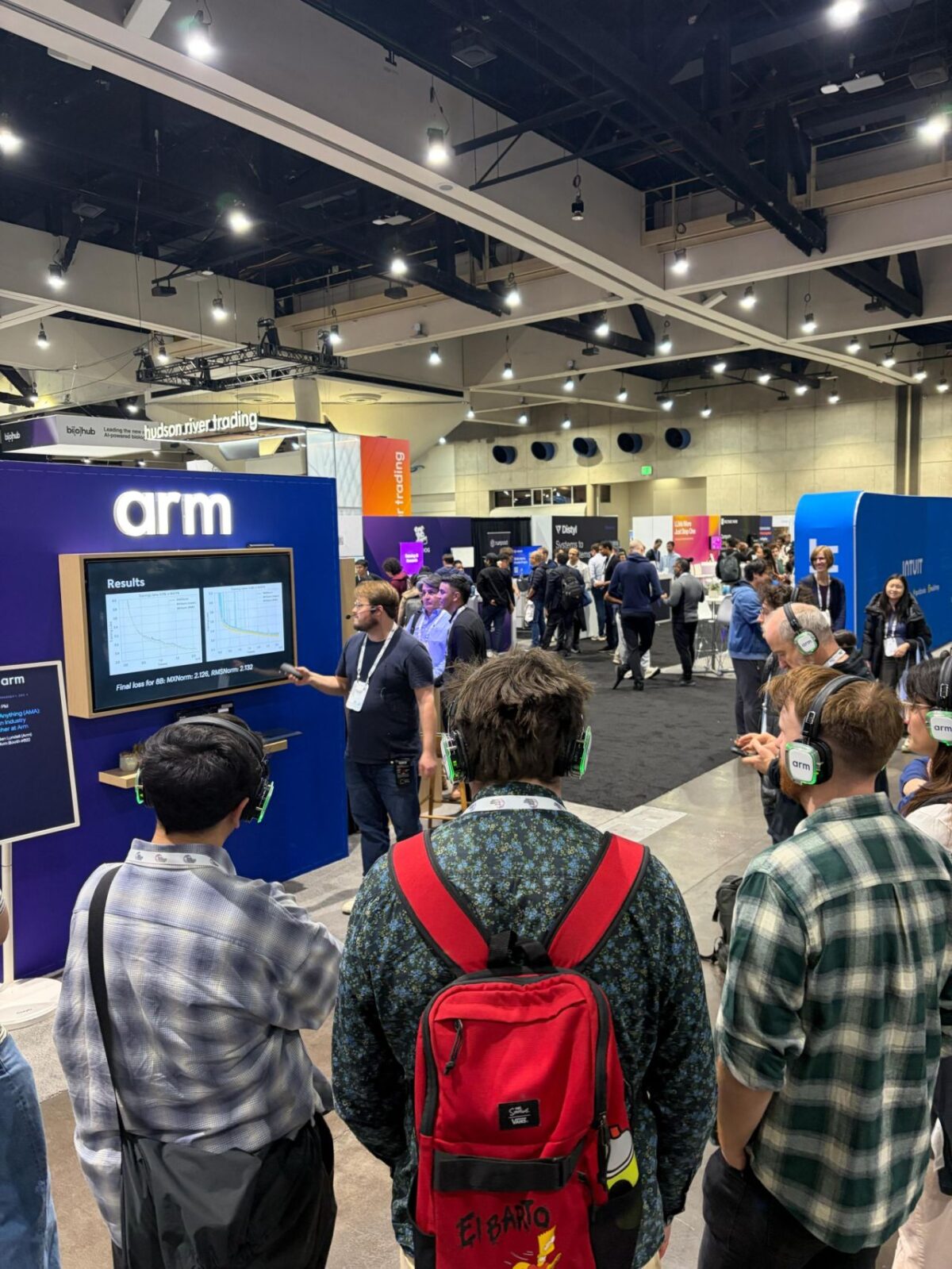
NeurIPS 2025 signaled a shift from raw scale and power to AI that is more intelligent, efficient and responsible. Arm is committed to supporting this future direction through deep collaboration with the global research community, sharing insights, advancing state-of-the-art compute, and building the foundations for sustainable, scalable AI. Whether you’re an AI researcher, data scientist, or developer, Arm wants to talk with you and explore how we can work together to enable efficient, scalable, smarter AI for everyone.
Frequently asked questions
Q: What is NeurIPS 2025?
A: NeurIPS 2025 is the 39th annual Neural Information Processing Systems conference, which brings together researchers and industry experts to showcase the latest in AI research and systems innovation.
Q: What were the major AI research themes at NeurIPS 2025?
A: Key themes included architectural efficiency, generative systems, foundational AI models, reasoning capabilities, and stable system-level design.
Q: Why does Arm participate in NeurIPS?
A: Arm engages with global research community to exchange insights, refine future research strategies, and align its compute platform roadmap with emerging trends in efficient and scalable AI.

Any re-use permitted for informational and non-commercial or personal use only.
Editorial Contact
Stay informed with Arm's top stories, insights, and conversations.



Latest on X

What does it take to accurately benchmark CPU performance for agentic AI?
Our white paper, developed in collaboration with @Meta, @fujitsulabs, and @OpenAI, explores a framework for measuring CPU performance across representative agentic AI workloads and the broader software

F1 pit stops 🤝 Safer patient handovers. Who would've thought?
@GreatOrmondSt took inspiration from pit crews to improve patient handovers.
As Arm technology helps @AstonMartinF1 deliver their fastest pit stops, it gets us thinking: where else could advances in physical AI make
From server-level performance to rack-level impact.
Independent testing from @Signal_65 highlights how Arm AGI CPU performs across key agentic AI workloads, demonstrating the importance of CPU performance as AI infrastructure scales.
Take a closer look:



Agentic AI is redefining what CPUs need to deliver.
@modal's early benchmarks show @NVIDIA Vera, built on Arm, delivering up to 2x the throughput of comparable x86 systems under heavy concurrency.
It's a powerful validation of Arm's role in scaling the next generation of AI
Goodbye to the #OCPGlobalSummit2026 👋
One thing was clear throughout the week: building infrastructure for the agentic AI era requires innovation across the entire system, from silicon to rack.
It was great to see the OCP community come together to advance this vision, with



Different companies. Different terminology. One increasingly complex robotics ecosystem.
A Robotics Capability Framework creates a shared language to help reduce fragmentation, simplify integration and accelerate adoption.
Hear from @AnaxiLabs, @McKinsey and @Lenovo on why

From first lines of code to millions of young creators! 💻
From Arm technology in the original device to collaborations with @UNICEFinnovate supporting digital and AI skills, swipe through to see what our partnership with micro:bit has made possible. 👇https://okt.to/nW3fp5