Arm and UNICEF launch AI in Play to expand access to AI innovation

Artificial intelligence (AI) is already reshaping the systems that young people and communities rely on, from education and healthcare to climate resilience. Yet as AI adoption accelerates, access to the tools, data, and expertise needed to build AI systems remains uneven. Without broader access, existing digital divides risk widening.
The challenge is not simply whether AI will play a role in our future, but how it is designed, who gets to build it, and whether its benefits reach those who need them most.
This week, UNICEF announced AI in Play, a new initiative co-designed with Arm, to accelerate practical AI-based solutions for children and communities in emerging economies.
AI in Play marks the next phase of Arm and UNICEF’s decade-long partnership, with a shared ambition to help ensure AI is inclusive, ethical, and responsible, and designed to serve every young person. By enabling local innovators, educators, and communities and calling on other tech industry partners to join the initiative, AI in Play aims to broaden who participates in building the AI-powered future.
“The technology industry has a shared responsibility to help ensure the benefits of AI reach everyone,” said Charlotte Eaton, Chief People Officer, Arm. “With Arm technology powering billions of devices worldwide and UNICEF’s global reach to communities most in need, together we can help diverse innovators build AI solutions that improve children’s lives and equip the next generation with the skills to shape the future. We hope others across the industry will join us.”
“The decisions the tech industry makes about AI in the next four years will shape how a whole generation of children grow up, learn, and work,” said Kitty van der Heijden, UNICEF Deputy Executive Director of Partnerships. “Arm has shown what it looks like to make that decision with children in mind: a decade of joint work and an investment of expertise and resources to design AI in Play, an ecosystem open to the tech sector to join and play a critical and positive role in.”

What is AI in Play?
AI in Play brings together technology companies, entrepreneurs, governments, young people, and communities in a diverse ecosystem to co-create AI solutions that address real-world challenges in education, climate, and health and have the potential to scale.
By connecting proven programs, technology partners, and local innovators through a single open ecosystem, AI in Play aims to move promising AI-powered solutions from ideas and pilots to meaningful impact more quickly.
The initiative aims to:
- Reach 2.5 million children and communities across 12 countries
- Support 20 AI-powered ventures
- Equip 200,000 young people with foundational AI literacy skills
To achieve these goals, AI in Play will focus on:
- Building AI-powered solutions for health, education, and climate challenges
- Growing a more diverse community of AI builders and innovators so solutions reflect a wider range of perspectives
- Equipping young people with foundational AI skills to become the next generation of builders
- Mobilizing partners and investment to take promising AI solutions from pilot to scale
- Providing innovators with mentorship, tools, and access to relevant networks
- Advancing responsible AI practices and standards
- Supporting innovators from emerging economies

A decade of partnership
For the past 10 years, Arm and UNICEF have worked together to apply technology to real-world challenges facing children and communities, reaching more than 770,000 children across emerging economies.
Arm’s leadership in energy-efficient computing, combined with UNICEF’s deep experience working alongside governments and communities, provides a practical foundation for deploying AI in ways that can reach more people.
Recent initiatives from the partnership include:
- AI-enabled air-quality monitoring in schools in Lao People’s Democratic Republic, using real-time pollution data to help protect children’s health
- Bookbot, a virtual reading assistant supporting children in Colombia
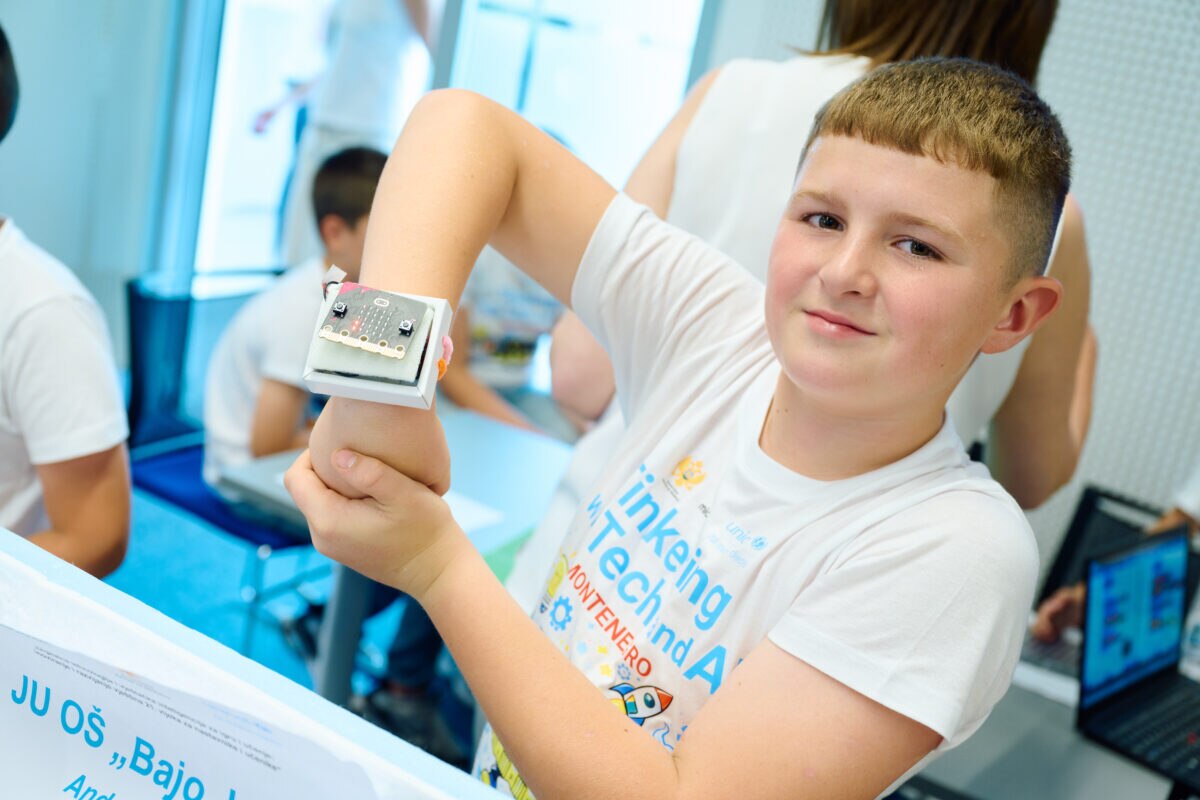
- Tinkering with Tech, an initiative designed to build AI literacy
Many solutions designed for emerging economies must work in places where connectivity is limited or inconsistent. Edge AI can help by processing data directly on devices rather than relying continuously on cloud infrastructure. This can enable faster, more reliable AI experiences in schools and communities where connectivity and access to technology may be constrained.
Building an AI future that includes everyone
AI in Play is designed as an open ecosystem, and Arm and UNICEF are calling on the wider technology industry to participate.
By bringing together technology, expertise, investment, and local knowledge, the initiative aims to ensure young people are not simply beneficiaries of the AI era, but have the opportunity to help shape it.

Any re-use permitted for informational and non-commercial or personal use only.
Editorial Contact
Stay informed with Arm's top stories, insights, and conversations.



Latest on X

What does it take to accurately benchmark CPU performance for agentic AI?
Our white paper, developed in collaboration with @Meta, @fujitsulabs, and @OpenAI, explores a framework for measuring CPU performance across representative agentic AI workloads and the broader software

F1 pit stops 🤝 Safer patient handovers. Who would've thought?
@GreatOrmondSt took inspiration from pit crews to improve patient handovers.
As Arm technology helps @AstonMartinF1 deliver their fastest pit stops, it gets us thinking: where else could advances in physical AI make
From server-level performance to rack-level impact.
Independent testing from @Signal_65 highlights how Arm AGI CPU performs across key agentic AI workloads, demonstrating the importance of CPU performance as AI infrastructure scales.
Take a closer look:




Agentic AI is redefining what CPUs need to deliver.
@modal's early benchmarks show @NVIDIA Vera, built on Arm, delivering up to 2x the throughput of comparable x86 systems under heavy concurrency.
It's a powerful validation of Arm's role in scaling the next generation of AI
Goodbye to the #OCPGlobalSummit2026 👋
One thing was clear throughout the week: building infrastructure for the agentic AI era requires innovation across the entire system, from silicon to rack.
It was great to see the OCP community come together to advance this vision, with



Different companies. Different terminology. One increasingly complex robotics ecosystem.
A Robotics Capability Framework creates a shared language to help reduce fragmentation, simplify integration and accelerate adoption.
Hear from @AnaxiLabs, @McKinsey and @Lenovo on why

From first lines of code to millions of young creators! 💻
From Arm technology in the original device to collaborations with @UNICEFinnovate supporting digital and AI skills, swipe through to see what our partnership with micro:bit has made possible. 👇https://okt.to/nW3fp5