Arm at Embedded World 2026: Powering intelligent edge AI systems at scale

Embedded systems are no longer limited to small, fixed-function models. They’re becoming intelligent, distributed endpoints that need to run responsive, real-time AI, while meeting strict power, thermal, security, and lifecycle constraints.
However, for most teams, the challenge isn’t chasing the latest model class; it’s reducing integration friction, reusing software across product lines, shipping products faster at scale, and delivering predictable real-time behavior even with limited connectivity. A platform approach that aligns silicon, software, and deployment makes all these practical. At its core are standardized Arm architectures paired with validated runtimes, reusable model libraries, and repeatable toolchains. Together, these provide a consistent, unified foundation that helps teams move from development to production faster, with more predictable performance and less rework.
At Embedded World 2026, Arm and its ecosystem showed how this unified foundation – spanning Armv9 CPUs, Ethos-U NPUs, secure software stacks, and ecosystem tooling – lets developers build once and scale across edge devices as embedded products evolve into intelligent systems.
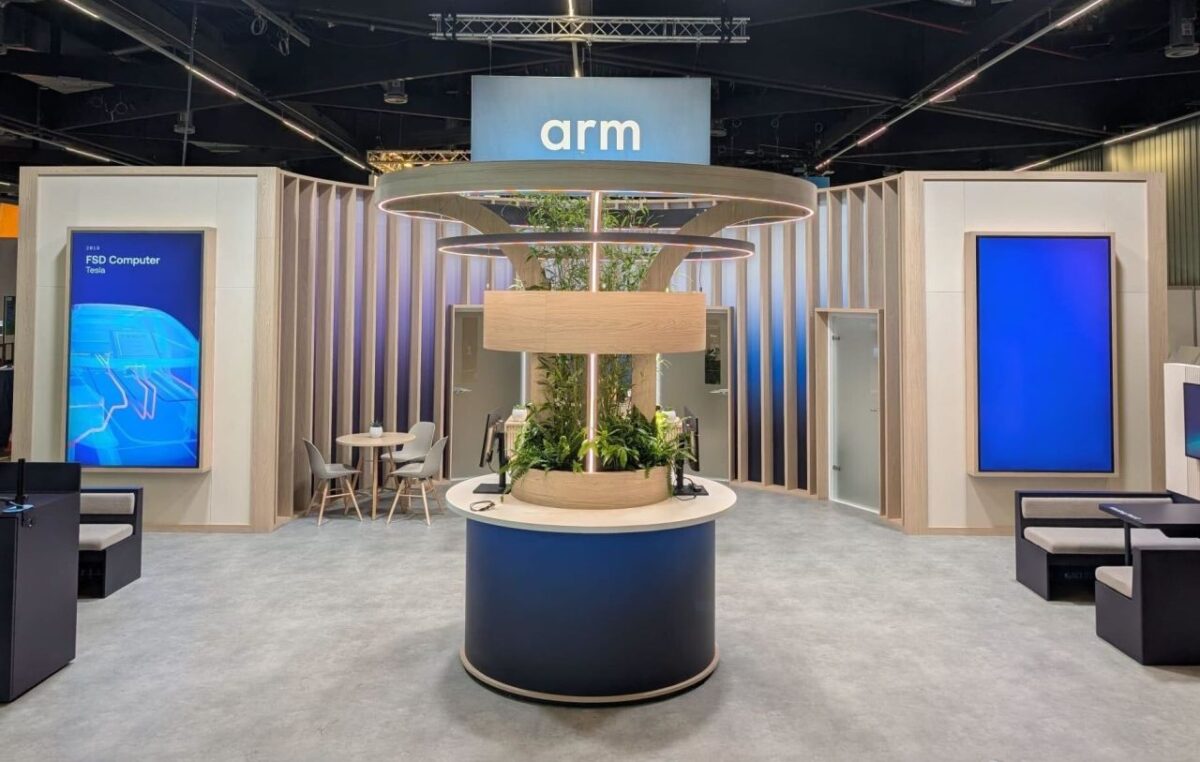
Inside the Arm booth: More compute, faster model deployment, and new edge AI experiences
Arm’s booth at Embedded World featured four demonstrations that brought this shift into focus, showing how more capable on-device intelligence can scale from collective agents to always-on experiences and faster model deployment.
Demo #1: AI-enabled edge devices discover and coordinate with each other
What visitors saw: Arm-powered robots, cameras, and industrial controllers discovering one another and forming a coordinated, distributed AI system. Powered by mimik’s device-native software, AI agents run locally on each device, share context, and coordinate actions in real time. If one device detects an event, others adapt their behavior immediately.
What it showed: Edge AI can move beyond isolated devices into collaborative systems that coordinate in real time. Meanwhile, distributed agents can operate without centralized gateways, sharing context and adapting locally while behaving as a unified system.
Real-world impact: In production environments, this level of coordination reduces reliance on central gateways and cloud connectivity, leading to faster response times, fewer single points of failure, lower bandwidth costs, and better privacy. This approach can be applied to physical AI deployments, like robotics fleets, to improve responsiveness, resilience, and autonomy.
Demo #2: Always-on voice within embedded power budgets
What visitors saw: A low-power device continually listening for a wake word and responding with speech recognition in real time.
What it showed: Always-on AI workloads can be sustained on embedded hardware with NPU acceleration, while meeting strict power and cost targets.
Real-world impact: OEMs can deploy persistent voice capabilities within existing power and bill of material constraints, and without cloud dependency. Also, ambient compute – always-on, context-aware intelligence – becomes practical and repeatable, turning what could be an operational liability into a durable product capability.
Demo #3: On-device multimodal AI
What visitors saw: A camera capturing an image of someone holding an item, and the device generating a personalized story in real time. The full experience runs locally.
What it showed: Transformer-based vision and language models can run together on embedded hardware and deliver rich, real-time experiences.
Real-world impact: OEMs can differentiate products with LLM-class features, while keeping data local and operational costs under control.
Demo #4: Accelerating model to production
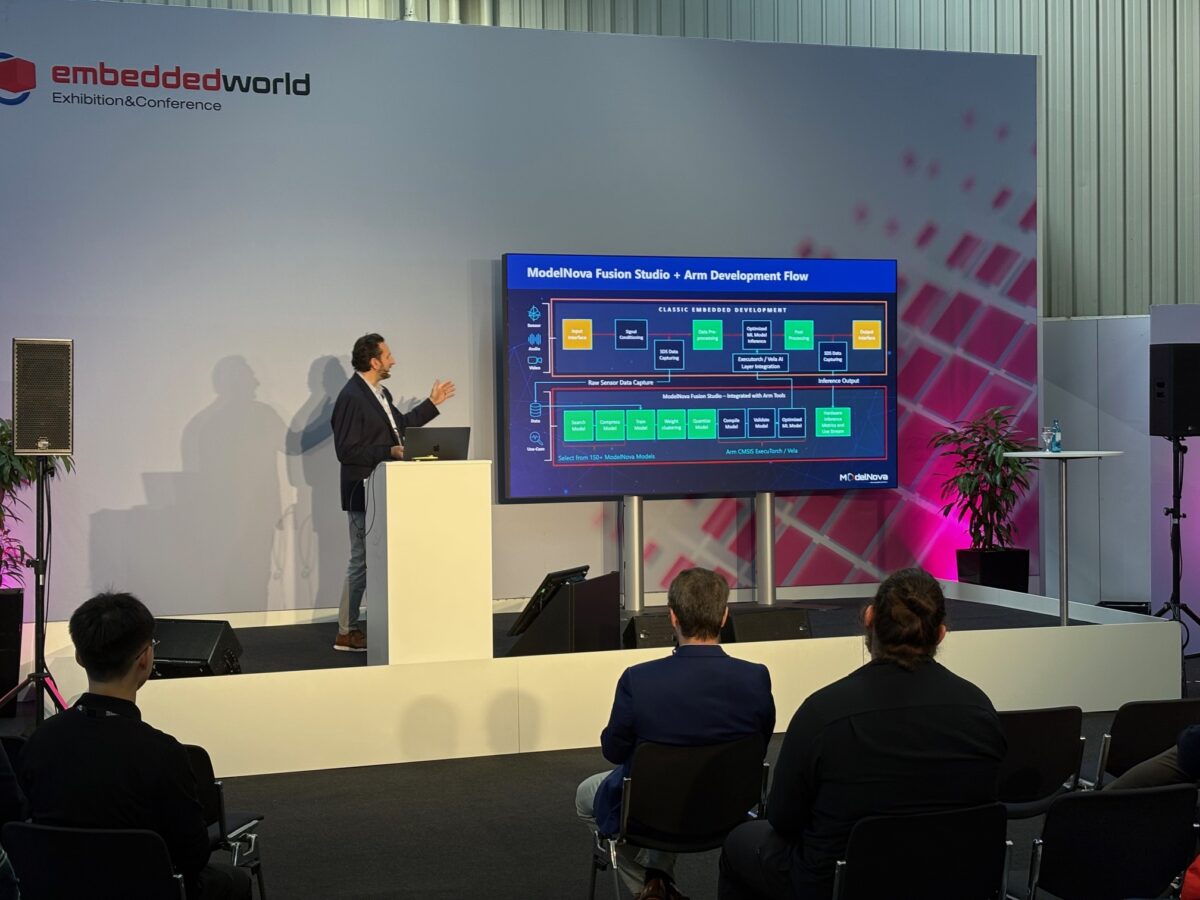
What visitors saw: In collaboration with the ModelNova Fusion Studio, visitors saw how to quickly deploy a trained model on Arm-based embedded hardware using Keil MDK v6, ExecuTorch, and Zephyr.
What it showed: Edge AI bottlenecks are increasingly due to integration challenges, not model innovation. Streamlined workflows and reusable, deployment-ready models reduce tooling mismatches and integration overhead, helping teams shorten development cycles and ship product lines on schedule.
Real-world impact: Shorter integration cycles mean faster time to market and lower engineering risk. Teams can scale AI features across product lines without rebuilding toolchains or revalidating the entire software stack for each device.
Stronger software with CoreCollective
The workflow demo in the Arm booth reflected a broader ecosystem shift, away from fragmented, device-specific integration and toward a more unified, standardized software foundation across all Arm platforms. With the launch of CoreCollective, Arm and Linaro are working with industry partners to reduce software fragmentation across the stack. For embedded teams, this means fewer custom integration points, more reusable components, and a more predictable path from model to production.
One foundation across markets: Innovation from the Arm ecosystem
Beyond the Arm booth, this consistent architectural foundation was visible across various partner showcases at Embedded World 2026, spanning energy infrastructure, connected systems, consumer products, and industrial environments.
In critical energy infrastructure, Eurotech’s ReliaGATE 15A-14 demonstrated secure, always-on edge processing built on Arm-based NXP i.MX platforms. Designed for high-voltage grid environments, it combines data aggregation, protocol translation and long lifecycle support, with integrated Software Bill of Materials capabilities addressing growing cybersecurity and regulatory requirements.
For connected systems, NXP’s motion-enabled connectivity work showed how intelligence can be layered onto existing hardware. Using the i.MX93W – which combines Arm Cortex-A55 CPU and Arm Cortex-M33 cores – motion signals can trigger AI workloads without redesigning the entire platform, extending the life and capability of deployed infrastructure.
For emerging smart consumer and industrial IoT products, Racyics’ EdgeVision demo showed how small, power‑efficient systems can run AI that interprets imagery directly on the device. Built on the Arm Cortex‑M85 processor, Arm Ethos‑U85 NPU, and Arm Mali‑C55 ISP, it combines high‑performance processing, dedicated AI acceleration, and integrated imaging capability to deliver fast, private, low‑power intelligence at the edge. Early evaluation units are expected later this year, giving partners a first look at how advanced visual AI can be embedded into compact, energy‑efficient designs.
In industrial environments, SECO expanded its Arm-based portfolio with new system-on-modules built on MediaTek’s Genio 360 and 360P processors, alongside AI-enabled Modular Vision human machine interface (HMI) platforms. These solutions bring integrated AI acceleration into industrial automation and embedded systems while maintaining consistent software foundations across performance tiers.
Raspberry Pi also showcased its AI HAT+ 2 in live demos focused on edge AI applications, alongside the Raspberry Pi Smart Display Module for industrial displays and embedded solutions. Together with its broader hardware and software portfolio, this demonstrated how Arm-based platforms support AI-enabled embedded designs across industrial and edge use cases.
These examples show that while the markets differ, the compute foundation is consistent. Arm-based platforms allow partners to scale performance, reuse software and extend AI capabilities across product lines without rebuilding systems from scratch.
Prototype and scale with Arm Flexible Access
The technologies and capabilities showcased at Embedded World are ready to be evaluated today. Arm Cortex-A320 provides a modern Armv9 CPU foundation for scalable edge systems, while the Arm Ethos-U85 NPU delivers efficient NPU acceleration designed for embedded constraints and transformer-based workloads. Both are available through Arm Flexible Access, helping teams evaluate, prototype, and move faster with fewer upfront barriers.
Start exploring Cortex-A, Cortex-M, and Ethos-U85, and learn about the implementation options available through Arm Flexible Access.

Any re-use permitted for informational and non-commercial or personal use only.
Editorial Contact
Stay informed with Arm's top stories, insights, and conversations.


Latest on X

Headed to the #OCPGlobalSummit2026 next week? Make sure you have @awadmo 's keynote on your schedule!
As Agentic AI is changes the unit of scale in the data center - he'll explore why scaling this shift depends on open, interoperable infrastructure built for performance and

Meet @amazon's first-ever lineup of Alexa tablets! 📱
Built on Arm, the flagship 12 Pro features the @MediaTek Dimensity 8400 with Arm Cortex-A725 CPUs and Mali-G720 graphics, delivering performance and power efficiency for everyday experiences.
https://x.com/i/article/2108180370860425216
10 years of micro:bit! 🎉
From inspiring stories to hands-on demos and a little friendly duck-throwing competition, it was an evening full of fun!
We loved celebrating this milestone at our Cambridge office, alongside the micro:bit champions and partners who've helped make it




Moving a cloud-native app from x64 to Arm takes less than you might think. 👀
Multi-architecture containers make it possible to build for and deploy on Arm-based Microsoft @Azure Cobalt 200 with minimal changes.
Watch the demo to learn how!
https://okt.to/iLB29e

One compute platform. From the device in your hands to the cloud behind it. @ctbergey explores how Arm is enabling the future of hybrid intelligence. 👇

From cloud to PC: Arm is powering the next era of intelligent computing
We’re entering an exciting new chapter for Arm, not just in personal computing, but across the computing landscape...
okt.to
The next chapter of hybrid intelligence is taking shape on Arm.
Microsoft's new Surface PC featuring @NVIDIARTXSpark brings that vision one step closer, building on the same Arm compute platform that powers Azure Cobalt in the cloud.
It marks a new milestone for our
More power. More possibilities. More places to make it happen.
Meet the most advanced Windows laptops ever, powered by @NVIDIARTXSpark.
Available for pre-order now. https://msft.it/6018aol50
Video Credit: @BBC Tech Now
Technology restoring touch for amputees and those born without a limb today — and advancing what’s possible in robotics. 🦾
@paulcarterTV, @DOUBLExA and Arm’s @drewhenry explored the @PSYONICinc Ability Hand at our Cambridge office – and the