Hot Chips 2026: The CPU’s next chapter is being built on Arm
Hot Chips 2026 made two things clear: agentic AI is creating a new CPU moment and the industry’s next generation of CPUs is increasingly being built on Arm.
As AI moves from answering questions to reasoning, planning, retrieving data, invoking tools and taking action, more of the work around the model falls to the CPU. Agentic systems need to run code, coordinate services, move data, manage memory and storage and keep increasingly specialized accelerators supplied with useful work.
But the CPU sessions at Hot Chips revealed something else.: Arm showed up almost everywhere.
Of the six CPU papers on the first day of the conference, Arm was central to four of them: IBM’s future dual-architecture Z and LinuxONE processor, NVIDIA Vera, FUJITSU-MONAKA and the Arm AGI CPU. The designs could hardly be more different, spanning mission-critical enterprise computing, green data centers, accelerated AI systems and purpose-built agentic infrastructure. Yet they are increasingly connected by the same architectural and software foundation.
That may be the bigger story coming out of Hot Chips. Arm is not defining one CPU for the AI era. An increasingly broad ecosystem is using Arm to redefine what a CPU can be.
The software pull behind the silicon
IBM provided perhaps the clearest evidence of why. The company’s future Z and LinuxONE processor will natively execute both IBM Z and Arm AArch64 software on the same CPU cores. That is a remarkable architectural achievement (in fact Ryan Smith, writing in Serve the Home, said, “I am sitting here still in awe of what IBM is doing here, this is not Z+Arm cores, this is Z and Arm in one core.”)
IBM’s approach is significant not only because of the architecture itself, but because of what it unlocks: access to the Arm software ecosystem while preserving the security, availability and operational characteristics customers expect from IBM Z and LinuxONE.
That ecosystem now spans more than 22 million developers along with Linux distributions, cloud-native software, enterprise applications and AI frameworks. For IBM customers, the potential result is access to that software without forcing developers to port applications to an entirely different environment.
As analyst Matthew Kimball put it in his reaction to the announcement, “The enormous catalog of software already built for Arm becomes reachable on a mainframe without anyone porting it first.”
That is the value of a common software foundation: hardware can become more specialized without the software world becoming more fragmented.
Different CPUs, one expanding ecosystem
Fujitsu offered another version of the same story.
FUJITSU-MONAKA is a 144-core Arm-based processor designed around the performance and energy-efficiency requirements of next-generation data centers. Fujitsu is bringing decades of supercomputing experience into a processor intended for a much wider range of AI, HPC and data-center workloads.
Software is central to making that expansion possible. FUJITSU-MONAKA is based on Armv9 and is being developed alongside a broad AI and HPC software environment, including major open-source software, operating systems, frameworks and libraries. Fujitsu says the platform will provide access to the Arm software ecosystem without modification while still allowing it to optimize deeply around its own performance and efficiency objectives.
That is exactly the model Arm enables: differentiate the hardware without rebuilding the software universe around it.
Agentic AI is changing what the CPU is for
NVIDIA Vera shows what happens when that model is applied directly to AI infrastructure.
Vera is an Arm-based CPU built around NVIDIA’s custom Olympus cores and designed specifically for the work created by agentic AI. Rather than treating the CPU and GPU as competing pieces of infrastructure, NVIDIA is designing them as complementary parts of a tightly integrated system.
Vera serves as the host CPU for the Vera Rubin platform, including Vera Rubin NVL72. Its job extends well beyond simply feeding GPUs: CPUs increasingly sit on the critical path as agents execute Python, orchestrate tools, query data, manage runtime services and coordinate highly concurrent workflows.
That is why NVIDIA itself describes Vera as a CPU purpose-built for agents. The architecture pairs high single-thread performance with high memory bandwidth and coherent CPU-GPU connectivity to keep the entire AI system moving.
The point is not that accelerators matter less but that more specialization creates more work to orchestrate. Agentic AI therefore elevates the CPU alongside the accelerator.
Arm AGI CPU: designing from the workload backward
That same principle shaped the Arm AGI CPU. Rather than adapting a conventional server processor to agentic workloads, Arm started with the requirements those workloads create: high concurrency, sustained per-core performance, large amounts of memory bandwidth, fast I/O and the ability to operate efficiently within increasingly constrained rack-level power envelopes.
The resulting design integrates up to 136 Arm Neoverse V3 cores, 12 DDR5 memory channels, 96 lanes of PCIe Gen6 and CXL 3.0 support within a 300-watt TDP. It delivers more than 6GB/s of memory bandwidth per core while providing the connectivity needed to work alongside accelerators and expanded memory.
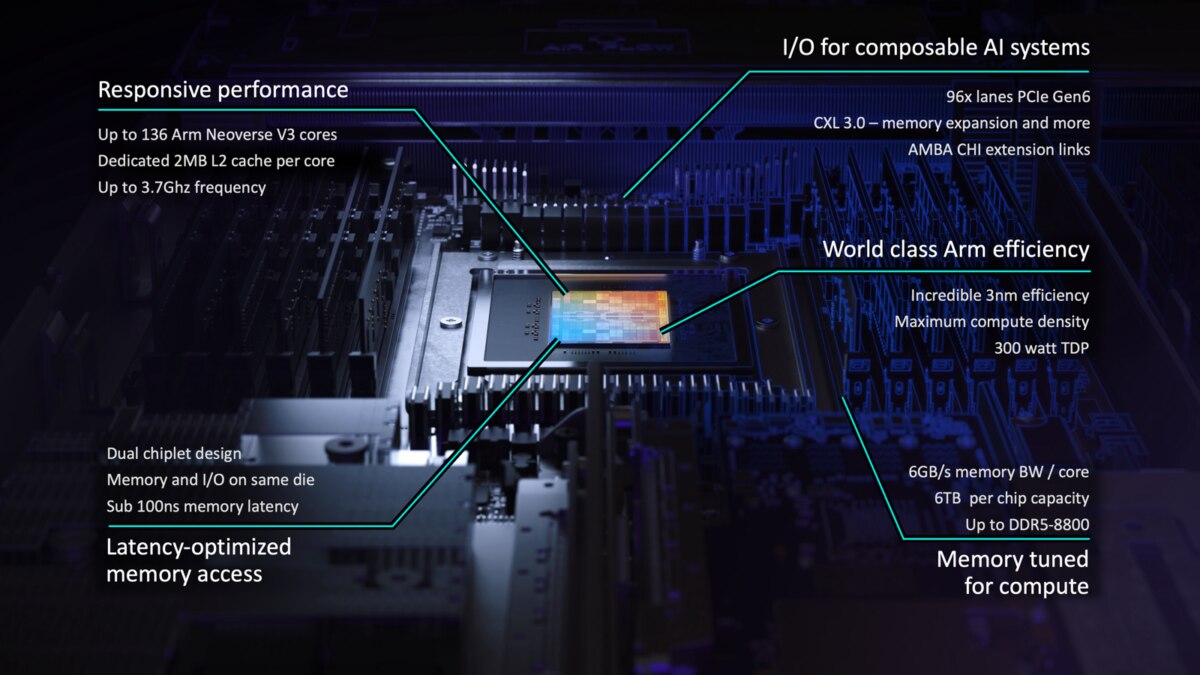
Those choices reflect how agentic workloads behave. Planning and code execution can place latency-sensitive work on individual CPU cores. Retrieval and memory-intensive operations increase pressure on memory bandwidth. Tool calls bring networking, storage and I/O into the execution path. Multi-agent systems drive large amounts of concurrent activity.
The CPU has to keep all of it moving within the power and physical limits of the data center. That makes performance at the rack level increasingly important. The objective is not simply a faster CPU in isolation, but more useful compute, better accelerator utilization and greater workload density inside the available power envelope.
Hardware differentiation without software fragmentation
Taken together, the CPU presentations at Hot Chips told a profound story. IBM is bringing Arm-native software into the mainframe. Fujitsu is using Arm to extend its HPC heritage into a broader AI and data-center market. NVIDIA has built its next-generation CPU for agentic AI on Arm. And the Arm AGI CPU extends the platform into production silicon purpose-built around the demands of agentic infrastructure.
The processors are different because the workloads are different. What connects them is Arm. That is the opportunity of a common compute platform: greater hardware specialization without greater software fragmentation.
If Hot Chips offered a preview of where the CPU is heading next, that future is increasingly being built on Arm..
And that may be the most important signal from Hot Chips 2026.

Any re-use permitted for informational and non-commercial or personal use only.
Editorial Contact
Stay informed with Arm's top stories, insights, and conversations.


Latest on X

Headed to the #OCPGlobalSummit2026 next week? Make sure you have @awadmo 's keynote on your schedule!
As Agentic AI is changes the unit of scale in the data center - he'll explore why scaling this shift depends on open, interoperable infrastructure built for performance and

Meet @amazon's first-ever lineup of Alexa tablets! 📱
Built on Arm, the flagship 12 Pro features the @MediaTek Dimensity 8400 with Arm Cortex-A725 CPUs and Mali-G720 graphics, delivering performance and power efficiency for everyday experiences.
https://x.com/i/article/2108180370860425216
10 years of micro:bit! 🎉
From inspiring stories to hands-on demos and a little friendly duck-throwing competition, it was an evening full of fun!
We loved celebrating this milestone at our Cambridge office, alongside the micro:bit champions and partners who've helped make it




Moving a cloud-native app from x64 to Arm takes less than you might think. 👀
Multi-architecture containers make it possible to build for and deploy on Arm-based Microsoft @Azure Cobalt 200 with minimal changes.
Watch the demo to learn how!
https://okt.to/iLB29e

One compute platform. From the device in your hands to the cloud behind it. @ctbergey explores how Arm is enabling the future of hybrid intelligence. 👇

From cloud to PC: Arm is powering the next era of intelligent computing
We’re entering an exciting new chapter for Arm, not just in personal computing, but across the computing landscape...
okt.to
The next chapter of hybrid intelligence is taking shape on Arm.
Microsoft's new Surface PC featuring @NVIDIARTXSpark brings that vision one step closer, building on the same Arm compute platform that powers Azure Cobalt in the cloud.
It marks a new milestone for our
More power. More possibilities. More places to make it happen.
Meet the most advanced Windows laptops ever, powered by @NVIDIARTXSpark.
Available for pre-order now. https://msft.it/6018aol50
Video Credit: @BBC Tech Now
Technology restoring touch for amputees and those born without a limb today — and advancing what’s possible in robotics. 🦾
@paulcarterTV, @DOUBLExA and Arm’s @drewhenry explored the @PSYONICinc Ability Hand at our Cambridge office – and the