How Lenovo is scaling Level 4 autonomous robotaxis on Arm

After years of autonomous driving pilots and controlled trials, the automotive industry is moving toward the production-scale deployment of Level 4 (L4) robotaxis. This marks a significant moment for artificial intelligence (AI), as it moves from advising humans on recommended actions to enabling vehicles that perceive their environment, although it comes with a steep increase in technical demands.
Compared with today’s advanced L2++ vehicles, L4 systems typically require broader sensor stack, such as LiDAR, cameras and radar, which drive data processing requirements from roughly 25GB per hour to as much as 19TB per hour. This has forced a fundamental rethink of compute for physical AI.
To that effect, Lenovo has developed L4 Autonomous Driving Domain Controller AD1, a production-ready autonomous driving computing platform powered by dual Arm-based NVIDIA DRIVE AGX Thor chips. WeRide is deploying the platform in its GXR Robotaxi, which is the world’s first mass-produced L4 autonomous vehicles.
Inside Lenovo AD1
The Lenovo AD1 serves as the central brain inside the GXR Robotaxi, managing multiple functions from perception, prediction and trajectory planning, to real-time motion control and safety monitoring. The platform is designed for production-grade L4 autonomy for robotaxis and other autonomous vehicles. Supporting over 2,000 TOPS of AI capacity, it enables dense perception, prediction, and planning models to run simultaneously for faster, better decision-making on the roads.
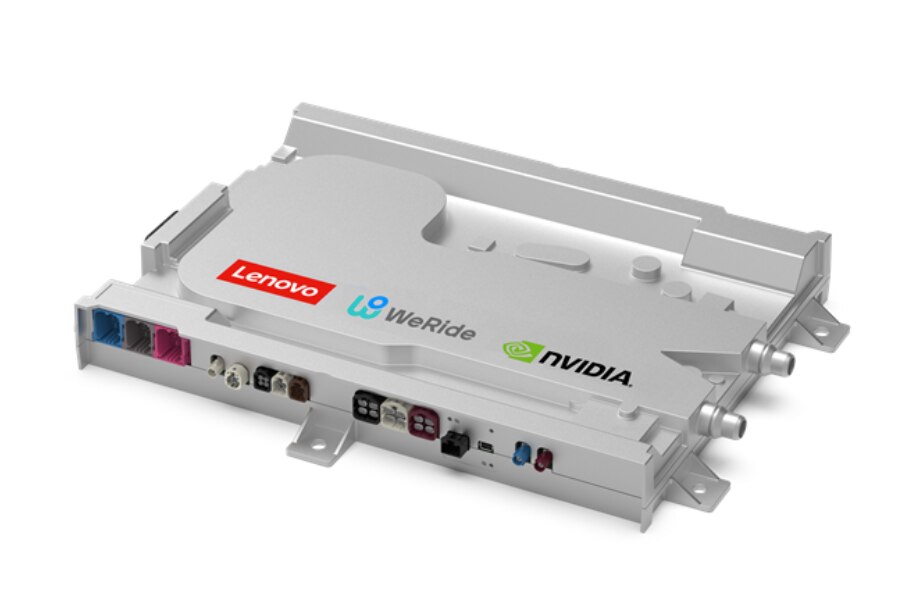
For robotaxis, many loosely coupled electronic control units (ECUs) cannot deliver the latency, safety, or scalability L4 requires, so instead they need centralized, high-performance compute platforms. Therefore, AD1 is powered by NVIDIA DRIVE AGX Thor, a centralized car computer built on the Arm Neoverse V3AE CPU, which brings previously separate driving, parking, cockpit, and monitoring functions into one compute domain.
Efficiency, safety, and foundation for physical AI
Arm serves as the foundational compute architecture of the NVIDIA DRIVE AGX Thor platform, enabling advanced computing capabilities that power Lenovo’s AD1 platform.
- Performance per watt for fleet economics: As robotaxis operate for extended hours in demanding dense urban environments, the Arm compute platform delivers server-class performance into a highly efficient power envelope, enabling large AI workloads without compromising vehicle battery or thermal design.
- A safety-ready architecture: The Arm ecosystem – including functional-safety-capable technologies, toolchains, software solutions, and long-established automotive partners – supports the platforms designed to meet ASIL-D and other global safety requirements, a critical factor for long-lived commercial deployments.
- A mature, scalable software ecosystem: Since Arm provides a unified architecture across cloud, edge and physical environments, it allows developers to build, optimize, and scale AI models using widely available software tools and frameworks.
- A roadmap aligned with future AI workloads: As physical AI models continue to grow in size and complexity, compute efficiency and architectural stability become increasingly important. By building on Arm, automakers gain a consistent architectural foundation with a long-term roadmap and helps avoid future redesigns and keeping the compute strategy stable even as AI evolves.
The road to autonomy is being built on Arm
The deployment of Lenovo AD1 in WeRide’s GXR Robotaxis shows how physical AI in autonomous driving systems is moving beyond controlled pilots and into real, complex urban environments. As autonomous capabilities advance through L4 robotaxis and other autonomous vehicles, the industry is converging on platforms that deliver high performance, safety, and power-efficiency through a centralized architecture.
Arm sits at the core of this shift, providing the foundation that enables companies like Lenovo and WeRide to run dense AI workloads continuously, adapt to rapidly evolving models, and support fleets that must operate reliably for years. As robotaxis expand into new cities and global markets, the Arm compute platform – built for safety and engineered to meet the real-world demands of physical AI at scale – is a critical part of the road ahead.
Accelerating L4 autonomy with the Arm compute platform
Learn more on how Lenovo and WeRide are moving Level 4 autonomy robotaxis from pilot to production using the Arm compute platform

Any re-use permitted for informational and non-commercial or personal use only.
Editorial Contact
Stay informed with Arm's top stories, insights, and conversations.


Latest on X

Headed to the #OCPGlobalSummit2026 next week? Make sure you have @awadmo 's keynote on your schedule!
As Agentic AI is changes the unit of scale in the data center - he'll explore why scaling this shift depends on open, interoperable infrastructure built for performance and

Meet @amazon's first-ever lineup of Alexa tablets! 📱
Built on Arm, the flagship 12 Pro features the @MediaTek Dimensity 8400 with Arm Cortex-A725 CPUs and Mali-G720 graphics, delivering performance and power efficiency for everyday experiences.
https://x.com/i/article/2108180370860425216
10 years of micro:bit! 🎉
From inspiring stories to hands-on demos and a little friendly duck-throwing competition, it was an evening full of fun!
We loved celebrating this milestone at our Cambridge office, alongside the micro:bit champions and partners who've helped make it




Moving a cloud-native app from x64 to Arm takes less than you might think. 👀
Multi-architecture containers make it possible to build for and deploy on Arm-based Microsoft @Azure Cobalt 200 with minimal changes.
Watch the demo to learn how!
https://okt.to/iLB29e

One compute platform. From the device in your hands to the cloud behind it. @ctbergey explores how Arm is enabling the future of hybrid intelligence. 👇

From cloud to PC: Arm is powering the next era of intelligent computing
We’re entering an exciting new chapter for Arm, not just in personal computing, but across the computing landscape...
okt.to
The next chapter of hybrid intelligence is taking shape on Arm.
Microsoft's new Surface PC featuring @NVIDIARTXSpark brings that vision one step closer, building on the same Arm compute platform that powers Azure Cobalt in the cloud.
It marks a new milestone for our
More power. More possibilities. More places to make it happen.
Meet the most advanced Windows laptops ever, powered by @NVIDIARTXSpark.
Available for pre-order now. https://msft.it/6018aol50
Video Credit: @BBC Tech Now
Technology restoring touch for amputees and those born without a limb today — and advancing what’s possible in robotics. 🦾
@paulcarterTV, @DOUBLExA and Arm’s @drewhenry explored the @PSYONICinc Ability Hand at our Cambridge office – and the