Why Arm-powered Chromebooks are winning in education

Education technology decisions are shaped by practical needs. Schools require laptops that last throughout the day, remain reliable under constant use, and are easy to manage across large fleets. Here, budgets tend to be tight, device lifecycles are getting longer, and downtime can disrupt learning. In such environments, success is defined by consistency, efficiency, and total cost over time.
This is why Chromebooks for education have become a common choice across schools, with many built on Arm to deliver responsive performance, strong multitasking, and high efficiency at scale. It is this compute foundation that enables long battery life, cool and quiet operations, fast start-up, and devices that last over years of daily use.
Events such as BETT, one of the world’s largest education technology exhibitions, offer a clear view into how technology is used across education markets. Beginning with BETT UK in London this week, it’s evident that practical considerations like uptime, ease of management, and cost at scale are shaping decisions, with these criteria driving the continued adoption of Arm-powered Chromebooks in education.
Arm in Chromebooks: Efficiency, longevity, and cost
Today, Arm powers a significant and growing share of the global Chromebook market, and ecosystem momentum suggests that this will continue to increase throughout the year as more Chromebook devices come to market. While recent attention has been on the latest higher-end Chromebook Plus series that integrate powerful AI features and tools, OEMs have launched a range of high-volume Arm-powered Chromebook devices for education markets. For education buyers, this growing presence translates into more platform choice and longer device lifecycles.
Some of the new Arm-powered Chromebooks – many of which are being showcased at BETT UK – include:
- Acer Chromebook 315, which is designed to run a full school day without frequent charging.
- ASUS Chromebook CM14 and CM32 detachable that support flexible classroom and hybrid learning setups.
- Lenovo’s latest 100e and 500e series Chromebooks for education that are designed for durability and long-term fleet deployment.
Built on Arm CPUs and GPUs, these devices deliver continuous performance, efficient multitasking, and smooth everyday graphics while maintaining long battery life. Many of the devices listed above are built on MediaTek’s latest Arm-powered Kompanio processors, like the Kompanio 540 in the ASUS Chromebook CM14 and CM32 detachable, that are designed specifically for Chromebooks, with a strong focus on battery life and thermal efficiency.
Since these devices are based on the Arm compute platform, they place less stress on internal components and help devices remain reliable over years of daily use. For education deployments at scale, this efficiency can support lower total cost of ownership through longer battery life, reduced energy use, and simpler thermal requirements, alongside other factors such as device durability and usage patterns.
The strength of the ecosystem
Chromebooks continue to gain ground in education not due to any single device, but because of the strength of the ecosystem around them. Hardware, software, and management tools are evolving together, with platforms like Google Classroom anchoring day-to-day teaching and learning workflows. This alignment matters when technology is deployed at scale, ensuring that devices, applications, and instructional tools work seamlessly from the moment students sign in.
For schools, this ecosystem approach reduces risk. ChromeOS provides a consistent platform across devices and price tiers, allowing OEMs to introduce new designs without changing how fleets are deployed or managed. Teachers and students benefit from the familiarity while IT teams benefit from predictable behaviour and simpler long-term support.
This ecosystem momentum is now extending into AI-enabled experiences as well. Many Chromebooks used in education can access AI-powered tools through cloud-based services, such as writing assistance, text summarization, image tools, and smarter search and organisation within ChromeOS and Google Workspace. On higher-end Chromebook Plus models, Google has introduced built-in AI capabilities, such as tools for creative editing, generative AI assistance, and deeper integrations with Google’s Gemini AI suite.
As AI becomes a standard part of education workflows, the ability to deliver these features without increasing device cost, power draw, or management complexity is becoming a key differentiator. The power-efficient Arm-powered Chromebooks deliver AI-enabled services that run smoothly in the background while preserving battery life and responsiveness throughout the school day.
A platform built for education at scale
As schools plan for the years ahead, the priority is moving beyond short-term specifications toward platforms that deliver lasting value. Chromebooks built on Arm sit at the heart of a mature education-ready ecosystem, bringing together efficient compute, long device lifecycles, and predictable performance. The result is technology that just works, supported by an ecosystem designed to scale and endure, allowing learning to take center stage in classrooms everywhere, day after day.
Behind your laptop, there is a chip built on Arm
Check out the latest laptops that are powered by the Arm compute platform.

Any re-use permitted for informational and non-commercial or personal use only.
Editorial Contact
Stay informed with Arm's top stories, insights, and conversations.



Latest on X

AI is changing how silicon gets designed.
On @NoPriorsPod, Rene Haas joins @Saranormous and @EladGil to discuss how AI could accelerate chip development, Arm’s evolution from IP to silicon, and why CPUs remain at the heart of computing as AI scales.
Listen
Developers should have the freedom to use the models that best fit what they’re building. Arm provides the compute foundation behind that flexibility. We’re proud to support the @NVIDIA and @HuggingFace partnership and the innovation it will unlock across the AI ecosystem.
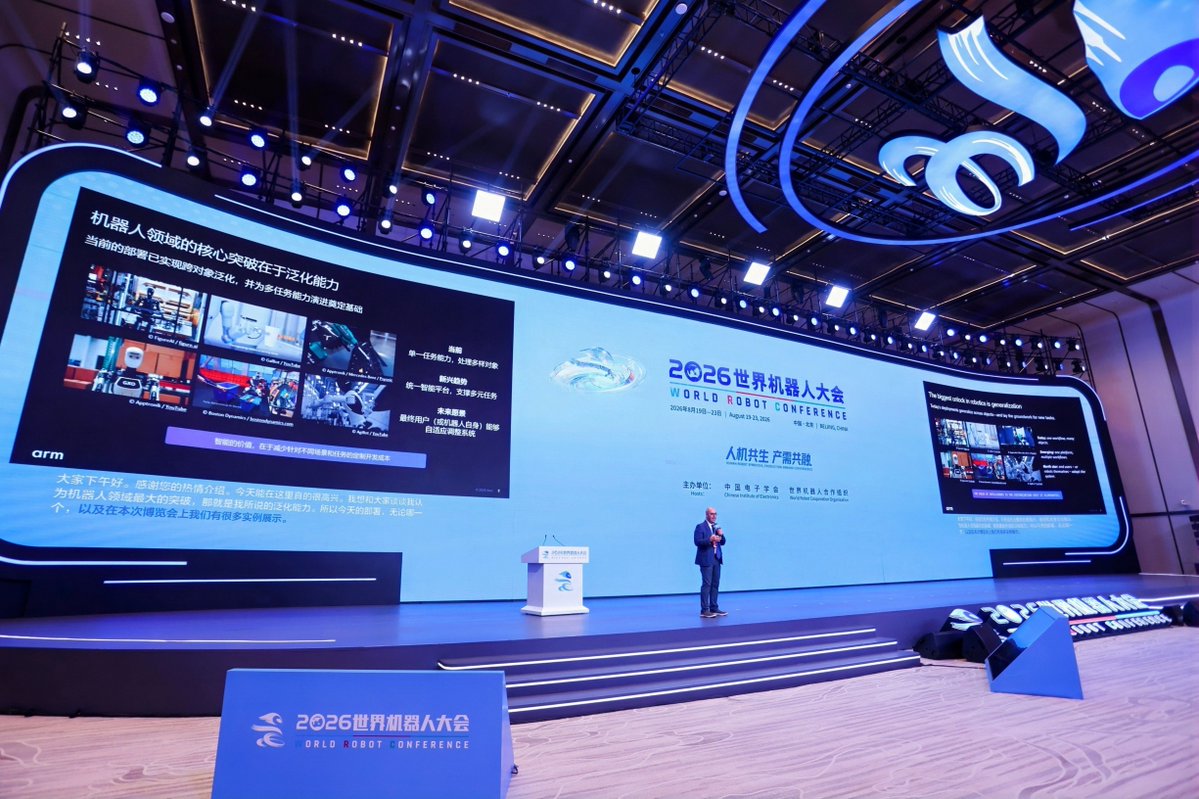
Last week at World Robotics Conference, Federico Pecora shared how the next phase of robotics is becoming an increasingly complex systems challenge.
At Arm, we’re exploring the compute foundation needed to bring sensing, AI, planning, control and safety together reliably as

Building the next generation of mobile experiences starts with the compute platform underneath them.
Arm Compute Subsystems (CSS) for mobile bring together CPU, GPU, system technologies and software to help our partners build and get to market faster.
Stay tuned for what’s

Pssst!
Do you know how much of the tech shaping our world is built on Arm? From the phone you're probably reading this on to developer infrastructure, gaming, robotics, and physical AI. Arm is powering an increasingly diverse range of products and experiences.
A few

The biggest takeaways from Hot Chips 2026? The ecosystem building the next era of agentic AI understands that:
1️⃣ Agentic AI requires a new type of data center infrastructure, and the CPU is central to this
2️⃣ That future will be built on Arm
From IBM to Nvidia and Fujitsu,


Our partner @Apple just announced something BIG! 🎉
The new M6 and M5 Ultra chips, built on Arm, represent a significant step forward in AI compute and performance. It's moments like this when we celebrate a partner ecosystem that is actively ushering in the next era of compute