Arm Performix brings AI-guided performance analysis to agentic development
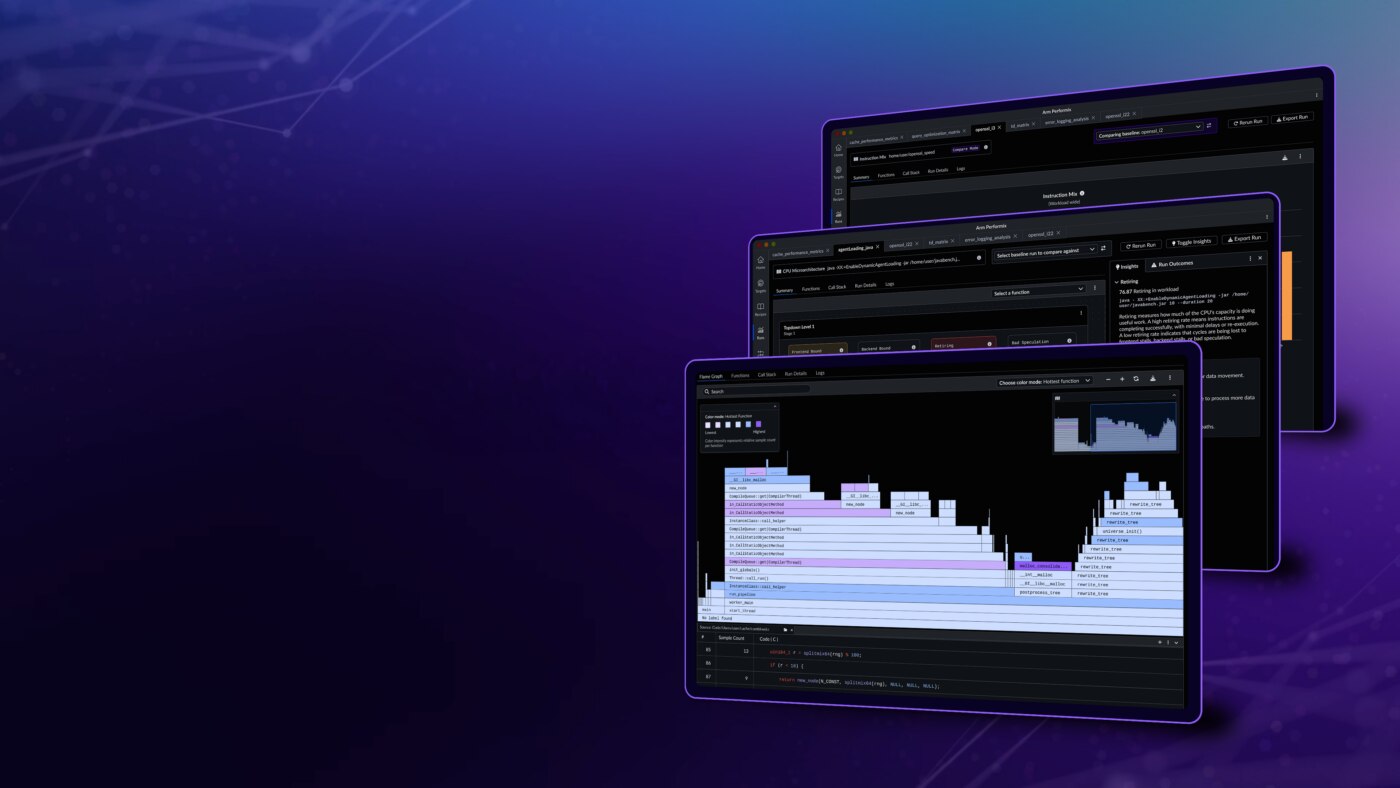
Agentic development and AI coding agents are changing software development by accelerating the generation, modification and refactoring of code. As these tools help developers move from idea to implementation faster, one challenge looms large: ensuring that the resulting code performs efficiently on the systems where it runs.
Generating functional code is only part of the engineering work. Developers still need to understand how applications behave under real workloads, where execution time is spent, how system resources are used, and which constraints limit performance. As AI produces more code at greater speed, this visibility is essential in preventing performance analysis from becoming a bottleneck.
Dynamic Insights, part of the latest release of Arm Performix, helps address this challenge. It enables developers and AI coding agents to turn detailed runtime data into evidence-based recommendations for optimizing software on Arm-based platforms.
Dynamic Insights combines runtime performance evidence with the reasoning capabilities of large language models (LLMs). This helps developers identify bottlenecks, understand their root causes, and focus optimization efforts where they are most likely to improve performance.
Reliable AI guidance requires more than a prompt
Producing consistent AI-assisted performance analysis requires more than throwing profiling data into an LLM. Real-world profiles are noisy, system interactions are complex, codebases are enormous, and AI development environments can only process limited context at a time. Effective performance analysis depends on selecting, structuring and presenting the right evidence without losing the detail needed to validate conclusions.
Dynamic Insights addresses this challenge by combining Performix runtime data with performance-analysis guidance developed from Arm’s architectural and software expertise. By integrating this guidance directly into the toolkit, Arm can update, test and distribute it alongside Performix.
Arm also evaluates the quality and consistency of Dynamic Insights recommendations across a broad range of performance-analysis scenarios. This product-level approach makes the guidance easier to maintain, validate, and improve than instructions managed separately from the analysis tool.
Why AI coding agents need runtime performance data
Today’s AI coding assistants excel at analyzing source code, but they cannot infer everything from code alone.
Many performance issues only become visible when an application is running. Without runtime evidence, AI agents often cannot determine:
- Which functions consume the most execution time;
- Whether workloads are constrained by the CPU, memory, or I/O;
- How effectively AI accelerators are being utilized; and
- Whether an apparent software issue originates elsewhere in the system.
For example, a slow database query may appear to require code optimization when storage latency is the real constraint. Likewise, an application may seem CPU-bound when inefficient memory access limits overall throughput.
Runtime analysis through Dynamic Insights provides the evidence needed to distinguish between these scenarios before developers spend time optimizing the wrong part of the system. This system-wide view grounds AI guidance in how the workload and hardware behave together, rather than in source code assumptions alone.
How Dynamic Insights helps developers make faster optimization decisions
Performance data is most valuable when developers can quickly determine what it means and where to act. Dynamic Insights helps developers move from runtime evidence to a clear, prioritized investigation path.
Using runtime data collected by Performix, Dynamic Insights generates evidence-based recommendations that highlight where engineering effort is most likely to improve performance. This helps developers focus sooner on the issues that matter, reduce time spent interpreting complex profiles, and avoid pursuing low-impact changes.
Developers can then ask follow-up questions, request additional explanations or challenge recommendations, while retaining access to the underlying performance evidence. This makes each recommendation easier to understand, assess and validate.
How developers can optimize software on Arm
Dynamic Insights supports several software engineering workflows.
Validate and optimize software migrated to Arm
Teams migrating applications to Arm-based infrastructure often inherit software optimized originally for another architecture. The Arm MCP Server gives AI coding agents access to Arm development tools and technical knowledge.
Dynamic Insights adds runtime performance evidence, helping developers validate migrated workloads, identify architecture-specific bottlenecks and uncover where tuning can improve performance on the target system. Together, the Arm MCP Server and Performix support a more connected workflow for assessing, migrating, validating, and optimizing software on the Arm compute platform.
Find bottlenecks that static analysis cannot reveal
Many optimization opportunities cannot be identified through source code inspection alone. By connecting source code with runtime behavior across the system, Dynamic Insights helps developers understand how processor utilization, memory access, I/O activity and other system interactions influence application performance.
Accelerate expert performance analysis
Experienced performance engineers can use Dynamic Insights to reduce the time required to move from profiling to root-cause analysis. For example, Performix’s CPU Microarchitecture recipe provides detailed visibility into processor behavior during execution. Dynamic Insights helps engineers interpret that data, investigate cache utilization, instruction throughput, hot loops and opportunities to apply Scalable Vector Extension (SVE). Engineers can validate every recommendation to be validated against the underlying evidence.
Ground autonomous optimization workflows in evidence
Dynamic Insights also supports emerging agentic workflows in which AI coding agents can execute performance analysis, interpret the results, propose code changes and measure their impact automatically.
Developers remain responsible for reviewing and validating proposed changes, but grounding these workflows in runtime evidence provides a stronger foundation for trustworthy AI-assisted optimization. It also creates a repeatable feedback loop: profile the workload, identify a constraint, change the code, and measure the result on the target system.
Generate Arm Performix AI insights Visual Studio Code with Codex
Bringing evidence-based performance optimization to agentic development
As AI becomes an active participant in software engineering, performance optimization must evolve with it. AI agents need more than the ability to generate code. They need trusted tools, system context, and runtime evidence to determine whether that code performs efficiently on the hardware where it runs.
By combining detailed runtime analysis with Arm’s architectural expertise and familiar AI development workflows, Dynamic Insights helps developers move more quickly from generated code to validated, efficient software running on Arm-based platforms.
Dynamic Insights is now available in Arm Performix alongside other new features. The toolkit is free to download and integrates with supported AI coding agents via its built-in MCP Server, helping developers analyze bottlenecks, validate recommendations, and optimize software using evidence from the live system.
Profile and optimize AI workloads with Arm Performix
Learn how to use Arm Performix to identify performance bottlenecks, optimize AI workloads, and measure results. Join our live, hands-on code-along on November 4.

Any re-use permitted for informational and non-commercial or personal use only.
Editorial Contact
Stay informed with Arm's top stories, insights, and conversations.



Latest on X

A strong software ecosystem is essential to bringing agentic AI to life.
See how open-source frameworks and tools come together on Arm AGI CPU to support agent orchestration, data retrieval, and tool execution in our multi-agent customer service demo.
🔗:

AI demand isn't slowing down - but the ability to supply enough compute is becoming a critical constraint.
Arm CMO Ami Badani joined @traderTVLIVE to discuss why power-efficient compute is essential to unlocking AI's potential across industries, and the opportunity ahead for

Scaling physical AI takes more than powerful hardware.
Hear from our Dermot O’Driscoll on @RoadtoAutonomy as he discusses how the Arm compute platform and ecosystem collaboration are helping accelerate the adoption of robotics and autonomous vehicles. 👇

The Physical AI market is growing, and @Arm's low power architecture is powering it.
Dermot O'Driscoll, Vice President, Go-To-Market for Physical AI at Arm, explains how a common architecture enables companies to scale Physical AI on The Road to Autonomy with @gbrulte.
$ARM
🎙️Tune in today from 10:30-10:45 a.m. PT as Ami Badani joins @traderTVLIVE to discuss Arm’s role in the AI ecosystem, the growing demand for power-efficient compute, and what’s next for AI.
🔴Watch live:
Agile Robots SE has unveiled Agile ONE SN, a new humanoid reference platform designed to help researchers and developers create, train and validate robot capabilities.
Powered by NVIDIA Jetson Thor, built on Arm Neoverse V3AE CPUs, Agile ONE SN delivers onboard compute for
From six months to as little as 14 days. That's the potential leap in AI factory deployment speed with NVIDIA's new DSX POD.
Powered by NVIDIA Vera Rubin infrastructure, built on Arm-based Vera CPUs, DSX POD is helping make the next generation of AI infrastructure faster to

AI builders need computing capacity they can put to work sooner.
We introduced DSX POD at NVIDIA GTC Berlin: AI factories integrated and tested before delivery, enabling deployment at prepared sites in as little as 14 days.
Arm really is everywhere 👀
From Neoverse to the AGI CPU, the Open Compute Project Global Summit was a reminder of how we're showing up across our partner ecosystem.