Top 12 Arm-based innovations from March 2026

From training AI models in the data center to running real-time intelligence on devices, the way compute is being built and used is changing fast. Across the Arm ecosystem, partners and developers are solving real problems: building more efficient AI infrastructure, modernizing embedded workflows, enabling smarter cloud analytics, and bringing advanced experiences to mobile, gaming, and robotics platforms.
This month’s roundup highlights how these innovations are coming to life in practice. From Arm’s first silicon for AI infrastructure to on-device generative AI, neural graphics, and scalable autonomous systems, each story offers a closer look at how Arm-based technologies are helping teams move faster, build more efficiently, and deploy intelligence where it matters most.
Introducing the Arm AGI CPU
Arm has taken a major step forward with the introduction of its first Arm-designed silicon, the Arm AGI CPU, extending the Neoverse platform beyond IP and Compute Subsystems (CSS) to give customers greater choice, from building custom silicon to integrating full platform solutions or deploying Arm-designed processors.
Building on this milestone, Shivangi Agrawal, Product Manager, explores what this means in practice with a ready-to-deploy 1U dual-node reference server designed for high-density AI and cloud workloads. The platform gives partners a production-representative environment to evaluate performance, optimize software stacks, and design for rack-level efficiency across power, cooling, and space. For cloud providers and system builders, it offers a clearer, faster path to deploying Arm-based AI infrastructure at scale.
Bringing real-world robotics to life with Arm
Robots stepped into Arm’s Cambridge office as Shanghai-based robotics company AGIBOT, known for its humanoid and embodied AI systems, showcased its latest humanoids and quadruped systems in action, demonstrating everything from precise task execution to dynamic, human-like movement.
Behind each interaction is the Arm compute platform, enabling intelligence from sensor-level processing through to high-performance AI. It highlights how Arm-based systems are supporting real-world robotics, where efficiency, responsiveness, and scalable compute are critical to moving from demonstration to deployment.
Aligning embedded development with modern LLVM workflows
Arm is taking another step toward a more unified and modern software ecosystem by beginning the transition of Arm Toolchain for Embedded from Picolibc to LLVM-libc. Paul Black, Director of Product Management, outlined how this shift is being introduced gradually, starting as an optional overlay before becoming the default C library. The move is designed to better align embedded development with the broader LLVM ecosystem, improving integration across tools and enabling more consistent, portable workflows.
For developers, the transition offers advantages such as simplified licensing and closer integration with LLVM-based runtimes, while also requiring updates to elements like linker scripts, semihosting, and startup code.
Turning smartphone cameras into real-time AI creation tools
Smartphone cameras are rapidly evolving from capture devices into real-time generative AI tools, enabling users to preview and create content directly on their devices.
Through its partnership with TECNO, Arm is helping bring this shift to life with fully on-device AI-generated content previews running at 30 frames per second, without relying on the cloud. Built on Armv9 CPUs and accelerated by Arm KleidiAI, the solution delivers faster AI processing while maintaining responsiveness and energy efficiency.
How Arm Developer Labs helps bring industry challenges into the classroom
Arm Developer Labs gives students and educators a practical way to work on real computing problems using professional tools, workflows, and guidance from Arm engineers, helping bridge the gap between classroom learning and industry needs. In this Arm Community blog, Kieran Hejmadi, Software & Academic Ecosystem Development Manager, explores how Arm Developer Labs is helping universities modernize computing curricula through hands-on, industry-driven software challenges built on Arm technologies.
In this example, students at Anglia Ruskin University Cambridge built a web-scraping and data-visualization project that tracked research trends over time, while also extending the work with AI-driven analysis. It shows why industry-aligned learning matters now, giving students more relevant technical experience and helping universities prepare graduates for fast-changing software and AI careers.
Advancing the future of gaming on Arm at GDC
At GDC 2026, Arm brought together developers and partners to explore the next phase of gaming innovation, from neural graphics and AI-driven upscaling to real-world performance optimization.
Across sessions at the Arm Developer Summit, a clear theme emerged: how to push visual quality further on mobile without exceeding power and thermal limits. Developers explored practical techniques such as Neural Frame Rate Upscaling and AI-assisted rendering, alongside tools that help identify bottlenecks and optimize performance in production workflows. Additionally, Annie Tallund, Solutions Engineer, explored how the Arm Neural Graphics Development Kit is expanding with new neural technologies to help developers bring AI-enhanced graphics and rendering workflows to mobile platforms.
The next generation of AI data centers with Arm
As AI data centers take on more always-on workloads, the challenge is no longer just delivering peak performance. It is also about keeping complex systems running efficiently at scale. Learn why CPUs have become a critical control layer for orchestrating accelerators, managing workloads, and improving overall infrastructure efficiency. It highlights Arm’s work with Meta to help advance more power-efficient AI data center design across the ecosystem.
New Kiro Powers help streamline agentic AI development on Arm
Agentic AI is reshaping how developers build and move software across cloud and edge environments, especially when teams need faster workflows with more architectural guidance. Arm has introduced new Kiro Powers to accelerate agentic AI development and simplify cloud-to-edge workflows on Arm-based platforms, as explained by Zach Lasiuk, Principal Solutions Designer, in this Arm Community blog.
It is these new capabilities that are helping cloud teams plan migrations to AWS Graviton and help embedded developers manage transitions between Arm SoCs with more structure, visibility, and confidence. For developers working across modern AI, embedded, automotive, and edge systems, Zach also explains how Arm is helping make complex platform changes easier to manage.
Accelerating real-time event analytics in the cloud with Arm
Cloud-based event analytics is helping platforms turn live audience activity into immediate business decisions, from dynamic ticket pricing to targeted VIP experiences, while demand is still building.
Pascal Mudimba, Arm Ambassador, shows how stdio x Labs reduced analytics latency by 40% by combining Arm-based compute with optimized BigQuery ML pipelines on Google Cloud. By moving key stages such as stream processing and model preparation onto Arm, the team improved throughput, lowered infrastructure costs, and delivered faster insights for always-on data workloads.
The result is a practical example of how developers and digital platforms can use Arm in the cloud to make real-time analytics more responsive, scalable, and efficient, especially in environments where timing directly impacts revenue and user experience.
Customizing AI models for real-world use cases on Arm
In this video, Michael Hall, Principal Software Engineer and Developer Evangelist, explores how to turn a general-purpose large language model into a domain-specific AI system that can deliver faster, more accurate responses.
Using an NVIDIA DGX Spark desktop powered by Arm CPUs and NVIDIA GPUs, the session walks through fine-tuning a Llama 3.2 model with a custom dataset of Raspberry Pi device specifications. It demonstrates how widely used tools like PyTorch and Hugging Face Transformers can be combined to load models, prepare data, train efficiently, and deploy tailored AI solutions.
Training humanoid robots faster with NVIDIA DGX Spark
Reinforcement learning is becoming a key tool for robotics, helping humanoid systems learn how to move, balance, and respond to real-world conditions through simulation before deployment.
In this Arm Community blog, Odin Shen, Principal Solutions Architect, offers a practical end-to-end workflow for training humanoid robots using NVIDIA DGX Spark, combining high-fidelity simulation, parallelized training, and scalable infrastructure to accelerate real-world robot policy development. Using Isaac Sim and Isaac Lab on a single Arm-based DGX Spark system, developers can build, train, and evaluate humanoid locomotion policies more efficiently and move faster toward reproducible physical AI workflows.
A stronger foundation for Vulkan frame analysis
Frame Advisor is part of Arm Performance Studio, a free toolset that helps graphics developers capture and analyze Vulkan frames so they can spot GPU bottlenecks faster and optimize with more confidence.
In this Arm Community blog, Daniel Baines, Staff Software Engineer, explains how the latest Frame Advisor upgrade introduces a new Vulkan capture pipeline built on GFXReconstruct, improving reliability, correctness, and scalability for today’s increasingly complex graphics workloads. The result is a stronger foundation for developers working on performance-critical applications, especially when accurate frame analysis is essential to diagnosing issues and validating optimizations. Modern tooling can make Vulkan development more dependable today while opening the door to future capabilities.
Any re-use permitted for informational and non-commercial or personal use only.
Editorial Contact
Stay informed with Arm's top stories, insights, and conversations.


Latest on X

Moving a cloud-native app from x64 to Arm takes less than you might think. 👀
Multi-architecture containers make it possible to build for and deploy on Arm-based Microsoft @Azure Cobalt 200 with minimal changes.
Watch the demo to learn how!
https://okt.to/iLB29e

One compute platform. From the device in your hands to the cloud behind it. @ctbergey explores how Arm is enabling the future of hybrid intelligence. 👇

From cloud to PC: Arm is powering the next era of intelligent computing
We’re entering an exciting new chapter for Arm, not just in personal computing, but across the computing landscape...
okt.to
The next chapter of hybrid intelligence is taking shape on Arm.
Microsoft's new Surface PC featuring @NVIDIARTXSpark brings that vision one step closer, building on the same Arm compute platform that powers Azure Cobalt in the cloud.
It marks a new milestone for our
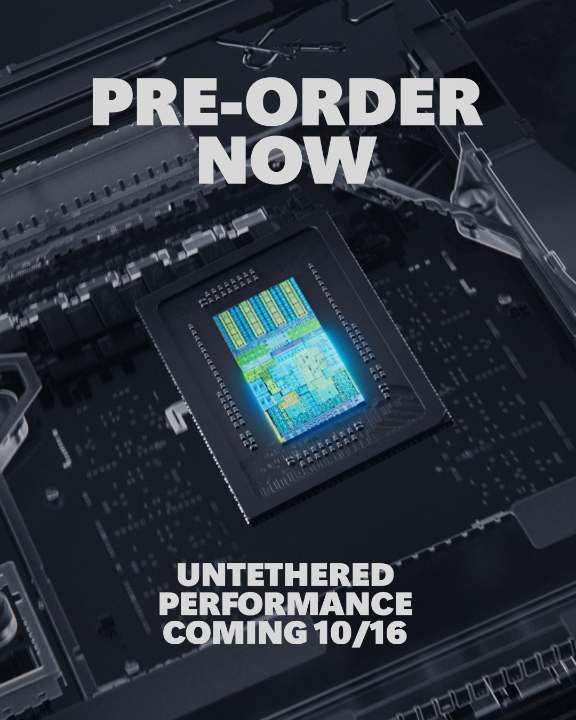
More power. More possibilities. More places to make it happen.
Meet the most advanced Windows laptops ever, powered by @NVIDIARTXSpark.
Available for pre-order now. https://msft.it/6018aol50
Video Credit: @BBC Tech Now
Technology restoring touch for amputees and those born without a limb today — and advancing what’s possible in robotics. 🦾
@paulcarterTV, @DOUBLExA and Arm’s @drewhenry explored the @PSYONICinc Ability Hand at our Cambridge office – and the

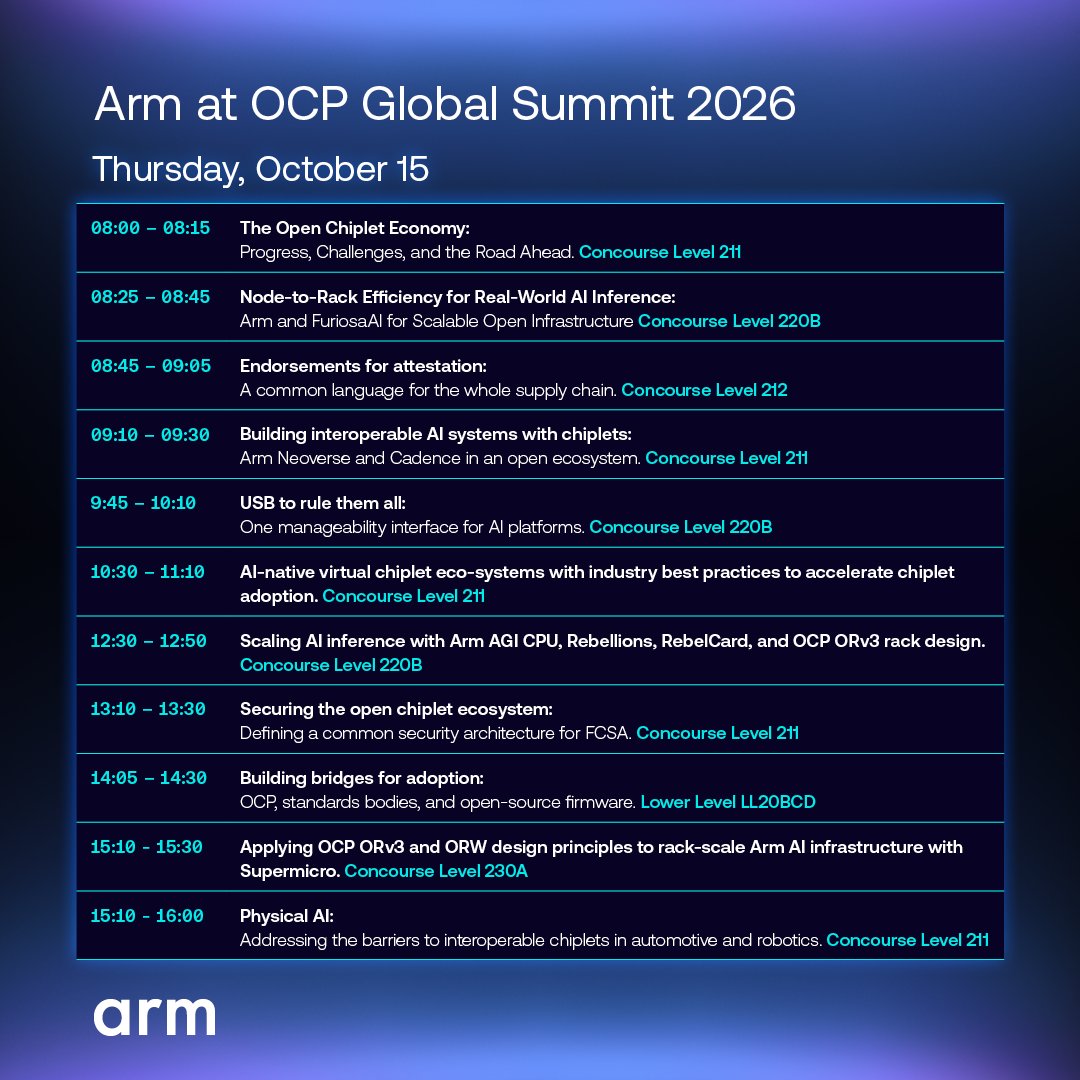
Arm is heading to the #OCPGlobalSummit2026 with a full week of conversations about what it takes to scale AI infrastructure.
If you're headed to the show, make sure to fit Arm into your schedule where you'll hear from Arm experts and ecosystem partners about open


The next era of Windows is taking shape across hybrid intelligence and we're excited to see @Microsoft continue to innovate across the Windows ecosystem.
The new Windows PCs powered by NVIDIA RTX Spark and built on Arm mark an exciting new chapter for what’s ahead. 👏
From reactive to self-improving, how do we consistently describe what robots can do?
A Robotics Capability Framework creates a shared language for describing and comparing increasingly intelligent robotic systems.
Dermot O’Driscoll explains why this is just the beginning.