Top Arm-based innovations advancing AI infrastructure, on-device intelligence and physical AI in July 2026

July’s roundup of Arm-based innovations shows how the Arm ecosystem is pushing intelligence from the cloud to the edge, turning breakthrough research into real-world systems that are already reshaping AI infrastructure, devices, robotics and even space exploration.
This month’s highlights range from new infrastructure for agentic AI and evidence-based optimization for AI coding agents to intelligent mobile applications, browser-based AI and tools that make complex graphics workloads easier to understand. Beyond software, Arm-based technology is also helping robots move from demonstrations into commercial environments, giving bionic hands more responsive control and taking autonomous machines to the Moon.
NVIDIA Vera Rubin reaches a major AI infrastructure milestone
NVIDIA Vera Rubin is moving into production with support from 300 global partners, including cloud and infrastructure providers deploying the platform around the world.
At the center of the rack-scale platform is the Arm-based NVIDIA Vera CPU, designed to coordinate the data movement, control flow and orchestration work surrounding increasingly complex AI models and agents. NVIDIA says Vera Rubin combines seven chips and five rack trays through system-level codesign rather than assembling independent, off-the-shelf components.
Early results from CoreWeave show Vera Rubin NVL72 delivering 10 times more throughput per megawatt than Grace Blackwell NVL72 on a DeepSeek-R1 benchmark, illustrating how performance per watt is becoming one of the defining measures for power-constrained AI infrastructure.
PSYONIC advances bionic dexterity for people and robots
PSYONIC is developing bionic hardware designed to bring greater dexterity to both prosthetic users and robotic systems. Dermot O’Driscoll speaks with PSYONIC founder and CEO Dr. Aadeel Akhtar about the company’s Ability Hand. Muscle signals from a user’s residual limb are translated into movement, while sensors in the fingertips detect pressure and provide touch feedback.
Arm-based computing helps coordinate sensing, motor control and feedback in real time, allowing the hand to respond quickly and helping users control their grip when handling objects ranging from everyday tools to delicate items.
The same technology can also be used as a robotic hand. As intelligent machines move into real-world environments, responsive and power-efficient control will be important for systems that must sense, decide and act reliably.
Databricks expands its use of Arm-based Microsoft Azure Cobalt
Databricks and Microsoft have extended their strategic partnership into the 2030s, with Databricks deepening its use of Microsoft Azure infrastructure for its own business operations, analytics and enterprise AI services.
As part of the agreement, Databricks is increasing its use of Arm-based Azure Cobalt processors. It currently uses Cobalt 100 and plans to adopt Cobalt 200 to improve performance and efficiency across agentic AI and data-intensive workloads.
The announcement provides further evidence of Arm-based CPUs being adopted for large-scale cloud and AI platforms where compute density, efficiency and predictable performance are increasingly important.
CPUs provide the control layer for persistent local AI agents
As AI applications move beyond isolated prompts and responses, developers need to consider how agents maintain context, coordinate memory, retrieve information and manage workflows over time.
Odin Shen, Principal Physical AI BU Champion, explores why CPUs play a central role in persistent local AI systems. Rather than focusing only on model execution, the CPU can act as the system’s control layer, coordinating state, memory, retrieval, events and control flow across multiple stages of an agent workflow.
Using DGX Spark as a practical environment, the article shows how CPU-side orchestration can connect local inference with semantic memory and contextual retrieval. This system-level approach helps turn an impressive one-off AI demonstration into a stable runtime that can continue to respond, remember and operate over time.
Arm Performix gives AI coding agents evidence for optimization
AI coding agents are increasingly being asked not only to write software, but also to find and resolve performance problems. Doing this reliably requires measurement and architecture-aware profiling rather than assumptions based on general coding knowledge.
Henry Wang, Staff Software Engineer, explains how an Arm Performix agent skill gives tools such as Claude Code and GitHub Copilot the knowledge needed to select profiling recipes, run an investigation and interpret the results. In the example, an agent used Arm Performix to identify a memory-bound loop in a C workload. After changing the loop order, runtime fell from 26.03 seconds to 4.67 seconds, producing a 5.6-times speedup with an unchanged checksum. The agent then profiled the application again to validate the improvement rather than assuming the change had worked.
The demonstration shows how profiling data can make AI-assisted optimization more measurable, repeatable and architecture-aware.
ASRock Rack brings the Arm AGI CPU to high-density server platforms
The launch of the Arm AGI CPU introduced a production silicon platform designed for the compute density, memory bandwidth and power efficiency required by agentic AI infrastructure.
ASRock Rack was among the first manufacturers to offer systems powered by the Arm AGI CPU. At the OCP EMEA Summit earlier this year, that collaboration could be seen at rack level through the company’s 2OU2N-ARM server platform.
The system combines a 136-core Arm AGI CPU, based on Arm Neoverse V3, with 12 DDR5 memory channels and PCIe 6.0 connectivity within a 300-watt CPU power envelope. It shows how silicon, server and rack-level design can come together to support dense cloud services and AI inference workloads more efficiently.
Robotics moves from demonstrations to real-world deployment
As robotics matures, the industry conversation is shifting from what an individual machine can demonstrate to how autonomous systems can deliver value reliably and at scale. John Kourentis, Director of Market Development for Physical AI at Arm, discusses the opportunities emerging across transportation, warehousing, logistics, healthcare and hospitality at the AGIBOT UK launch 2026.
Deploying robots in these environments requires more than increasingly capable AI models. Systems must combine real-time control with efficient AI processing, connect cloud-based development and simulation to edge deployment, and provide a consistent architecture across sensors, microcontrollers, onboard computing and cloud infrastructure.
Power efficiency is also critical. Robots have limited battery capacity, cooling and physical space, but must still process sensor data, execute AI workloads, plan movement and respond to their surroundings in real time. These system-level requirements will play an increasingly important role as physical AI moves into commercial environments.
AMBA CHI C2C helps chiplets interoperate across generations
Chiplets give silicon designers more flexibility to combine specialized components, but scalable adoption depends on open standards that allow independently developed chiplets to communicate and work together. Francisco Socal, Director of Product Management, Architecture and Technology Group, introduces a new property-negotiation guide and Issue B of the AMBA CHI C2C specification.
Property negotiation allows connected chiplets to discover one another’s capabilities and select the features needed for a particular system. This supports forward and backward compatibility while allowing anything from a simple peripheral to a fully coherent accelerator to use an appropriate subset of the protocol.
Issue B also adds capabilities including multi-request operations, software-visible registers and multi-hop routing. These improvements are especially relevant as larger AI models increase demand for memory and interconnect bandwidth across increasingly complex heterogeneous systems.

Any re-use permitted for informational and non-commercial or personal use only.
Editorial Contact
Stay informed with Arm's top stories, insights, and conversations.



Latest on X

Thank you to the @verdacloud team for joining us at Arm in San Jose as we continue to build the foundation for scalable, production-ready AI systems. 💪
Verda’s adoption of the Arm AGI CPU reflects a broader trend toward integrated, heterogeneous systems optimized for AI, where

Congratulations to @Valve on the launch of Steam Frame, an exciting new wireless VR headset built on Arm.
We love seeing the Steam hardware family expand with Arm at its core. 👏

Steam Frame is here! Our wireless VR headset + controllers, available now in the following models:
Steam Frame 256GB
Steam Frame 1TB
Sign up now and learn more on @Steam https://store.steampowered.com/hardware/steamframe
Less time searching and benchmarking. More time building. ⚡️
At Arm Create, Shantu Roy shared how the Arm AI Portal helps you discover optimized models, performance data, code examples and deployment workflows - all accessible to coding agents through the Arm MCP Server.

The AI in your pocket. Intelligent machines. The infrastructure behind it all. Here’s what’s new on Arm. 👇
Catch up. ➡️


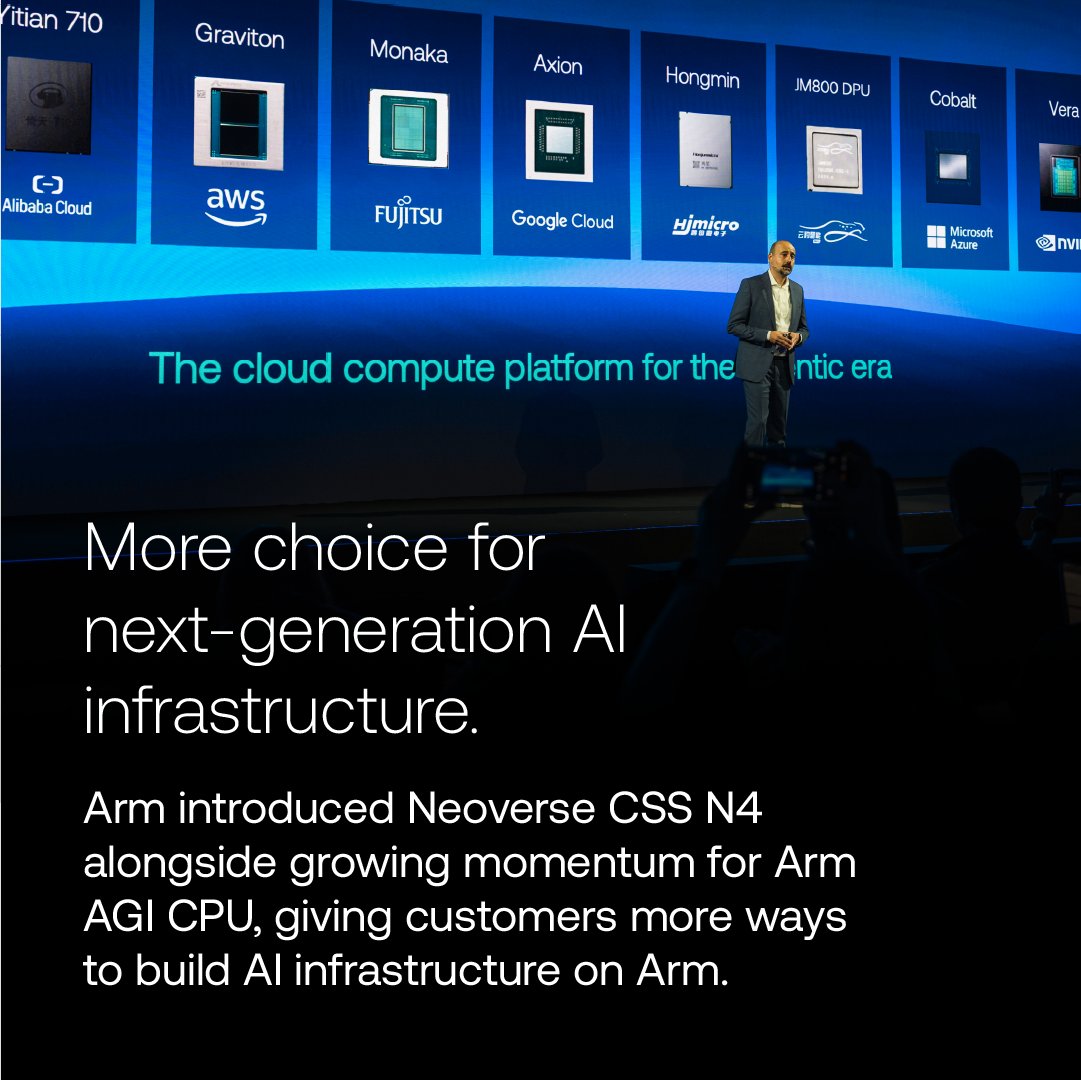

We're delivering more choice for the next generation of AI infrastructure.
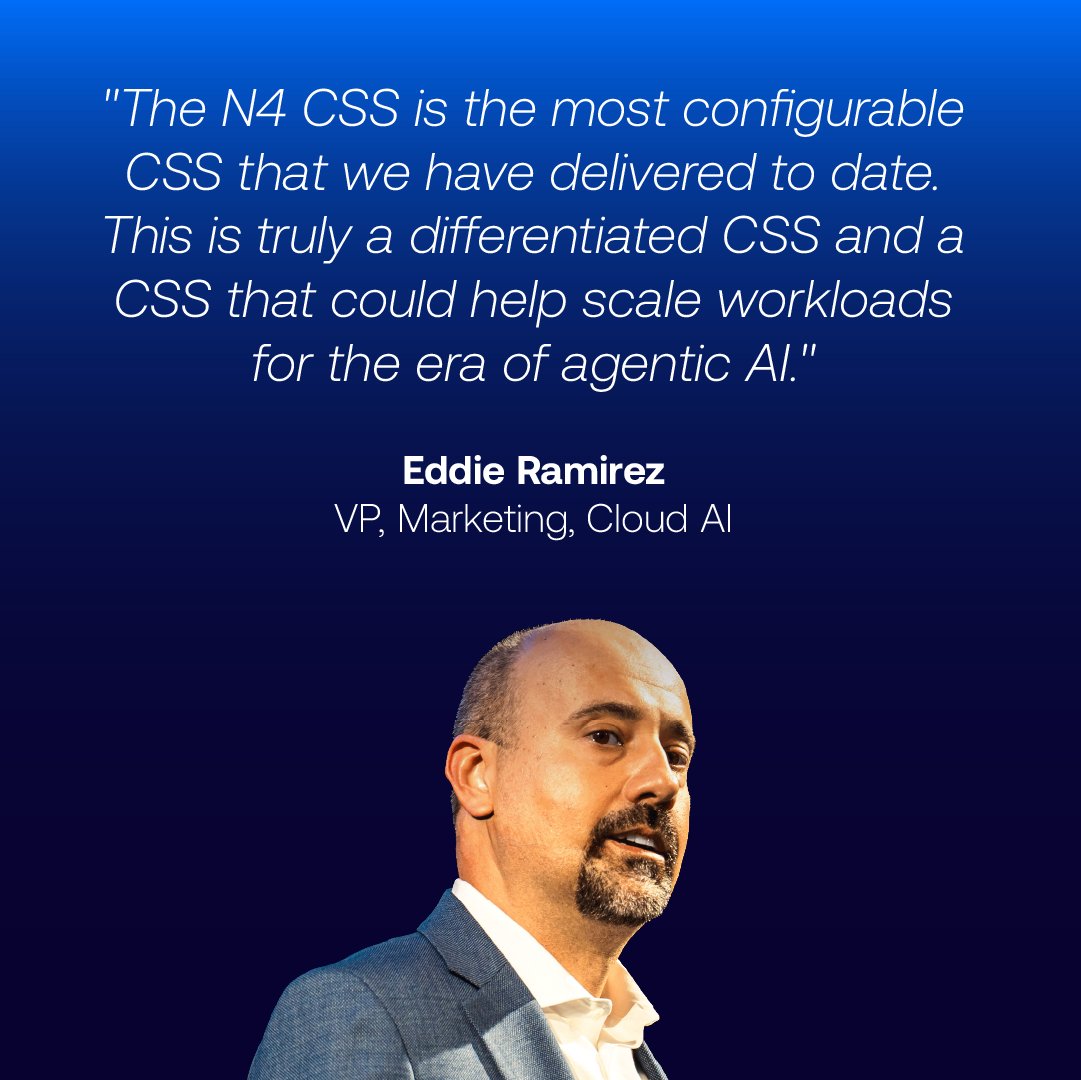
At Arm Everywhere China, Eddie Ramirez introduced Neoverse CSS N4 — Arm’s most configurable CSS yet and fastest path from CSS to silicon. ⚡️
From IP and CSS to production silicon with the Arm AGI CPU,
What does AI research look like on one of the UK’s most powerful supercomputers?
Mohamed Awad visited Isambard-AI at @BristolUni (BriCS) to see how its computing power is helping researchers advance work - from personalized cancer vaccines to dementia diagnosis.
The future of


Agentic AI and AI-native graphics are changing the mobile workload.
In 60 seconds, see how Arm CSS for Mobile 2 brings together world-class AI CPU and GPU capabilities through the Arm C2 CPU Cluster with SME2 and Mali G2-Ultra NX, alongside system IP and software in an AI-native