Why Arm is becoming the CPU foundation for AI data center architecture
For more than a decade, cloud infrastructure scaled through abstraction. Standardized servers, virtualized resources, and software layers helped smooth over hardware differences. That model worked because some workloads could tolerate inefficiency. But AI cannot. It exposes the limits of legacy architectures on power delivery, thermal and compute density, memory bandwidth, and system-level performance.
Essentially, AI has redefined what “good” infrastructure looks like. In response, platform design is shifting beyond individual chips and servers to rack-level, scale-up systems engineered to grow efficiently under power and budget constraints. This is against the backdrop of expanding inference and agentic AI workloads that are running continuously and accelerating demand for dense, always-on compute.
Futurum’s report “Arm at the Center of the AI and Data Center Revolution” frames this as a shift to “system-level harmony” where the key design question is how effectively platforms orchestrate compute across accelerators, CPUs, memory, networking, and software – not simply how much raw compute can be deployed.
That is why the industry is moving toward purpose-built rack-level system design, where platforms are engineered end-to-end around AI behavior, power volatility, and sustained utilization. Increasingly, system architects are revisiting foundational compute assumptions, and choosing Arm-based architectures to address the constraints shaping modern AI platforms.
What is changing in AI data center architecture?
AI data centers are shifting from general-purpose, server-level infrastructure to rack-scale systems designed around sustained inference, accelerator utilization, power efficiency, memory bandwidth, networking, and CPU-led orchestration. In this model, the CPU acts as the head-node layer that coordinates accelerators, storage, networking, security, scheduling, and data movement. Arm Neoverse provides a power-efficient, scalable CPU foundation for these converged AI systems.
Why AI data centers are moving to rack-scale architecture
The biggest break is not that general-purpose, commodity infrastructure cannot run AI. It is that fragmented system design shows up as real cost at AI scale.
AI workloads are tightly coupled across compute, memory, networking, storage, and software. If CPUs fall behind, expensive accelerators wait. If power consumption and cooling headroom fluctuates, utilization drops. If the data pipeline, scheduling, and orchestration are not tuned to the platform, throughput becomes unpredictable. Peak performance still matters, but stability, performance-per-watt and system balance matters more.
Futurum notes that hyperscalers are structurally realigning toward architectures that can deliver exponential compute growth without exponential energy consumption. It cites Arm data indicating that nearly half the compute shipped to top hyperscalers at the end of 2025 is expected to be Arm-based.
Architects are now pushing past the “headline benchmark” questions and into those that actually decide whether an AI platform holds up when running agentic AI and continuous inferencing workloads in real-world applications. For example:
- What happens under sustained load, hour after hour?
- How do power limits and thermals reshape the performance curve in the real world?
- How do compute layers in the stack in a rack-level system deterministically make sure accelerators stay continuously fed, minute by minute, not just on paper specs?
When efficiency, scalability, and system balance become first principles, it is natural to revisit the CPU foundation. That’s exactly why Arm – with our leading architecture and broad ecosystem – is central to this conversation through our architecture and broad ecosystem.
In the data center, the Arm Neoverse platform is a core enabler of this transition, with major hyperscalers and AI leaders, including AWS, Google, Microsoft, and NVIDIA, building on and adopting Arm-based platforms. Arm’s model supports purpose-built system design while preserving consistency across platforms, ecosystem partners and software. That flexibility matters when teams are designing tightly integrated platforms, but do not want a single path to be the only path.
How agentic AI and continuous inference change infrastructure requirements
AI workloads are changing and infrastructure needs to support different profiles as AI and general compute workloads are converging.
The center of gravity is shifting toward agentic AI, and that’s fundamentally an inference problem. Agentic systems don’t “serve one answer” and stop; they plan, call tools, retrieve data, validate results, and loop. That creates continuous inferencing patterns: steady, always-on token generation, more variability in request shapes, and much heavier orchestration and data movement around the accelerators.
In agentic AI, CPUs are not just “support” actors; they act as the head node for an AI system. They coordinate the control plane, schedule and route work, manage IO, handle networking and storage services, enforce security, and keep the overall system balanced as models, contexts, and tool chains evolve.
Consider a service hosting a large language model (LLM) with hundreds or thousands of concurrent requests. Even when the accelerator is doing the core compute, the CPU is often responsible for request admission control, tokenization and pre-processing, batching and queueing decisions, orchestrating data movement, and coordinating the network and storage paths for model weights and KV cache behavior. With agentic workflows, that CPU-side work expands further, adding tool calling, retrieval pipelines, structured output validation, and multi-step scheduling that runs continuously, not just per-request.
All this means the CPU layer matters more than many teams planned for. If the CPU can’t keep up with orchestration, then data movement, processing, and accelerators become structurally stranded.
Where Arm Neoverse fits in AI data center architecture
This is where Arm momentum is accelerating. Across the industry’s leading integrated AI systems, Neoverse-based CPUs are being selected for the orchestration layer supporting agentic, inference-heavy fleets, particularly where efficiency, predictable scaling, and broad deployment footprints are required.
Independent testing underscores the impact of a modern CPU foundation in these “AI-adjacent” workloads. Futurum’s Signal65 benchmarking of AWS Graviton4 (Neoverse) versus comparable AMD and Intel EC2 alternatives, Neoverse-based Graviton4 instances delivered significantly higher performance and better price/performance across all tested workloads, including generative AI (Llama-3.1-8B), database (Redis), Machine Learning (XGBoost), and networking (Nginx.)
Those results map directly to agentic AI data center realities: LLMs, retrieval layers, caching, web and API tiers, and classical ML components all sit on the hot path of agentic systems, and they scale better when the CPU layer is both fast and efficient.
The newest “rack-scale” AI systems are being designed around a purpose-built accelerator layer and an Arm-based CPU layer for orchestration, data movement, and agentic reasoning. NVIDIA’s portfolio spanning Grace Hopper and Grace Blackwell systems, pair NVIDIA GPUs with Grace CPUs built on Neoverse, while the company’s newest rack-scale platform, Vera Rubin NVL72, integrates 72 Rubin GPUs with 36 Arm-powered Vera CPUs in a system designed to drive down inference costs for interactive, deep reasoning agentic AI.
AWS is making the same system-level move. AWS Trainium3 UltraServer pairs Trainium3 accelerator chips with AWS Graviton CPUs reinforcing the “converged” design pattern: matching accelerating with purpose-built, performance per watt efficient CPUs that can effectively scale.
Why workload portability matters for AI infrastructure
AI systems evolve too fast for static architectures, so providing better choice to customers is a risk-management requirement.
System architects want:
- Platforms that can adapt across hardware generations, workload profiles, and deployment environments; and
- Software portability that reduces friction when systems change.
At the same time, they want to avoid optimizing so tightly around a single vendor path that future decisions become constrained when the model mix shifts, the footprint expands, or new requirements appear. That’s especially important in the agentic era where the “shape” of inference keeps changing leading to longer contexts, more tool use, more multimodal inputs, and more always-on workloads that reward efficiency and balance over peak-only design.
Arm is designed to preserve that portability while scaling system-level performance. The Arm architecture brings features that matter in modern AI infrastructure, while being supported by a robust software ecosystem. Arm Compute Subsystems (CSS) provide validated, infrastructure-grade building blocks that accelerate silicon development, while still enabling differentiation and preserving choice across partners. For any Arm-based platform, there is consistency across the board and it is easy to migrate cloud workloads to Arm. Meanwhile, at the software level, the Arm ecosystem helps teams move faster with a consistent foundation across environments and platforms without rewriting everything that runs on it.
Why system architects choose Arm Neoverse for AI data centers
System architects are increasingly shifting to Arm because it aligns with what purpose-built AI systems are demanding: power efficiency, scalability, and performance per watt. Efficiency matters because power and budgets are hard limits. System balance and CPU performance matter because stranded accelerator utilization is expensive. Consistency matters because AI infrastructure changes quickly and increasingly spans multiple environments.
In the converged, agentic AI data center, continuous inferencing turns those priorities into day-one requirements. Agentic systems don’t just need accelerators that can generate tokens; they need CPU-led orchestration that can sustain real utilization across networking, storage, scheduling, and security – continuously, efficiently, and at scale.
That’s the momentum behind Arm right now, with Neoverse acting as the CPU foundation for the agentic era. It is the head-node layer that keeps AI systems coherent, efficient, and ready for the future.
FAQs
What is AI data center architecture?
AI data center architecture is the design of compute, accelerator, CPU, memory, networking, storage, software, power, and cooling systems to support AI training, inference, and agentic workloads at scale.
Why do CPUs matter in AI data centers?
CPUs coordinate the control plane around accelerators. They manage scheduling, routing, I/O, networking, storage, security, tokenization, batching, queueing, retrieval, and data movement.
What is rack-scale AI infrastructure?
Rack-scale AI infrastructure treats the rack as the unit of system design, optimizing compute, accelerators, memory, networking, power, and cooling together rather than as isolated servers.
How does agentic AI affect data center infrastructure?
Agentic AI creates continuous inference patterns involving planning, tool calls, retrieval, validation, and multi-step workflows. This increases demand for CPU orchestration, data movement, and predictable system performance.
Why is performance per watt important for AI infrastructure?
Power and cooling are hard constraints in AI data centers. Better performance per watt helps increase useful compute density, reduce stranded accelerator capacity, and improve infrastructure economics.
What is Arm Neoverse used for in AI data centers?
Arm Neoverse provides the CPU foundation for cloud and AI infrastructure, supporting orchestration, scale-out performance, power efficiency, and software portability across AI data center platforms.
How does Arm compare with x86 for AI infrastructure?
Rather than focusing only on CPU peak performance, AI infrastructure decisions increasingly depend on system-level efficiency, accelerator utilization, power consumption, software portability, and total cost of ownership.

Any re-use permitted for informational and non-commercial or personal use only.
Editorial Contact
Stay informed with Arm's top stories, insights, and conversations.


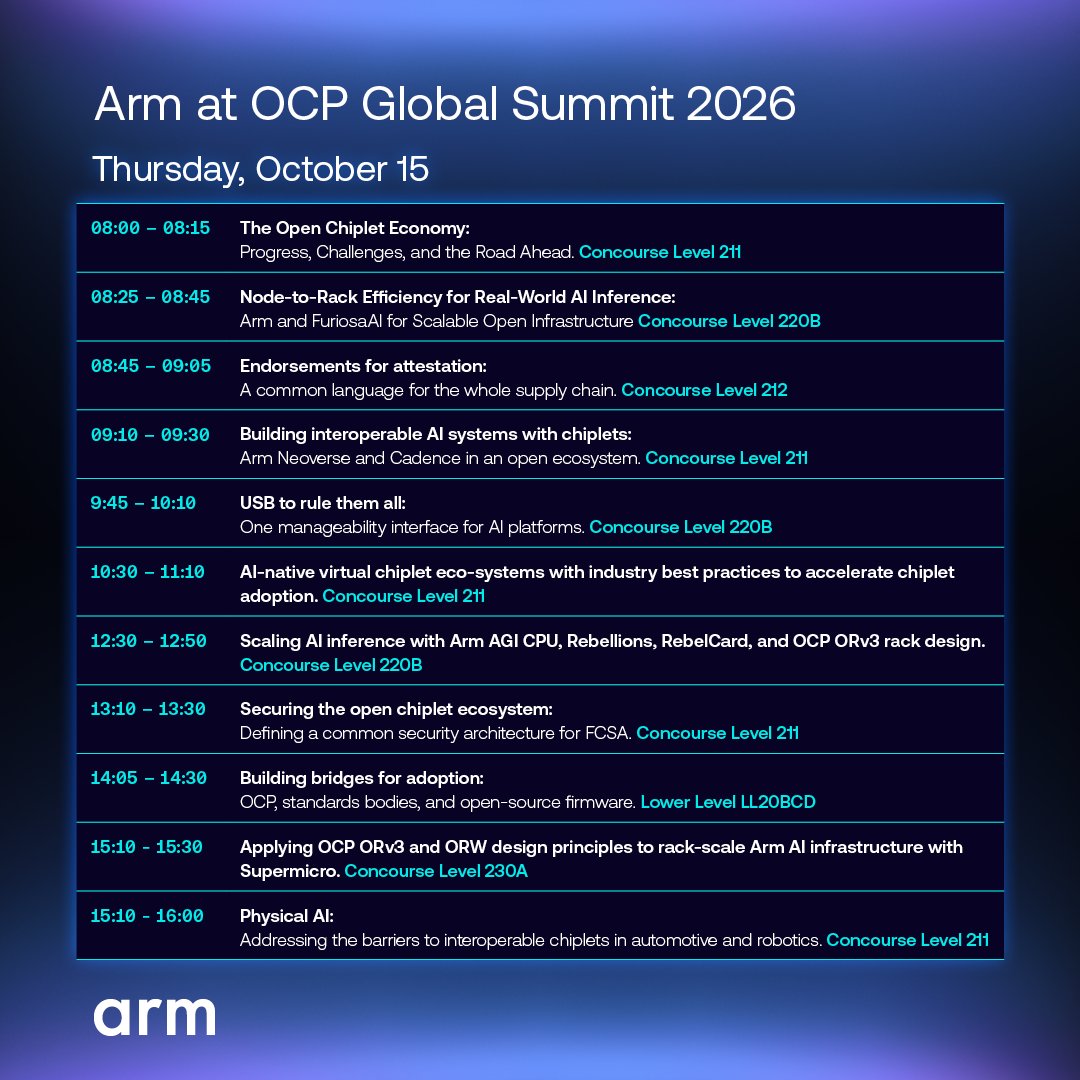
Latest on X

Arm is heading to the #OCPGlobalSummit2026 with a full week of conversations about what it takes to scale AI infrastructure.
If you're headed to the show, make sure to fit Arm into your schedule where you'll hear from Arm experts and ecosystem partners about open


The next era of Windows is taking shape across hybrid intelligence and we're excited to see @Microsoft continue to innovate across the Windows ecosystem.
The new Windows PCs powered by NVIDIA RTX Spark and built on Arm mark an exciting new chapter for what’s ahead. 👏
From reactive to self-improving, how do we consistently describe what robots can do?
A Robotics Capability Framework creates a shared language for describing and comparing increasingly intelligent robotic systems.
Dermot O’Driscoll explains why this is just the beginning.

We're glad to see @elastic Cloud adding compute-optimized instances on Arm-based Microsoft Azure Cobalt, bringing more throughput per dollar to compute-intensive search workloads.
With Elastic reporting up to 44% better price-performance with its CPU Optimized Arm profile, it’s
As AI becomes more continuous, distributed and personal, world-class AI CPU capabilities will be critical to keeping agents responsive on-device.
@ctbergey explains why the CPU is at the heart of agentic AI with Arm CSS for Mobile 2. 👇

Build. Validate. Scale. 🤝
Through Arm Total Design for Physical AI, @liquidai brings efficient AI models with hardware-aware optimization for Arm platforms into an ecosystem designed to help accelerate full-stack solutions for real-world deployment.
Hear from Jeffrey Li,

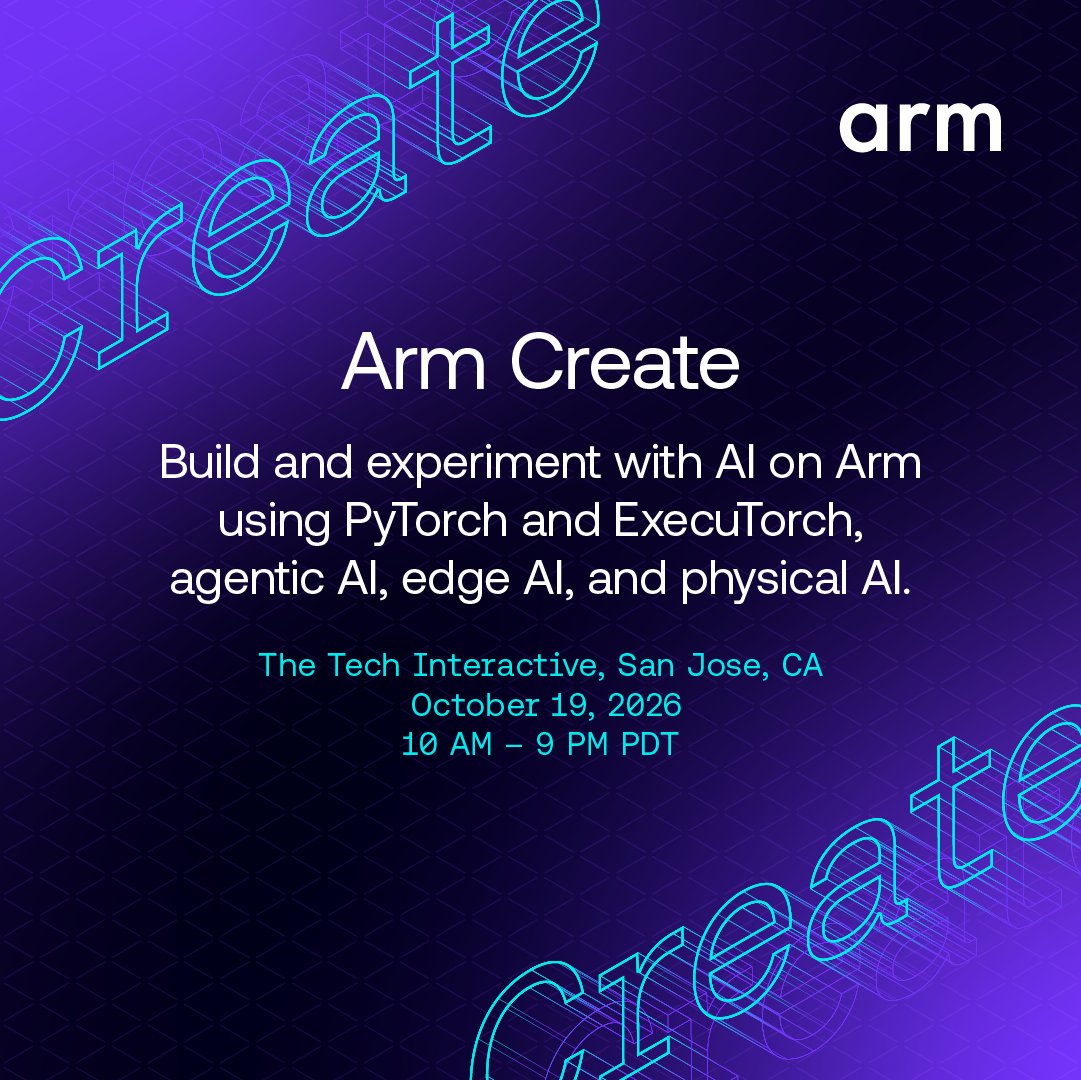
Explore what’s next for AI development at Arm Create.
Join Arm experts and ecosystem partners as we explore what's next through presentations, hands-on demonstrations, and technical sessions. Then connect with the community over cocktails while customizing your Arm-powered